MARKET RESEARCH REPORT
United States Recreational Vehicle Market
Insights, Analysis & Forecasts to 2034
Published by GMI Reports | www.gmigreports.com
Executive Summary
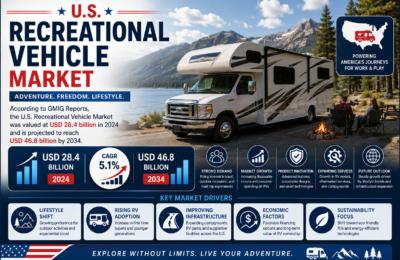
The United States recreational vehicle market was valued at USD 28.4 billion in 2024 and is projected to grow at a compound annual growth rate (CAGR) of approximately 5.1%, reaching USD 46.8 billion by 2034, according to GMI Reports. The United States is the world’s largest recreational vehicle market by a substantial margin, reflecting the country’s deeply embedded outdoor recreation culture, vast national park and campground infrastructure, extensive highway network enabling long-distance RV travel, and a broad consumer demographic spanning retirees, young families, remote workers, and adventure-seeking millennials who have collectively embraced RV travel as a preferred vacation and lifestyle format.
The RV market experienced extraordinary pandemic-era demand acceleration between 2020 and 2022 as domestic outdoor travel surged amid international travel restrictions and hotel capacity limitations, driving record RV shipment volumes and substantially expanding the first-time buyer consumer base. While the market has moderated from these unprecedented peak levels, the structural consumer base expansion achieved during the pandemic period has meaningfully raised the long-term market floor, as millions of new RV owners continue active usage and eventual replacement purchasing cycles.
Towable RVs, encompassing travel trailers and fifth-wheel trailers, continue to dominate the market by both unit volume and revenue contribution, while motorhomes command the highest average transaction values and represent a premium market segment with strong growth momentum among affluent retirees and remote-work-enabled lifestyle consumers. The emerging electric RV segment, while currently representing a modest market share, is attracting substantial manufacturer and consumer interest as EV technology advances address range and charging infrastructure considerations.
Market Overview
The United States recreational vehicle market encompasses the full spectrum of self-contained, wheeled leisure accommodation vehicles used for camping, long-distance travel, full-time living, and outdoor recreation. The market comprises two primary categories: towable RVs, requiring a separate tow vehicle, including travel trailers, fifth-wheel trailers, folding camping trailers, and truck campers; and motorized RVs, incorporating their own powertrain, including Class A motorhomes, Class B campervans, and Class C motorhomes.
The US RV market is supported by an extensive and mature ecosystem of campgrounds, RV parks, and public land camping areas across all fifty states, with the national infrastructure encompassing over 16,000 private campgrounds and RV parks alongside extensive federal and state public land camping access. This comprehensive destination infrastructure distinguishes the US RV market from most international comparators and represents a foundational structural advantage that sustains RV travel as a practical, accessible, and continuously improving leisure travel format.
RV Industry Association data indicates a substantial and growing installed US RV owner base exceeding 11 million households, representing approximately 9% of US vehicle-owning households. This installed base provides a continuous replacement and upgrade demand stream that underpins market stability alongside new first-time buyer demand. Significant generational shift in RV consumer demographics, with millennials now representing a growing proportion of first-time RV buyers alongside the historically dominant Baby Boomer retiree segment, supports long-term market demand sustainability.
Market Size & Forecast
Market Driving Factors
1. Deep-Rooted American Outdoor Recreation Culture
The United States’ profound cultural affinity for outdoor recreation, national park visitation, and road trip travel provides an exceptionally stable structural foundation for sustained RV market demand. With over 330 million national park visits annually, an extensive network of state parks, national forests, and Bureau of Land Management camping areas, and a cultural tradition of road trip travel deeply embedded across multiple generations, the US market benefits from structural demand advantages that distinguish it from virtually every other national RV market globally.
2. Pandemic-Era Consumer Base Expansion Sustaining Structural Demand
The unprecedented first-time RV buyer market expansion achieved during the 2020-2022 pandemic period, driven by domestic leisure travel preference shift and outdoor recreation participation surge, has permanently expanded the total US RV owner base by several million households. These new RV owners represent both ongoing active usage and future replacement and upgrade purchasing demand that will sustain market volume at structurally higher levels than pre-pandemic baselines throughout the forecast period.
3. Millennial and Remote Work Consumer Demographic Expansion
Growing millennial and younger generation RV adoption, accelerated by remote work flexibility enabling extended RV travel and full-time nomadic lifestyle, has substantially broadened the RV consumer demographic beyond its historically dominant Baby Boomer retiree base. This demographic expansion improves long-term market demand sustainability as younger owners enter the market with multi-decade potential ownership and upgrade purchasing horizons extending well beyond typical retiree owner lifecycle windows.
4. Affordability and Vacation Cost Advantage
RV travel’s compelling total cost advantage relative to equivalent hotel and airline-based vacation travel, particularly for families and groups, continues to drive new consumer consideration and first-time purchase activity. Rising hotel room rates and airline ticket prices have widened the relative cost advantage of RV travel for multi-night vacation scenarios, supporting new buyer market conversion from traditional travel modalities toward RV ownership or rental as primary vacation format.
5. Growing RV Rental Market Enabling Trial and Conversion
The expansion of RV rental marketplace platforms, enabling non-owners to rent privately-owned RVs for trial travel experiences, has substantially lowered the barrier to first-time RV experience for consumers considering ownership. These rental trial experiences serve as an effective funnel for eventual RV purchase conversion, with rental platform data consistently indicating high ownership conversion rates among renters who have positive first-experience outcomes.
6. Campground Infrastructure Expansion and Modernization
Continued private campground investment in expanded capacity, premium amenity upgrades, and reservation system modernization is improving the overall RV travel experience and supporting increased trip frequency among existing RV owners while enhancing the appeal of RV travel for prospective new buyers evaluating accommodation quality expectations. Private equity-backed campground platform companies have driven substantial campground infrastructure investment and quality standardization across the US camping market.
Market Restraining Factors
1. Post-Pandemic Demand Normalization and Inventory Correction
The significant demand overshoot and inventory surplus generated during the 2020-2022 pandemic period required a painful market correction through 2023, with RV shipments declining substantially from peak levels as dealer inventory normalization and consumer demand moderation from extraordinary pandemic highs ran their course. While the market has resumed growth from normalized levels, the correction cycle illustrated the RV market’s sensitivity to consumer sentiment shifts and economic confidence fluctuations.
2. Rising Interest Rate and Financing Cost Impact
RV purchases are predominantly financed through installment loans, and the substantial interest rate increases experienced from 2022 through 2024 have materially elevated monthly payment obligations for financed RV purchases, compressing affordability for rate-sensitive consumer segments and moderating purchase volume relative to the low-rate environment that supported extraordinary 2020-2022 market expansion. Rate environment normalization will be an important factor shaping demand recovery trajectory through the forecast period.
3. Fuel Cost Sensitivity and Motorhome Operating Expense
RV travel, particularly in motorized Class A and Class C motorhomes with fuel efficiency often below 10 miles per gallon, carries meaningful fuel cost exposure that creates demand sensitivity to gasoline and diesel price fluctuations. Periods of elevated fuel costs reduce trip frequency among existing owners and can defer purchase decisions among prospective buyers evaluating total RV ownership operating cost projections.
4. Dealership Service Capacity and Quality Constraints
RV dealership service department capacity and quality have historically been identified as significant consumer satisfaction concerns, with extended service wait times and inconsistent repair quality representing meaningful detractors from the overall RV ownership experience. These service quality constraints have become more pronounced as the expanded RV owner base has increased aggregate service demand beyond many dealer service department capacity levels.
Market Segmentation
By Vehicle Type
Travel trailers retain the dominant market share as the most accessible and affordable entry point into RV ownership, serving first-time buyers and younger demographics drawn to the flexibility of detachable towable configurations. Class B campervans are the fastest-growing vehicle type category, benefiting from their urban-friendly parking capability, fuel efficiency advantage relative to larger motorhomes, and strong appeal among younger, adventure-oriented consumers and remote work nomadic lifestyle adopters.
By Propulsion
Conventional internal combustion engine motorhomes and diesel truck-towed towables remain overwhelmingly dominant, reflecting the current limitations of battery technology and charging infrastructure relative to RV travel’s range, weight, and power demand requirements. Electric RVs are a nascent but fast-growing category attracting significant manufacturer investment and consumer curiosity as an important long-term market development direction.
By Price Segment
Competitive Landscape
The United States RV manufacturing industry is characterized by moderate market concentration, with a small number of major publicly traded and privately held RV conglomerates controlling the majority of production capacity across multiple brand portfolios, alongside a smaller independent manufacturer and luxury custom-build segment. Competition centers on product quality, dealer network coverage, brand loyalty, and warranty and service infrastructure.
Regional Analysis (Within the United States)
RV ownership and travel activity within the United States exhibits regional variation reflecting both climate seasonality, outdoor recreation access, and regional income and lifestyle demographic factors. The South and Midwest represent the largest regional RV ownership bases, while the West and Mountain regions attract disproportionate RV travel activity given their concentration of national parks, public lands, and scenic outdoor recreation destinations.
Emerging Market Trends
Electric RV Development and Range Anxiety Solutions
Multiple RV manufacturers and startup companies are advancing electric RV development programs, with early commercial electric Class B campervans from companies including Airstream eStream and various EV startup entrants demonstrating the viability of electric powertrain integration. Simultaneous expansion of high-power DC fast charging infrastructure along major US highway corridors is gradually improving the practical range confidence context for electric RV adoption among early-adopter consumer segments.
Full-Time and Semi-Permanent RV Living Growth
The growing full-time and semi-permanent RV lifestyle segment, enabled by remote work flexibility and driven by housing cost considerations in expensive metropolitan markets, is creating distinct product specification demands including enhanced residential-quality interior appointments, superior insulation and climate control, and connectivity infrastructure supporting continuous working-from-RV use cases. This segment commands premium pricing and represents a disproportionately high-value revenue contribution relative to its unit volume share.
Smart RV Technology and Connectivity Integration
Accelerating integration of smart home-equivalent connectivity and automation technology within new RV interiors, including smartphone-controlled systems for slide operation, leveling, climate control, tank monitoring, and security, is becoming a meaningful product differentiation factor and purchase decision influence across mid-market and premium RV segments. App-connected RV management systems are transitioning from optional features toward consumer expectation within newer model year offerings.
Premium Campground and Resort Destination Development
Continued substantial private equity and institutional investment in premium campground and outdoor resort property development is elevating the overall RV camping experience quality, with amenity-rich RV resorts offering resort-quality pools, fitness facilities, entertainment programming, and high-speed internet attracting RV travelers who previously favored hotel accommodation for luxury amenity access. This destination quality elevation supports RV travel frequency and trip value among existing owners.
RV Subscription and Rental Business Model Innovation
Growing development of RV subscription services, enabling consumers to access rotating RV inventory across different vehicle types and sizes on flexible subscription terms, and expanding peer-to-peer rental marketplace platforms are introducing new commercial models that broaden RV experience accessibility beyond traditional ownership, capturing spending from occasional users and complementing the core ownership-driven market with rental and subscription revenue streams.
Key Companies in the United States Recreational Vehicle Market
-
Thor Industries, Inc.
-
Forest River, Inc. (Berkshire Hathaway)
-
Winnebago Industries, Inc.
-
Airstream (Thor Industries)
-
Newmar Corporation (Winnebago)
-
Grand Design RV (Winnebago)
-
Tiffin Motorhomes (Thor)
-
Northwood Manufacturing
-
nuCamp RV
-
Outdoors RV Manufacturing
-
Leisure Travel Vans
Report Target Audience
-
RV Manufacturers and Component Suppliers
-
RV Dealership Networks and Retail Groups
-
Investment and Private Equity Firms
-
Campground and RV Park Operators
-
RV Financing and Insurance Companies
-
Aftermarket Parts and Accessories Companies
-
Management and Strategy Consultants
-
Academic Researchers in Leisure, Tourism, and Consumer Behavior
Market Segmentation Summary
By Vehicle Type
-
Travel Trailers
-
Fifth-Wheel Trailers
-
Class A Motorhomes
-
Class B Campervans
-
Class C Motorhomes
-
Folding/Truck Campers
By Propulsion
-
Conventional (Gas/Diesel)
-
Electric/Hybrid
By Price Segment
-
Entry-Level (Under $30K)
-
Mid-Market ($30K–$80K)
-
Premium ($80K–$200K)
-
Luxury (Above $200K)
By Region (Within the US)
-
South
-
Midwest
-
West
-
Mountain
-
Northeast
About GMI Reports
GMI Reports is a premier market intelligence and research organization providing data-driven insights and strategic analysis across global leisure, automotive, and consumer goods markets. Our research empowers manufacturers, dealers, and investors to navigate the evolving recreational vehicle market landscape with confidence. For the United States Recreational Vehicle Market report and related research, visit www.gmigreports.com or contact our research team for customized intelligence solutions.
www.gmigreports.com
© 2025 GMI Reports. All Rights Reserved. Unauthorized reproduction or distribution is strictly prohibited.