MARKET RESEARCH REPORT
India Agricultural Tractor & Farm Equipment Market
Insights, Analysis & Forecasts to 2034
Published by GMI Reports | www.gmigreports.com
Executive Summary
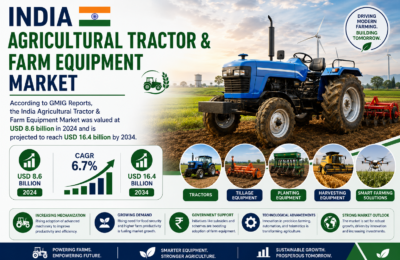
The India agricultural tractor and farm equipment market has continued its multi-year expansion, underpinned by rising rural mechanization, sustained government subsidy support, and a structural shift away from manual and animal-drawn farming methods. According to GMI Reports, the market was valued at USD 8.6 billion in 2024 and is projected to expand at a compound annual growth rate (CAGR) of approximately 6.6%, reaching USD 16.4 billion by 2034.
Growth is being reinforced by expanding rural credit access, the widening reach of Custom Hiring Centers that allow small and marginal farmers to access mechanized equipment without full ownership costs, and continued government capital support under national farm mechanization programs. Tractors remain the dominant product category, though harvesting, sowing, and precision-agriculture equipment segments are growing at a faster relative pace.
Domestic manufacturers continue to command the majority of unit volumes, supported by extensive dealership networks and after-sales service infrastructure tailored to India’s fragmented landholding structure. Meanwhile, global OEMs are expanding local assembly and component sourcing to serve both the domestic market and India’s growing role as an export hub for compact and mid-horsepower tractors.
Market Overview
The India agricultural tractor and farm equipment market encompasses tractors, harvesters, threshers, power tillers, sowing and planting equipment, irrigation pumps, and a growing category of precision and post-harvest handling machinery. The market serves a farming base characterized predominantly by small and marginal landholdings, shaping strong demand for compact, fuel-efficient, and multi-purpose equipment.
India remains the largest tractor-producing and tractor-consuming market globally by unit volume, with domestic manufacturing clusters concentrated in Punjab, Haryana, Maharashtra, and Madhya Pradesh. The equipment ecosystem is supported by an extensive network of implement manufacturers producing rotavators, cultivators, seed drills, and trailers designed for compatibility with the dominant tractor horsepower bands sold domestically.
Government mechanization initiatives, including subsidy schemes administered through state agriculture departments and the expansion of Custom Hiring Centers, have progressively lowered the ownership barrier for smallholder farmers. This policy architecture, combined with improving rural incomes and expanding institutional credit access, continues to underpin structural demand growth across both tractor and standalone implement categories.
Market Size & Forecast
Market Driving Factors
1. Sustained Government Mechanization Support
National and state-level farm mechanization schemes continue to offer capital subsidies ranging from 25% to 80% depending on farmer category and equipment class. Expanding Custom Hiring Centers have broadened equipment access for small and marginal farmers who cannot justify full ownership, sustaining aggregate demand even as individual purchasing power varies across regions.
2. Rural Labor Scarcity and Wage Inflation
Migration of agricultural labor toward urban employment opportunities has tightened the availability of manual farm labor during peak sowing and harvesting windows. Rising rural wage rates have made mechanized alternatives increasingly cost-competitive relative to manual labor, accelerating farmer adoption of tractors and associated implements.
3. Expansion of Institutional Rural Credit
Growing penetration of formal agricultural financing through public sector banks, regional rural banks, and non-banking financial companies has reduced the effective cost of tractor ownership. Extended loan tenures and interest subvention schemes have improved affordability for first-time buyers in tier-two and tier-three agricultural markets.
4. Growth in Horticulture and Cash Crop Cultivation
The expansion of horticulture, cotton, and sugarcane cultivation across several states has increased demand for specialized implements and higher-horsepower tractors capable of handling heavier draft loads. This shift is broadening the addressable equipment base beyond traditional cereal-cropping regions.
5. Export Demand for Compact and Mid-Horsepower Tractors
India’s cost-competitive manufacturing base has positioned domestic OEMs as leading exporters of compact and mid-horsepower tractors to Africa, Southeast Asia, and Latin America. Rising export volumes are supporting capacity utilization and incentivizing continued domestic manufacturing investment.
Market Restraining Factors
1. Monsoon Dependency and Agricultural Income Volatility
A substantial share of Indian farmland remains rain-fed, making tractor and equipment demand sensitive to monsoon performance and resulting crop income. Below-normal rainfall years have historically triggered pronounced short-term demand contractions across rural equipment markets.
2. Fragmented Landholding Structure
The predominance of small and marginal landholdings limits the economic justification for individual equipment ownership among a large share of India’s farming population, constraining unit volume growth despite rising overall mechanization awareness.
3. Rising Input and Component Costs
Fluctuating steel, rubber, and component prices, combined with evolving emissions compliance requirements, have increased manufacturing costs for tractor and implement producers, creating periodic pricing pressure that affects affordability for cost-sensitive rural buyers.
4. Uneven Rural Infrastructure and Service Access
Limited after-sales service and spare-parts availability in remote agricultural regions can deter equipment adoption, particularly for more technologically advanced machinery requiring specialized maintenance and diagnostic support.
Market Segmentation
By Product Type
The India agricultural tractor and farm equipment market is segmented by product type into tractors, harvesting equipment, sowing and planting equipment, and other farm implements.
Tractors retain the dominant revenue share given their central role across virtually all cropping cycles, though harvesting and sowing equipment are gaining share as mechanization deepens beyond primary tillage into post-harvest and precision-planting operations.
By Horsepower Band
The market is segmented by tractor horsepower into below 30 HP, 31-50 HP, and above 50 HP categories.
By Application
Competitive Landscape
The India agricultural tractor and farm equipment market is highly consolidated at the tractor category level, with domestic manufacturers commanding the majority of unit volumes. The leading five tractor OEMs account for an estimated 80-85% of total domestic tractor sales, while the broader implement and equipment market remains more fragmented.
Regional Analysis
Northern India leads the agricultural tractor and farm equipment market, generating an estimated 33% of total national revenues, supported by intensive wheat and rice cultivation across Punjab, Haryana, and Uttar Pradesh. Western and Central India represent the second-largest regional cluster, driven by cash crop cultivation and expanding mechanization in Maharashtra and Madhya Pradesh.
Emerging Market Trends
Smart and Connected Tractor Technology
Leading OEMs are introducing telematics-enabled tractors offering GPS-based field mapping, fuel monitoring, and remote diagnostics, supporting improved fleet management for larger farm operations and Custom Hiring Centers.
Electrification of Compact Farm Equipment
Early-stage electric tractor and power tiller programs are emerging among domestic and startup manufacturers, targeting orchard, horticulture, and small-landholding applications where lower daily operating hours make battery-electric platforms commercially viable.
Rental and Custom Hiring Model Expansion
The Custom Hiring Center network continues to expand under government mechanization programs, supported by growing private-sector equipment rental platforms that use mobile applications to connect equipment owners with smallholder farmers on a pay-per-use basis.
Precision Agriculture Integration
Adoption of precision sowing, variable-rate application, and drone-based crop monitoring is gradually increasing among larger commercial farms, creating new equipment categories that complement traditional tractor and implement sales.
Key Companies in the India Agricultural Tractor & Farm Equipment Market
-
Mahindra & Mahindra Ltd.
-
Tractors and Farm Equipment Ltd. (TAFE)
-
Escorts Kubota Ltd.
-
International Tractors Ltd. (Sonalika)
-
John Deere India Pvt. Ltd.
-
CNH Industrial (India) Pvt. Ltd.
-
VST Tillers Tractors Ltd.
-
Force Motors Ltd.
-
Kubota Agricultural Machinery India
-
Action Construction Equipment Ltd.
-
Other Regional and Implement Manufacturers
Report Target Audience
-
Tractor and Farm Equipment OEMs
-
Agricultural Implement and Component Manufacturers
-
Investment and Private Equity Firms
-
Rural Banking and Agricultural Finance Institutions
-
Government Agriculture and Rural Development Bodies
-
Custom Hiring Center Operators and Equipment Rental Platforms
-
Management Consulting and Advisory Firms
-
Academic Researchers in Agricultural Economics
Market Segmentation Summary
By Product Type
-
Tractors
-
Harvesting Equipment
-
Sowing & Planting Equipment
-
Other Farm Implements
By Horsepower Band
-
Below 30 HP
-
31-50 HP
-
Above 50 HP
By Application
-
Land Preparation & Tillage
-
Harvesting & Post-Harvest
-
Sowing & Planting
-
Irrigation & Other Applications
By Region
-
North India
-
West & Central India
-
South India
-
East India
-
Northeast India
About GMI Reports
GMI Reports is a leading market intelligence and research firm delivering actionable insights across a broad spectrum of industries globally. Our rigorous research methodologies, extensive primary and secondary data sources, and sector-specialist analysts enable our clients to make informed strategic decisions in complex and fast-evolving markets.
For further information, customized research, or licensing inquiries, please visit www.gmigreports.com or contact our research team directly.
www.gmigreports.com
© 2025 GMI Reports. All Rights Reserved. Unauthorized reproduction or distribution is prohibited.