MARKET RESEARCH REPORT
Europe Busbar Trunking Systems Market
Regional Insights, Analysis & Forecasts to 2034
Published by GMI Reports | www.gmigreports.com
Executive Summary
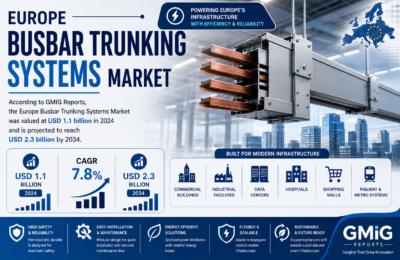
The Europe busbar trunking systems market is expanding steadily, underpinned by large-scale grid modernization investment, accelerating data center construction, and the region’s structural shift toward electrification and renewable energy integration. According to GMI Reports, the market was valued at USD 1.1 billion in 2024 and is projected to expand at a compound annual growth rate (CAGR) of approximately 7.7%, reaching USD 2.3 billion by 2034.
Growth is being reinforced by major utility-led infrastructure modernization programs across Germany, France, and the United Kingdom, rapid hyperscale and colocation data center expansion across key European digital infrastructure hubs, and tightening building energy efficiency codes that favor compact, low-loss power distribution systems over traditional cable-and-conduit installations.
European manufacturers and regional subsidiaries of global electrical equipment leaders continue to invest in sandwich-insulated and fire-resistant busbar system designs tailored to the region’s stringent building safety codes. Renewable energy project connections, including offshore wind and utility-scale solar installations, represent an increasingly important secondary demand driver alongside core commercial and industrial construction activity.
Market Overview
The Europe busbar trunking systems market encompasses modular, prefabricated electrical power distribution systems that use enclosed copper or aluminum conductors to transmit and distribute power within commercial, industrial, and infrastructure facilities. Compared to traditional cable-and-conduit wiring, busbar trunking systems offer faster installation, reduced material waste, improved thermal performance, and greater flexibility for future load reconfiguration.
Demand across Europe is concentrated among commercial high-rise construction, industrial manufacturing facilities, and a rapidly expanding data center sector, with Germany, the United Kingdom, and France representing the region’s largest national markets. The region’s mature construction and electrical contracting ecosystem, combined with well-established safety and fire-rating standards, has historically supported strong adoption of sandwich-insulated busbar designs over simpler air-insulated alternatives.
Regulatory momentum around building energy performance, including revisions to the EU Energy Performance of Buildings Directive, is reinforcing demand for power distribution systems that minimize transmission losses and support flexible integration with building management and energy monitoring systems. Grid modernization investment commitments from major European utilities are expected to sustain infrastructure-related demand through the forecast period.
Market Size & Forecast
Market Driving Factors
1. Large-Scale Grid Modernization Investment
Major European utilities have announced substantial multi-year investment commitments to modernize aging electricity grid infrastructure, directly supporting demand for reliable, high-capacity power distribution systems including busbar trunking installations across substations, industrial facilities, and commercial developments.
2. Rapid Expansion of Data Center Infrastructure
Europe’s hyperscale and colocation data center construction pipeline continues to expand across key digital infrastructure hubs, and busbar trunking systems are increasingly specified as the preferred power distribution solution given their high current capacity, compact footprint, and ease of future capacity expansion within data hall environments.
3. Tightening Building Energy Efficiency Regulations
Revisions to European building energy performance standards are increasing demand for power distribution systems with lower transmission losses and improved integration with building energy management systems, favoring busbar trunking over conventional cabling in new commercial construction.
4. Growth in Renewable Energy Project Connections
Expanding offshore wind, utility-scale solar, and battery storage project pipelines across the region are creating incremental demand for busbar trunking systems used in power collection, substation, and grid interconnection applications associated with renewable generation assets.
5. Preference for Faster, Lower-Waste Installation Methods
Rising construction labor costs and compressed project timelines across major European markets are increasing contractor preference for prefabricated busbar trunking systems, which offer significantly faster installation and reduced material waste compared to traditional cable-and-conduit approaches.
Market Restraining Factors
1. Volatile Copper and Aluminum Raw Material Prices
Busbar trunking system manufacturing costs remain sensitive to copper and aluminum commodity price fluctuations, and periods of elevated raw material pricing have historically compressed manufacturer margins and, in some cases, delayed project specifications toward lower-cost alternatives.
2. Higher Upfront Costs Relative to Conventional Cabling
Busbar trunking systems typically carry higher upfront material and installation costs than traditional cable-and-conduit wiring for smaller-scale projects, limiting adoption among cost-sensitive developers and smaller commercial construction projects despite long-term lifecycle cost advantages.
3. Construction Sector Cyclicality Across Key Markets
European commercial and industrial construction activity remains sensitive to interest rate conditions and broader macroeconomic cycles, and periods of construction sector slowdown in major markets such as Germany have historically translated into near-term demand softness for electrical infrastructure products.
4. Complex Multi-Country Regulatory and Certification Requirements
Manufacturers serving the European market must navigate varying national electrical safety codes, fire-rating standards, and certification requirements across different countries, creating compliance complexity and additional product development costs relative to single-market operations.
Market Segmentation
By Conductor Material
The Europe busbar trunking systems market is segmented by conductor material into copper and aluminum.
Copper conductors retain the larger regional share given superior conductivity and established specification preference in premium commercial and data center projects, while aluminum busbar systems are gaining share as cost-sensitive developers seek lighter-weight, lower-cost alternatives for large-scale installations.
By Insulation Type
The market is segmented by insulation type into air-insulated and sandwich-insulated busbar trunking systems.
By End-Use Industry
Competitive Landscape
The Europe busbar trunking systems market is moderately consolidated, led by global electrical equipment majors with strong regional manufacturing and distribution presence, supported by several specialized European busbar manufacturers with deep national market relationships. The leading five companies account for an estimated 45-50% of total regional market revenues.
Country-Level Analysis
Germany leads the Europe busbar trunking systems market, generating an estimated 27% of total regional revenues, supported by its large industrial manufacturing base and substantial grid modernization investment commitments. The United Kingdom and France represent the second and third largest national markets, driven respectively by data center construction and nuclear-linked grid infrastructure investment.
Emerging Market Trends
Smart Busbar Systems with Integrated Monitoring
Manufacturers are increasingly embedding current, temperature, and energy consumption sensors directly within busbar trunking systems, enabling real-time integration with building management systems and predictive maintenance capabilities for facility operators.
Data Center-Optimized High-Density Configurations
Rising rack power densities associated with AI computing infrastructure are driving demand for higher-capacity busbar trunking configurations specifically engineered for data hall environments, with several vendors introducing product lines tailored to hyperscale deployment requirements.
Sustainable and Recyclable Material Adoption
European manufacturers are increasingly emphasizing the recyclability and lower embodied carbon of busbar trunking systems relative to traditional cabling as a competitive differentiator, aligning with the region’s broader sustainable construction and circular economy priorities.
Modular Prefabrication for Faster Project Delivery
Growing adoption of off-site prefabrication and modular installation approaches is reducing on-site labor requirements and project timelines, particularly benefiting time-sensitive data center and commercial redevelopment projects across the region.
Key Companies in the Europe Busbar Trunking Systems Market
-
Schneider Electric SE
-
Siemens AG
-
ABB Ltd.
-
Eaton Corporation plc
-
Legrand S.A.
-
Rittal GmbH & Co. KG
-
E+I Engineering Ltd.
-
Naxso S.r.l.
-
Gersan Elektrik
-
DTM Elektroteknik
-
Other Regional and Specialized Manufacturers
Report Target Audience
-
Electrical Equipment Manufacturers and Distributors
-
Data Center Developers and Operators
-
Investment and Private Equity Firms
-
Utility and Grid Infrastructure Operators
-
Construction and Electrical Contracting Firms
-
Management Consulting and Advisory Firms
-
Building Energy Efficiency Regulatory Bodies
-
Academic Researchers in Electrical Engineering
Market Segmentation Summary
By Conductor Material
-
Copper
-
Aluminum
By Insulation Type
-
Sandwich-Insulated
-
Air-Insulated
By End-Use Industry
-
Commercial (Office, Retail, Data Centers)
-
Industrial (Manufacturing, Process Plants)
-
Infrastructure & Utilities
By Country
-
Germany
-
United Kingdom
-
France
-
Italy
-
Nordics
-
Rest of Europe
About GMI Reports
GMI Reports is a leading market intelligence and research firm delivering actionable insights across a broad spectrum of industries globally. Our rigorous research methodologies, extensive primary and secondary data sources, and sector-specialist analysts enable our clients to make informed strategic decisions in complex and fast-evolving markets.
For further information, customized research, or licensing inquiries, please visit www.gmigreports.com or contact our research team directly.
www.gmigreports.com
© 2025 GMI Reports. All Rights Reserved. Unauthorized reproduction or distribution is prohibited.