MARKET RESEARCH REPORT
United States Peptide Therapeutics Market
Insights, Analysis & Forecasts to 2034
Published by GMI Reports | www.gmigreports.com
Executive Summary
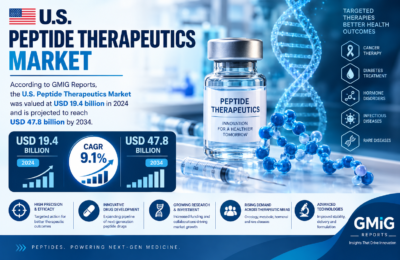
The United States peptide therapeutics market has experienced exceptional growth acceleration, driven overwhelmingly by explosive demand for GLP-1 receptor agonist therapies used in diabetes and obesity management, alongside sustained pipeline expansion across oncology and rare endocrine disease indications. According to GMI Reports, the market was valued at USD 19.4 billion in 2024 and is projected to expand at a compound annual growth rate (CAGR) of approximately 9.4%, reaching USD 47.8 billion by 2034.
Growth is being reinforced by unprecedented commercial demand for semaglutide and tirzepatide-based metabolic therapies, continued FDA orphan drug designations supporting peptide development in rare disease indications, and accelerating pharmaceutical industry investment in peptide-drug conjugates and long-acting formulation technologies that improve patient convenience and treatment adherence.
The United States continues to anchor global peptide therapeutics innovation, supported by a mature regulatory framework offering fast-track and breakthrough therapy designations, deep venture capital and pharmaceutical industry R&D investment, and a concentrated base of leading biopharmaceutical companies driving both branded and increasingly competitive generic peptide development pipelines.
Market Overview
The United States peptide therapeutics market encompasses branded and generic peptide-based drug products used across metabolic disorders, oncology, cardiovascular disease, and rare endocrine conditions, delivered primarily through parenteral routes of administration with a growing pipeline of oral peptide formulations under development. Peptide therapeutics occupy a distinctive position between traditional small-molecule drugs and larger biologics, offering high target specificity and favorable safety profiles relative to conventional pharmaceutical alternatives.
Metabolic disorder indications, led by GLP-1 receptor agonist therapies for type 2 diabetes and obesity management, represent the dominant and fastest-growing application segment within the US market, reflecting extraordinary commercial demand that has driven sustained manufacturing capacity expansion among leading pharmaceutical companies. Oncology applications, including peptide receptor radionuclide therapy and peptide-drug conjugates, represent an increasingly important growth segment supported by continued clinical pipeline expansion.
The US regulatory environment, anchored by the FDA’s established peptide drug approval pathways and continued orphan drug designation activity supporting rare disease peptide development, provides a supportive foundation for sustained innovation. Manufacturing capacity investment, including expanded solid-phase peptide synthesis and purification infrastructure among contract development and manufacturing organizations, continues to support the sector’s ability to meet surging commercial demand.
Market Size & Forecast
Market Driving Factors
1. Explosive Demand for GLP-1 Receptor Agonist Therapies
Extraordinary commercial and patient demand for semaglutide and tirzepatide-based therapies for type 2 diabetes and obesity management continues to drive the majority of near-term US peptide therapeutics market growth, prompting sustained manufacturing capacity expansion among leading pharmaceutical companies to address persistent supply constraints.
2. Expanding Oncology Peptide Pipeline Development
Growing clinical investment in peptide receptor radionuclide therapy and peptide-drug conjugates for oncology indications is expanding the therapeutic application base for peptide medicines beyond metabolic disorders, supported by demonstrated efficacy in cancer indications where conventional small-molecule therapies show limited specificity.
3. Continued FDA Orphan Drug Designation Activity
Sustained FDA orphan drug designation activity for peptide candidates targeting rare endocrine and genetic conditions continues to support peptide therapeutics development in indications with high unmet medical need and favorable regulatory and commercial exclusivity incentives.
4. Advancement of Long-Acting and Oral Peptide Formulations
Ongoing pharmaceutical industry investment in long-acting injectable and oral peptide formulation technologies is improving patient treatment adherence and convenience, expanding the commercial viability of peptide therapeutics across chronic disease management indications requiring sustained treatment regimens.
5. Growth in Outsourced Peptide Manufacturing Capacity
Expanding contract development and manufacturing organization capacity for solid-phase peptide synthesis and purification is enabling both large pharmaceutical companies and smaller biotechnology firms to accelerate clinical development timelines and address growing commercial-scale production demand.
Market Restraining Factors
1. High Drug Development and Manufacturing Costs
Peptide therapeutics development and manufacturing continue to carry substantially higher costs relative to conventional small-molecule drugs, reflecting complex synthesis, purification, and formulation stability requirements that can constrain smaller biotechnology companies’ ability to compete in the space.
2. Stringent Regulatory Approval Requirements
Peptide-based drug candidates continue to face rigorous FDA clinical trial and safety evaluation requirements, and lengthy approval timelines for novel peptide therapeutics can create development risk and delay commercial market entry relative to accelerated approval pathways available for other drug modalities.
3. Manufacturing Supply Constraints for High-Demand Products
Persistent manufacturing capacity constraints for high-demand GLP-1 receptor agonist products have created supply shortages affecting patient access, prompting regulatory scrutiny and highlighting broader industry vulnerability to demand surges that outpace available production infrastructure.
4. Rising Generic and Biosimilar Competition
Growing generic and follow-on peptide product development is increasing pricing competition for established branded peptide therapeutics as patent exclusivity periods expire, creating margin pressure for originator companies despite continued strong overall category demand growth.
Market Segmentation
By Product Type
The United States peptide therapeutics market is segmented by product type into branded (innovative) peptides and generic peptides.
Branded peptides retain the dominant market share given continued patent protection on leading GLP-1 receptor agonist products and premium pricing associated with innovative formulations, while generic peptides are gaining share as early-generation peptide therapeutics approach patent expiration.
By Application
The market is segmented by application into metabolic disorders, oncology, cardiovascular disease, and other indications.
By Route of Administration
Competitive Landscape
The United States peptide therapeutics market is highly consolidated at the branded product level, with a small number of leading pharmaceutical companies commanding the substantial majority of market revenue through blockbuster GLP-1 receptor agonist and other peptide franchise products. The top five companies account for an estimated 60-65% of total US market revenues.
Regional Analysis
The Northeast leads the United States peptide therapeutics market, generating an estimated 31% of total national revenues, reflecting its concentration of major pharmaceutical company headquarters and biopharmaceutical research clusters across New Jersey, New York, and Massachusetts. The West Coast represents the second-largest regional market, anchored by California’s biotechnology innovation ecosystem.
Emerging Market Trends
Rise of Oral GLP-1 and Peptide Formulations
Pharmaceutical companies are advancing oral peptide formulation technologies designed to overcome traditional bioavailability limitations, with several oral GLP-1 candidates progressing through late-stage clinical development as a lower-friction alternative to injectable therapies.
Expansion of Multi-Agonist and Combination Peptide Therapies
Development of dual and triple hormone receptor agonist peptides is accelerating, aiming to improve metabolic and weight management outcomes beyond single-target GLP-1 therapies through combined mechanisms of action within a single peptide molecule.
Growth in Peptide-Drug Conjugate Oncology Applications
Peptide-drug conjugates that combine targeting peptides with cytotoxic payloads are gaining increased clinical development attention as a precision oncology approach, leveraging peptide specificity to improve tumor targeting while reducing off-target toxicity.
Manufacturing Capacity Investment to Address Supply Constraints
Leading manufacturers and contract development organizations continue to announce substantial manufacturing capacity expansion investments specifically targeting high-demand GLP-1 receptor agonist production, aiming to resolve persistent supply constraints affecting patient access.
Key Companies in the United States Peptide Therapeutics Market
-
Novo Nordisk A/S
-
Eli Lilly and Company
-
Amgen Inc.
-
Bristol-Myers Squibb Company
-
Ferring Pharmaceuticals Inc.
-
Merck & Co. Inc.
-
Pfizer Inc.
-
AbbVie Inc.
-
Ipsen S.A.
-
Bachem Holding AG
-
Other Regional and Emerging Biopharmaceutical Companies
Report Target Audience
-
Pharmaceutical and Biotechnology Companies
-
Contract Development and Manufacturing Organizations (CDMOs)
-
Investment and Venture Capital Firms
-
Healthcare Payers and Insurance Providers
-
Regulatory and Drug Approval Bodies
-
Management Consulting and Advisory Firms
-
Clinical Research Organizations
-
Academic Researchers in Pharmaceutical Sciences
Market Segmentation Summary
By Product Type
-
Branded (Innovative) Peptides
-
Generic Peptides
By Application
-
Metabolic Disorders
-
Oncology
-
Cardiovascular Disease
-
Other Indications (Rare/Endocrine)
By Route of Administration
-
Parenteral (Injectable)
-
Oral
By Region
-
Northeast
-
West Coast
-
Midwest
-
South
-
Other Regions
About GMI Reports
GMI Reports is a leading market intelligence and research firm delivering actionable insights across a broad spectrum of industries globally. Our rigorous research methodologies, extensive primary and secondary data sources, and sector-specialist analysts enable our clients to make informed strategic decisions in complex and fast-evolving markets.
For further information, customized research, or licensing inquiries, please visit www.gmigreports.com or contact our research team directly.
www.gmigreports.com