MARKET RESEARCH REPORT
South Korea Alcoholic Beverages Market
Insights, Analysis & Forecasts to 2034
Published by GMI Reports | www.gmigreports.com
Executive Summary
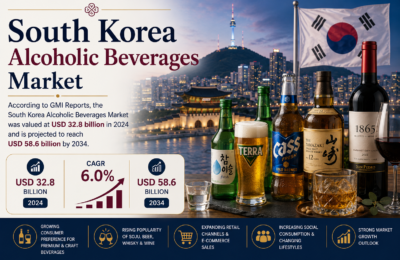
The South Korea alcoholic beverages market represents one of the most culturally embedded and commercially dynamic drinking markets in Asia. Valued at USD 32.8 billion in 2024, the market is forecast to grow at a CAGR of approximately 6.0%, reaching USD 58.6 billion by 2034, according to GMI Reports. South Korea’s unique drinking culture, driven by deeply ingrained social rituals, a vibrant nightlife economy, and rapidly evolving consumer tastes, sustains one of the highest per-capita alcohol consumption rates in the world.
Soju, the nation’s quintessential distilled spirit, continues to dominate by volume, commanding the largest share of the domestic alcoholic beverage market. However, the market is undergoing meaningful structural diversification. Beer holds the second-largest segment and is experiencing premiumization, with craft and imported varieties gaining share. Wine, whisky, and ready-to-drink (RTD) categories are recording above-average growth rates, driven by younger consumers, the influence of global pop culture, and the flourishing HoReCa sector in Seoul and major provincial cities.
The South Korean government’s progressive liberalization of alcohol retail regulations, combined with the explosive growth of online alcohol delivery platforms, has broadened distribution infrastructure and expanded consumer access. Export demand for Korean alcoholic beverages, particularly soju and makgeolli, is also growing significantly, propelled by the global Hallyu cultural wave and expanding Korean diaspora communities worldwide.
Market Overview
The South Korea alcoholic beverages market encompasses the production, importation, distribution, and retail of a broad spectrum of fermented, distilled, and mixed alcoholic drinks consumed domestically and exported internationally. The market is characterized by a dual structure: a mass-market foundation dominated by domestically produced soju and beer at highly accessible price points, layered with a growing premium and imported beverages segment driven by aspirational consumption among urban and affluent demographics.
South Korea’s drinking culture is shaped by distinctive social norms centered on group dining and communal alcohol sharing, known as ‘hoesik’ (company dining events) and ‘meokbang’ drinking culture. These traditions create structurally high on-trade consumption occasions and sustain consistent demand across both traditional Korean alcohol categories and imported beverages. The proliferation of pojangmacha (street food tents), norebang (karaoke bars), and Western-style cocktail bars in Seoul’s Hongdae, Gangnam, and Itaewon districts has further diversified the occasion landscape for alcoholic beverage consumption.
The domestic production landscape is anchored by two dominant conglomerates — HiteJinro and Lotte Chilsung Beverage — whose combined share of the soju and beer markets remains formidable. However, the entry of international brewing majors, the emergence of craft beer microbreweries, and the rapid growth of the imported wine and spirits sector are progressively reshaping competitive dynamics and creating opportunities for new entrants and niche brands.
Market Size & Forecast
Market Driving Factors
1. Deeply Rooted Drinking Culture and Social Consumption Occasions
South Korea’s drinking culture is among the most entrenched in the world, with alcohol consumption woven into professional, familial, and social rituals. The hoesik tradition of employer-organized group dining and drinking events remains a significant institutional demand driver, sustaining high on-trade consumption volumes across the restaurant and entertainment hospitality sector. Seasonal celebrations including Chuseok (Harvest Festival), Lunar New Year, and summer outdoor festivals create predictable consumption peaks that anchor annual market revenues. The normalization of multi-generational social drinking occasions creates broad and consistent demand across demographic cohorts.
2. Premiumization and Trading-Up Consumer Behavior
South Korean consumers are demonstrating increasingly sophisticated alcohol preferences and a pronounced willingness to trade up to higher-quality and higher-priced products. This premiumization trend is evident across all major categories: premium soju brands with higher-quality ingredients commanding price premiums over standard labels; craft and imported beers displacing standard lager consumption among urban millennials; aged whisky and Scotch single malts gaining new enthusiast communities; and premium wine selections expanding in both on-trade and off-trade channels. Per-occasion spend on alcohol has increased measurably as consumers prioritize quality and experience over volume.
3. Hallyu Cultural Wave and Export Growth
The global proliferation of Korean popular culture — K-pop, K-dramas, Korean cinema, and Korean cuisine — has generated remarkable international demand for Korean alcoholic beverages. Soju, featured prominently in Korean entertainment content, has become a recognized global brand category in its own right, with exports reaching over 70 countries. Makgeolli, the traditional rice wine, is experiencing an international renaissance among natural fermentation enthusiasts and Korean food culture adopters. Export revenue for Korean alcoholic beverages has grown substantially year-on-year, providing a complementary demand driver beyond the domestic market.
4. Online Alcohol Retail and Delivery Expansion
South Korea’s advanced digital commerce infrastructure has been brought to bear on the alcoholic beverages market through the liberalization of online alcohol sales and delivery. Major e-commerce platforms including Coupang, SSG.com, and Market Kurly operate extensive alcohol sections with rapid delivery services. Food delivery apps including Baemin and Coupang Eats have integrated alcohol ordering into their platforms, enabling unprecedented convenience in at-home consumption. The COVID-19 pandemic-era normalization of alcohol home delivery has created lasting behavioral shifts that continue to support online channel growth.
5. Tourism and Entertainment Hospitality Sector Recovery
South Korea’s inbound tourism sector, particularly driven by Chinese, Japanese, Southeast Asian, and Western visitors attracted by the Hallyu cultural wave, generates significant hospitality sector alcohol revenues. Seoul’s world-class hotel, restaurant, and nightlife infrastructure commands premium pricing for alcoholic beverages in on-trade settings. K-pop concert tourism and cultural events draw hundreds of thousands of international visitors annually, generating outsized per-visitor alcohol expenditure in the entertainment district economy.
6. Innovation in RTD and Low-Alcohol Categories
The ready-to-drink (RTD) segment is among the fastest-growing in the South Korean alcoholic beverages market, driven by younger consumers seeking convenience, moderate alcohol content, and innovative flavour profiles. Flavoured soju cocktails in convenient can formats, hard seltzers, and premium RTD cocktails have all recorded strong commercial launches. Simultaneously, the low-alcohol and alcohol-alternative segment is gaining traction among health-conscious consumers, with leading Korean beverage companies launching reduced-ABV soju variants and low-calorie beer alternatives.
Market Restraining Factors
1. Health Consciousness and Anti-Alcohol Social Movements
Growing health awareness among South Korean consumers, particularly younger generations, is creating structural headwinds for volume growth in the alcoholic beverages market. Government public health campaigns targeting alcohol-related disease burden and liver health are influencing consumption attitudes. The emergence of ‘sober curious’ lifestyles and moderation-focused drinking behaviours among urban millennials and Gen Z is reshaping occasion dynamics and potentially constraining long-term per-capita volume growth.
2. Stringent Alcohol Advertising and Marketing Regulations
South Korean regulations impose significant restrictions on alcohol advertising, including broadcast media time restrictions, content prohibitions on targeting minors, and limitations on depicting alcohol consumption in glamorizing contexts. These constraints limit the ability of alcohol brands to build mass market awareness through conventional media channels and require reliance on point-of-sale promotions, digital marketing, sponsorships, and influencer partnerships that carry higher per-impression costs and smaller reach.
3. Intense Domestic Price Competition
The South Korean soju and beer markets are characterized by intense domestic price competition, with leading producers maintaining retail prices at historically low levels to protect volume share. This dynamic constrains unit value growth and margin expansion for domestic producers, compressing profitability even as volumes remain robust. International premium brands face the challenge of justifying substantial price premiums in a market conditioned to expect affordable alcoholic beverages.
4. Demographic Aging and Shrinking Young Adult Population
South Korea faces one of the world’s most acute demographic aging challenges, with a sharply declining birth rate creating structural contraction of the 20-35 age cohort that historically constitutes the highest per-capita alcohol consuming demographic. This demographic headwind presents a long-term challenge to volume growth that market participants are seeking to offset through premiumization, export expansion, and tourism-driven demand.
Market Segmentation
By Product Type
Soju retains its dominant market position as South Korea’s most consumed alcoholic beverage by both volume and value, though its proportional share is projected to decline gradually as wine, whisky, and RTD categories grow at above-market rates. Beer holds a resilient second-place position, supported by casual dining pairing culture and the growing craft segment. Wine and whisky are the premium growth stories, driven by aspirational consumption and international cultural influence among urban professionals.
By Alcohol by Volume (ABV)
By Distribution Channel
The on-trade channel remains the dominant distribution vehicle for South Korean alcoholic beverages, reflecting the deeply social and occasion-driven nature of Korean drinking culture. Convenience stores are a structurally significant channel unique to the Korean market, with GS25, CU, and 7-Eleven operating over 50,000 combined outlets nationwide, many open 24 hours, providing ubiquitous access to soju, beer, and increasingly wine. Online delivery is the highest-growth channel, benefiting from infrastructure investments and regulatory liberalization.
By Packaging
By End-User
Competitive Landscape
The South Korea alcoholic beverages market is dominated domestically by two major conglomerates — HiteJinro and Lotte Chilsung Beverage — whose soju and beer brands command extraordinary market penetration and brand loyalty. However, the imported beverages, craft beer, wine, and premium spirits segments are served by a diverse ecosystem of international producers, specialty importers, and emerging domestic craft operators.
Regional Analysis
Seoul and the broader Seoul Capital Area (SCA) account for the majority of South Korea’s alcoholic beverages market revenues, reflecting the capital’s concentration of nightlife, fine dining, entertainment venues, and high-income consumers. However, provincial cities are developing increasingly vibrant alcohol consumption markets, supported by local economic growth and the diffusion of Seoul dining and drinking culture trends.
Emerging Market Trends
Craft Beer and Microbrewery Expansion
South Korea’s craft beer movement has transitioned from a niche novelty to a mainstream market segment since the 2014 regulatory amendment permitting craft breweries to sell through external channels. Over 200 licensed craft breweries now operate nationally, concentrated in Seoul but increasingly distributed across provincial cities. Craft beer tasting rooms, tap rooms, and craft-focused beer restaurants have become established components of Seoul’s food and entertainment landscape. American-style IPAs, Korean-influenced ingredient craft beers (utilizing ingredients such as makgeolli yeast, citrus, and Korean botanicals), and session ales are the most commercially successful sub-styles.
Makgeolli Renaissance and Premiumization
Traditional rice wine makgeolli is experiencing a cultural and commercial renaissance, driven by domestic interest in heritage food and beverage craftsmanship and growing international attention from fermentation enthusiasts. Premium artisanal makgeolli producers are commanding multiples of the price of mass-market products, offering aged, single-ingredient, and terroir-driven expressions in premium packaging. Seoul’s dedicated makgeolli bars and tasting houses are building new consumer communities and positioning the category as Korea’s answer to natural wine and craft sake movements globally.
Soju Category Innovation and Flavour Extension
South Korea’s leading soju producers are aggressively extending their portfolios with flavored, premium, and format-innovative expressions to maintain relevance with younger consumers and drive per-bottle value growth. Fruit-flavored soju variants including peach, grape, watermelon, and citrus have achieved remarkable commercial success, particularly among female consumers and export markets. Premium soju expressions featuring higher-quality ingredients, reduced artificial additives, and artisan production narratives are targeting the growing premiumization trend. Mini soju bottle formats designed for solo consumption and convenience store occasions are capturing the individualistic consumption trend among younger demographics.
Whisky Renaissance and Single Malt Culture
South Korea is experiencing an extraordinary whisky renaissance, with Scotch single malt whisky in particular attracting rapidly growing enthusiast communities. Korean whisky bars, dedicated tasting events, and whisky investment clubs have proliferated in Seoul and major cities. High-end Scotch expressions, Japanese whisky brands, and American bourbon have all recorded strong sales growth as Korean consumers approach whisky with the same collector and connoisseur mentality applied to wine. Several premium whisky brands have identified Korea as a priority growth market and are investing heavily in local market development.
Low-Alcohol and Non-Alcoholic Innovation
The convergence of health awareness trends and the ‘sober curious’ movement has prompted major Korean alcohol producers to invest in low-alcohol and zero-alcohol product innovation. Low-ABV soju variants, non-alcoholic beer from Hite and OB, and alcohol-free makgeolli alternatives have entered commercial distribution. This segment remains relatively small but is growing rapidly from a low base, reflecting a structural consumer preference shift that is reshaping product development priorities across the industry.
K-Content Driven Export and Global Brand Building
The globalization of Korean alcoholic beverages is accelerating, driven by the unprecedented international reach of K-pop, K-dramas, and Korean cuisine. Jinro Soju has maintained its position as the world’s best-selling distilled spirit by volume for multiple consecutive years, with sales across Asia, the Americas, Europe, and beyond. Korean alcohol exporters are investing in international brand building, expanding distribution partnerships, and tailoring product formats and marketing strategies to diverse international consumer markets.
Key Companies in the South Korea Alcoholic Beverages Market
-
HiteJinro Co., Ltd.
-
Lotte Chilsung Beverage Co., Ltd.
-
OB Beer (AB InBev Korea)
-
Kooksoondang Brewery
-
Korea Craft Beer Co. (The Booth, Magpie)
-
Seven Brewing Co., Ltd.
-
Diageo Korea
-
Pernod Ricard Korea
-
Moet Hennessy Korea
-
William Grant & Sons Korea
-
Beam Suntory Korea
-
Heineken Korea
-
Craft Beer Association of Korea Members
-
Aidea Korea (Wine Importer)
-
Lotte Duty Free & Shinsegae Duty Free (Travel Retail)
Report Target Audience
-
Alcoholic Beverage Producers and Brand Managers
-
International Brewers, Distillers, and Wine Producers Targeting Korea
-
Import and Distribution Companies
-
Retail Chains, Convenience Store Operators, and E-Commerce Platforms
-
HoReCa Operators: Hotels, Restaurants, Bars, Nightclubs
-
Private Equity and Consumer Goods Sector Investors
-
Government Trade and Industry Policy Bodies
-
Tourism Boards and Destination Marketing Organizations
-
Marketing and Advertising Agencies Specializing in Alcohol
-
Academic Researchers in Consumer Behavior and Korean Studies
-
Duty-Free and Travel Retail Operators
Market Segmentation Summary
By Product Type
-
Soju
-
Beer
-
Makgeolli (Rice Wine)
-
Wine (Imported and Domestic)
-
Whisky and Premium Spirits
-
RTD and Hard Seltzer
-
Other Alcoholic Beverages
By Alcohol by Volume (ABV)
-
Low ABV (Below 5%)
-
Medium ABV (5–15%)
-
High ABV (Above 15%)
By Distribution Channel
-
On-Trade (Restaurants, Bars, Nightclubs)
-
Off-Trade Supermarkets and Hypermarkets
-
Convenience Stores
-
Online and Delivery Platforms
-
Duty-Free and Travel Retail
-
Specialty Wine and Spirits Shops
By Packaging
-
Glass Bottle
-
Can
-
PET Bottle
-
Draft / Keg
-
Pouch / Bag
By End-User
-
Individual / Household
-
HoReCa
-
Corporate / Institutional
By Region
-
Seoul
-
Gyeonggi Province
-
Busan
-
Incheon
-
Daegu
-
Daejeon and Gwangju
-
Other Provinces
About GMI Reports
GMI Reports is a premier market intelligence and research organization delivering in-depth analysis across consumer goods, food and beverage, chemicals, healthcare, and technology sectors globally. Our South Korea Alcoholic Beverages Market report combines primary research, industry expert interviews, government trade statistics, and retail sales data to provide comprehensive and actionable market intelligence.
For customized research, additional country or segment analysis, or report licensing inquiries, please visit www.gmigreports.com or contact our food and beverage research team directly.
www.gmigreports.com