South Korea Luxury Watch Market
Insights, Analysis & Forecasts to 2034
Published by GMI Reports | www.gmigreports.com
Executive Summary
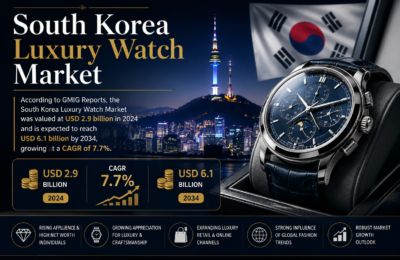
The South Korea luxury watch market stands among the most sophisticated and commercially significant luxury timepiece ecosystems in Asia, distinguished by an exceptionally affluent and watch-literate consumer base, the powerful cultural influence of Korean conglomerate gifting traditions, and the global reach of Hallyu’s lifestyle aspirational influence. Valued at USD 2.9 billion in 2024, the market is projected to grow at a compound annual growth rate (CAGR) of approximately 7.7%, reaching USD 6.1 billion by 2034, according to GMI Reports.
South Korea’s luxury watch consumption is underpinned by several structurally distinctive characteristics that differentiate it from other major Asian luxury watch markets. Korean corporate culture, particularly within Chaebol conglomerates and their affiliated business communities, has long maintained a tradition of high-value watch gifting as a marker of status, relationship investment, and professional achievement. Luxury timepieces function simultaneously as personal status symbols, investment assets, and corporate relationship instruments in Korean business culture, creating multi-dimensional demand motivations that sustain consumption well above what household income levels alone would predict.
The global ascendancy of Hallyu — Korean pop culture, K-drama, and Korean celebrity culture — has elevated Korean luxury consumption to global visibility, with Korean celebrities and influencers serving as brand ambassadors for the world’s most prestigious Swiss watchmakers. Rolex, Patek Philippe, Audemars Piguet, Richard Mille, and other haute horlogerie maisons have made South Korea a priority market for limited edition releases, flagship boutique investment, and celebrity partnership programs that reinforce the aspirational desirability of luxury watches among Korean consumers across age and income tiers.
The South Korean pre-owned luxury watch market has emerged as a significant and rapidly growing complement to the primary market, driven by investment-oriented collectors, the platform economy’s disruption of traditional retail channels, and a younger generation of watch enthusiasts accessing prestigious references at more accessible price points through authenticated resale platforms.
Market Overview
The South Korea luxury watch market encompasses the retail, wholesale, and secondary market trading of Swiss and international luxury timepieces across all distribution channels in the Korean domestic market. Luxury watches are defined for the purposes of this report as timepieces retailing at KRW 1,000,000 (approximately USD 750) and above, encompassing entry-level luxury, aspirational luxury, prestige, and ultra-high-net-worth collector segments.
South Korea’s luxury watch retail infrastructure is anchored by a highly developed department store ecosystem — particularly Lotte Department Store, Hyundai Department Store, and Shinsegae — that serves as the primary distribution channel for Swiss luxury watch brands in Korea. These department stores operate dedicated watch floors and brand boutiques that provide the controlled retail environment, service standards, and prestige associations that Swiss luxury brands require. The premium retail landscape has been supplemented by the growth of mono-brand flagship boutiques operated directly by leading maisons on Seoul’s luxury retail corridors including Cheongdam-dong, Garosu-gil, and the Lotte World Tower retail precinct.
The Korean luxury watch consumer base spans several distinct segments. At the pinnacle, ultra-high-net-worth individuals and senior Chaebol executives invest in rare and complicated timepieces from Patek Philippe, A. Lange & Sohne, and independent Swiss watchmakers as prestige assets and collection investments. The affluent professional and business class — the core of Korea’s luxury watch market by volume — purchases watches from established prestige maisons including Rolex, Omega, TAG Heuer, IWC, and Cartier as status symbols and professional presentation accessories. A growing younger affluent cohort, influenced by Hallyu culture and global watch media, is entering the market through aspirational entry luxury brands and the pre-owned market.
South Korea’s duty-free retail sector — one of the world’s largest by per-capita sales — plays a distinctive role in the luxury watch market. Major Korean duty-free operators including Lotte Duty Free, Shinsegae Duty Free, and The Shilla Duty Free at Incheon International Airport generate substantial luxury watch revenues from both outbound Korean travelers and inbound international tourists, particularly Chinese visitors for whom Korean duty-free pricing represents significant savings relative to domestic Chinese luxury retail.
Market Size & Forecast
Market Driving Factors
1. Chaebol Corporate Gifting Culture and Status Symbolism
Korean corporate gifting culture, deeply embedded within Chaebol business networks and broader Korean business relationships, represents a foundational and uniquely Korean driver of luxury watch demand. High-value watches are traditional gifts marking significant career milestones — promotions, retirements, business deal completions, and special anniversaries — within Korea’s hierarchical corporate culture. The reciprocity norms of Korean business relationships (jeong and kibun dynamics) create structured occasions for luxury watch gifting that generate reliable, high-value purchase events throughout the year. This corporate gifting dimension sustains luxury watch retail revenues that are partially insulated from individual consumer discretionary spending cycles, as business relationship maintenance obligations create purchase imperatives that extend beyond personal luxury preference.
2. Hallyu Cultural Influence and Global Brand Ambassador Programs
South Korea’s global cultural influence through K-pop and K-drama has made Korean celebrities among the most commercially valuable brand ambassadors in the global luxury industry. Swiss watch maisons including Rolex, IWC, TAG Heuer, Hublot, and Zenith have engaged Korean celebrities — including BTS members, top K-drama actors, and internationally recognized Korean cultural figures — as global brand ambassadors whose reach extends across Asia and increasingly into Western markets. These ambassador relationships generate enormous social media amplification of luxury watch brand desirability among Korean consumers and Korean cultural fans globally. The aspirational identification with Korean celebrities’ luxury lifestyle associations creates direct demand stimulus for their endorsed watch brands among Korean consumers motivated by cultural affinity and aspiration.
3. Investment-Grade Watch Collecting and Asset Diversification
South Korea’s affluent consumer class has progressively embraced luxury watches as investment assets alongside traditional financial instruments and real estate. The extraordinary appreciation of certain reference watches — particularly Rolex sports models, Patek Philippe complications, and Audemars Piguet Royal Oak variants — during the 2019–2022 period established luxury timepieces as credible alternative investment assets in Korean high-net-worth investor consciousness. Korean financial media coverage of watch investment returns, the growth of authenticated pre-owned trading platforms, and the development of watch-secured lending products by Korean private banks have normalized watch investment as a component of affluent Korean asset allocation strategies. This investment motivation reinforces purchase decisions at the prestige and ultra-luxury tier that might otherwise be deferred during economic uncertainty.
4. Duty-Free Channel and Inbound Tourism Watch Sales
South Korea’s world-class duty-free retail infrastructure at Incheon International Airport and downtown duty-free stores in Seoul generates substantial luxury watch revenues from both outbound Korean travelers benefiting from duty-free pricing on Swiss watches and inbound international visitors — particularly Chinese, Southeast Asian, and Japanese tourists — for whom Korean duty-free represents favorable luxury pricing relative to their home markets. Lotte Duty Free and Shinsegae Duty Free operate among the world’s most elaborately developed luxury watch duty-free environments, with dedicated watch floors featuring full Swiss luxury brand representation. The recovery and growth of international tourism to South Korea is reinforcing duty-free channel luxury watch revenues as a structurally important market component.
5. Rising UHNWI and Affluent Professional Population
South Korea’s high-net-worth and ultra-high-net-worth individual population has grown steadily, supported by asset price appreciation, equity market gains, and the continued wealth creation within the Chaebol-anchored corporate economy. The expansion of Korea’s technology sector, the growth of Korean startup entrepreneurship, and sustained professional income growth among senior corporate executives have created a broadening affluent consumer base with both the financial capacity and social motivation for luxury watch consumption. Korea’s exceptionally high educational attainment levels and the cultural premium placed on professional success create sustained demand for luxury goods as visible markers of achieved social status.
6. Pre-Owned Market Growth and Watch Collecting Democratisation
The rapid development of authenticated pre-owned luxury watch trading platforms — including Korean services such as Chronopost Korea, Watch Box Korea, and global platforms Chrono24 and Crown & Caliber with Korean market presence — has broadened luxury watch market access across Korean income tiers. Pre-owned watch platforms enable entry-level watch enthusiasts to access prestigious reference watches at more accessible price points, building category engagement and aspiration that frequently evolves into primary market purchases as income grows. The Korean watch collecting community, organized through online forums, social media groups, and collector events, has grown significantly, sustaining secondary market liquidity and driving demand for rare references that command substantial secondary market premiums.
7. Personalisation, Bespoke Services, and VIP Client Programs
Korea’s luxury watch maisons have invested heavily in bespoke and personalisation services catering to Korean UHNWI and VIP collector clients. Custom dial programs, engraving services, strap customisation, and invitation-only collector events for high-value clients create exclusive touch points that deepen brand loyalty and justify continued engagement with preferred maisons. Private preview events for limited edition releases, priority allocation programs for high-demand references, and dedicated watch specialist consultant services in flagship boutiques collectively create premium retail experiences calibrated to Korean VIP client expectations. These personalised relationship programs sustain purchasing cadence among core high-value clients while differentiating department store and mono-brand boutique channels from duty-free and online alternatives.
Market Restraining Factors
1. Grey Market and Parallel Import Competition
The South Korean luxury watch market faces persistent grey market competition from parallel imported watches sourced through Hong Kong, Singapore, and European retail channels at prices that may undercut official Korean retail pricing, particularly for reference watches subject to Korean market allocation constraints. Online platforms and informal networks facilitating parallel import purchases create pricing pressure on official distribution channels and complicate brand pricing control strategies. Grey market activity is most prevalent for high-demand references where official Korean allocation is insufficient to meet waiting list demand, with parallel import premiums and discounts fluctuating according to reference supply-demand dynamics in global secondary markets.
2. Won Exchange Rate Sensitivity and Imported Luxury Pricing
As a market served predominantly by imported Swiss luxury watches priced in Swiss francs and euros, South Korea’s luxury watch market is exposed to Korean Won (KRW) exchange rate fluctuations that affect the retail price of luxury timepieces in Korean consumer currency terms. Swiss franc and euro appreciation against the Won — which has experienced periods of weakness driven by global risk sentiment, US dollar strength, and Korean current account dynamics — increases the KRW retail prices of luxury watches, potentially dampening demand among price-sensitive aspirational buyers and stimulating overseas purchase tourism by Korean travelers visiting Switzerland, France, and duty-free environments in Asia. Exchange rate volatility creates pricing strategy challenges for Swiss brand Korean subsidiaries seeking to maintain consistent retail positioning.
3. Anti-Corruption Legislation and Corporate Gifting Restrictions
The Kim Young-ran Act (Improper Solicitation and Graft Act), effective since 2016, imposes value limits on gifts and hospitality that can be provided to public officials, journalists, and educators in South Korea. While the Act’s direct applicability to private sector gifting is limited, its implementation signaled a broader social shift toward greater scrutiny of high-value gift giving in professional contexts. Periodic anti-corruption enforcement campaigns and evolving corporate governance standards within major Chaebol groups have introduced compliance monitoring of high-value luxury gifting that moderates the volume of official corporate gift occasions for luxury watches in certain professional contexts. However, the Act’s impact on the overall luxury watch market has been relatively contained given the dominance of private sector gifting and personal purchase motivations.
4. Generational Shift Toward Smartwatch and Digital Lifestyle
Younger Korean consumers — particularly Gen Z and younger Millennials — demonstrate lower autonomous engagement with traditional Swiss mechanical watches compared to older cohorts, with smartwatch adoption (dominated by Apple Watch and Samsung Galaxy Watch) satisfying functional timekeeping and health monitoring needs for this demographic. While luxury watch brands have successfully engaged younger Korean consumers through Hallyu ambassador programs and entry-level aspirational offerings, the structural competition from smartwatch functionality for everyday wrist real estate remains a long-term consideration for the category’s volume growth trajectory. The challenge for traditional luxury watch brands is maintaining aspirational cultural relevance with digital-native Korean consumers whose reference points for desirable wearable technology extend well beyond traditional horology.
Market Segmentation
By Product Type
Sports and casual luxury watches — led by Rolex Submariner, Daytona, and GMT-Master references, Audemars Piguet Royal Oak, and Patek Philippe Nautilus — command the largest and fastest-growing product segment share, reflecting Korean consumers’ preference for versatile prestige references that transition between professional and lifestyle occasions. Complication and haute horlogerie watches are gaining share as Korea’s collector community deepens and UHNWI clients seek technically distinguished investments beyond standard prestige references. Jewellery and gem-set watches maintain significant demand driven by Korean gifting occasions and female luxury watch purchasing.
By Price Tier
The prestige tier commands the largest market share by value, anchored by core Rolex, Patek Philippe, and Audemars Piguet references that represent the foundational Korean luxury watch investment. The ultra-luxury segment is growing fastest as Korean UHNWI wealth expands and investment-grade watch collecting becomes more mainstream among Korea’s affluent class. The entry and aspirational luxury tiers are sustained by corporate gifting occasions, younger consumer recruitment, and the first-watch purchase occasions of Korea’s expanding professional class.
By Watch Movement
By Gender
Male consumers dominate luxury watch purchasing in Korea, driven by the prestige symbolism and investment motivations that predominate in Korean male professional and business culture. The female segment is the fastest growing, reflecting increasing female economic empowerment, the growth of female luxury watch collecting, and the expansion of female-oriented luxury watch marketing by major maisons. Female luxury watch demand is particularly strong in the jewellery-set and mid-complication categories and is closely correlated with K-drama and celebrity lifestyle influence on female consumer aspirations.
By Distribution Channel
Department stores retain the largest distribution share, reflecting their central role in Korean luxury retail culture and the trust and service standards they provide. Mono-brand boutiques are the fastest-growing channel as Swiss maisons invest in flagship retail environments that deliver brand-appropriate service levels and immersive brand storytelling. Pre-owned and certified second-hand platforms are experiencing rapid growth driven by investment collectors, platform economy adoption, and younger consumer entry into the category through authenticated resale channels.
By Brand Tier
Competitive Landscape
The South Korean luxury watch market is dominated by Swiss luxury watch maisons with long-established Korean distribution networks, supported by the world’s most sophisticated department store retail infrastructure. Brand competition centres on boutique investment, celebrity ambassador programs, limited edition allocation, and VIP client service quality.
Regional Analysis
South Korea’s luxury watch market is geographically concentrated in Seoul and its immediate metropolitan region, reflecting the capital’s dominance of Korean corporate headquarters, affluent residential districts, international tourism flows, and luxury retail infrastructure. Significant secondary markets exist in Busan and other major cities.
Regulatory and Policy Environment
The South Korean luxury watch market operates within a regulatory framework covering customs and import duties, consumer protection for luxury goods, anti-counterfeiting enforcement, and corporate governance standards that indirectly affect high-value gifting practices.
Customs Duties and Luxury Import Taxation
Imported luxury watches are subject to customs duties in South Korea under the Korea Customs Service tariff schedule, with applicable rates varying by watch type and value. Additional value-added tax (VAT) of 10% applies to all luxury watch sales in Korea. Individual duty-free exemption limits — KRW 800,000 for returning Korean travelers from most origins and USD 600 for duty-free purchases within Korea — shape the economics of duty-free channel luxury watch purchasing and create incentives for higher-value watch purchases in duty-free environments where the tax saving on prestige watch pricing is most financially significant.
Anti-Counterfeiting and Intellectual Property Enforcement
The Korean Intellectual Property Office (KIPO) and Korea Customs Service maintain active enforcement programs against counterfeit luxury watches, which represent a persistent challenge given the high global demand for counterfeit Swiss watch references. Korean customs routinely seize counterfeit watch shipments at Incheon Airport and Busan Port, with the volume and sophistication of counterfeits intercepted reflecting the global proliferation of high-quality replica production. KIPO’s cooperation with Swiss watch brand Korean subsidiaries on market surveillance and enforcement supports the integrity of the official luxury watch market and protects authorised channel price positioning.
Personal Information Protection Act and Consumer Data
The Personal Information Protection Act (PIPA) governs how luxury watch brands and retailers collect, store, and use Korean customer personal data in client relationship management, VIP program administration, and targeted marketing communications. PIPA compliance requirements affect the design of brand CRM systems and the cross-border transfer of Korean client data to Swiss parent company systems, requiring careful data architecture and consent management to maintain compliance while enabling the personalised client relationship management that is central to luxury watch brand strategy in Korea.
Foreign Exchange Regulations and High-Value Purchase Reporting
Korea’s foreign exchange regulations administered by the Bank of Korea establish reporting requirements for high-value overseas luxury purchases that affect Korean consumers buying watches while traveling abroad. Financial transaction reporting thresholds for high-value cash and card purchases in luxury retail environments reflect Korea’s broad anti-money laundering framework, which luxury watch retailers must navigate in customer transaction processing and record keeping for high-value watch sales.
Emerging Market Trends
K-Pop and Entertainment Industry Watch Culture
South Korea’s globally influential entertainment industry has transformed luxury watch visibility and desirability among younger global audiences. K-pop artists and Korean actors appearing in music videos, award ceremonies, drama productions, and social media content wearing specific luxury watch references generate immediate consumer awareness and purchase intent spikes in Korea and across Korean cultural influence markets in Asia and beyond. Swiss watch brands have responded by developing dedicated Korean entertainment ambassador programs that go beyond conventional celebrity endorsement to encompass co-designed limited editions, collector event partnerships, and integrated social media content strategies that leverage the extraordinary digital reach of Korean entertainment platforms. This entertainment-watch culture intersection has elevated Korea’s importance in global luxury watch brand strategy beyond what its market size alone would justify.
Phygital Retail and Digital Watch Authentication
Leading luxury watch retailers and brands in Korea are investing in phygital retail experiences that integrate digital technology with physical boutique environments. Augmented reality watch try-on features, digital certification and provenance documentation using blockchain technology, and AI-powered personalised recommendation tools are being deployed in flagship boutiques and brand digital platforms to enhance the purchase experience and address authentication concerns in both primary and secondary markets. Watch blockchain authentication programs — including Arianee-protocol based digital passports adopted by several luxury brands — are gaining traction in Korea’s watch market as buyers seek verifiable provenance documentation that supports both personal confidence and resale value preservation.
Limited Edition and Korea-Exclusive References
Swiss luxury watch brands are increasingly developing Korea-exclusive or Asia-exclusive limited edition references that cater to Korean collectors’ desire for distinctive and locally significant pieces. Dial designs incorporating Korean cultural motifs, lacquer work inspired by Korean traditional decorative arts, and limited editions released exclusively through Korean retail channels create collector-specific demand events that drive boutique traffic and social media engagement. These Korea-exclusive strategies reflect Swiss brands’ recognition of Korea’s importance as a premium market deserving of dedicated product development investment rather than generic Asian market product allocation. Limited edition launches are managed as carefully orchestrated marketing events with waitlists, VIP client previews, and social media amplification strategies.
Sustainable Luxury and Ethical Sourcing
Korean luxury watch consumers — particularly younger affluent buyers — are demonstrating growing interest in the sustainability credentials and ethical sourcing practices of luxury watch brands. Swiss watch brands’ adoption of Fairtrade-certified gold, recycled material components, solar-powered manufacturing facilities, and carbon footprint reporting is increasingly factored into brand preference decisions by environmentally conscious Korean consumers. Korean luxury media coverage of Swiss watch brand sustainability initiatives, combined with the broader Korean corporate ESG reporting trend, is elevating sustainability from a peripheral brand communication element to a meaningful competitive consideration in the luxury watch category.
Watch Investment Funds and Collector Finance
South Korea has seen the emergence of watch investment vehicles and collector finance products that reflect the mainstream acceptance of luxury watches as alternative investment assets. Korean private banks and family office advisors are incorporating watch investment guidance into UHNWI portfolio advisory services. Dedicated watch investment funds, watch-backed lending programs, and professional watch valuation services are developing around the core authenticated resale platform ecosystem, providing the financial infrastructure that supports sophisticated investment-oriented watch collecting. This financialisation of the watch collecting ecosystem reinforces investment-motivated purchasing at the prestige and ultra-luxury tiers while providing market liquidity that benefits the overall category’s investment credentials.
Key Brands and Companies in the South Korea Luxury Watch Market
-
Rolex SA — Korea Distribution (Hanjin Group affiliation)
-
Patek Philippe — Korea (Authorised Retailer Network)
-
Audemars Piguet Korea
-
Richemont Korea (IWC, Cartier, Vacheron Constantin, Jaeger-LeCoultre, A. Lange & Sohne)
-
Swatch Group Korea (Omega, Longines, Rado, Tissot, Hamilton)
-
LVMH Watch & Jewellery Korea (TAG Heuer, Hublot, Zenith, Bulgari)
-
Richard Mille Korea
-
Lotte Department Store (Watch Division — Lotte Retail)
-
Hyundai Department Store (Watch & Jewellery Division)
-
Shinsegae Department Store (Watch Concessions)
-
Lotte Duty Free (Watch Department)
-
Shilla Duty Free (Luxury Watch Concessions)
-
WatchBox Korea (Pre-Owned Platform)
-
Chrono24 Korea (Pre-Owned Marketplace)
-
Other Authorised Dealers and Specialist Retailers
Report Target Audience
-
Swiss Luxury Watch Brands and Korean Subsidiary Management
-
Luxury Retail Operators and Department Store Watch Buyers
-
Duty-Free Retail Operators and Concession Managers
-
Pre-Owned Watch Platform Operators and Investors
-
Private Equity and Luxury Goods Sector Investors
-
Korean Chaebol Corporate Procurement and Gifting Teams
-
Luxury Brand Marketing and Ambassador Strategy Teams
-
Private Banking and Family Office Wealth Advisors
-
Management Consultants in Luxury Goods and Korea
-
Academic Researchers in Luxury Consumer Behaviour and Korean Business Culture
Market Segmentation Summary
By Product Type
-
Dress and Formal Watches
-
Sports and Casual Luxury Watches
-
Complication and Haute Horlogerie
-
Jewellery and Gem-Set Watches
-
Limited Edition and Collector Pieces
By Price Tier
-
Entry Luxury (USD 750 to USD 5,000)
-
Aspirational Luxury (USD 5,000 to USD 15,000)
-
Prestige (USD 15,000 to USD 50,000)
-
Ultra-Luxury (USD 50,000 to USD 200,000)
-
Collector and UHNWI (Above USD 200,000)
By Watch Movement
-
Swiss Mechanical (Automatic)
-
Swiss Mechanical (Manual Wind)
-
Swiss Quartz (Luxury)
-
Hybrid and Smart Luxury
-
Other Premium
By Gender
-
Male
-
Female
-
Unisex and Gender-Neutral
By Distribution Channel
-
Department Stores
-
Duty-Free Retail
-
Mono-Brand Boutiques
-
Authorised Multi-Brand Dealers
-
Pre-Owned and Certified Second-Hand Platforms
-
Online Brand E-Commerce and Platforms
By Region
-
Seoul — Gangnam and Cheongdam
-
Seoul — CBD and Jung-gu
-
Seoul — Mapo, Hongdae and Yongsan
-
Incheon International Airport
-
Busan
-
Daegu and North Gyeongsang
-
Other Major Cities
About GMI Reports
GMI Reports is a leading global market intelligence and research organization providing comprehensive data-driven insights and strategic analysis across industries worldwide. Our luxury goods and consumer markets research practice delivers authoritative coverage of luxury watch, jewellery, fashion, and lifestyle markets across Asia-Pacific, Europe, and the Americas. For the South Korea Luxury Watch Market report, related Asian luxury goods research, or customized market intelligence solutions, please visit www.gmigreports.com.
www.gmigreports.com