MARKET RESEARCH REPORT
South Korea Logistics Automation Market
Insights, Analysis & Forecasts to 2034
Published by GMI Reports | www.gmigreports.com
Executive Summary
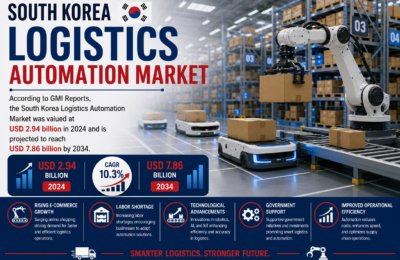
The South Korea logistics automation market was valued at USD 2.94 billion in 2024 and is projected to grow at a compound annual growth rate (CAGR) of approximately 10.3%, reaching USD 7.86 billion by 2034, according to GMI Reports. South Korea’s logistics automation market benefits from the convergence of an exceptionally mature e-commerce ecosystem, acute and persistent labor shortages within warehousing and distribution functions, and the country’s globally leading robotics and automation technology manufacturing base.
South Korea’s e-commerce penetration ranks among the highest globally, driven by same-day and dawn delivery service expectations that have fundamentally reshaped fulfillment center design and operational requirements. This consumer expectation environment has created compelling commercial justification for substantial automated storage and retrieval system, autonomous mobile robot, and automated sorting technology investment across the country’s logistics infrastructure.
South Korea’s distinctive advantage within the global logistics automation market stems from its concurrent position as both a leading technology consumption market and a globally significant robotics and automation equipment manufacturing hub, hosting major domestic conglomerates with deep vertical integration capabilities spanning robotics hardware, software platforms, and end-to-end logistics service delivery.
Market Overview
The South Korea logistics automation market encompasses automated storage and retrieval systems, autonomous mobile robots, automated guided vehicles, conveyor and sortation systems, warehouse management software, and related automation technologies deployed across distribution centers, fulfillment warehouses, and manufacturing logistics operations. The market serves e-commerce fulfillment, retail distribution, manufacturing logistics, and third-party logistics provider end-users.
South Korea’s logistics automation market dynamics are fundamentally shaped by the country’s unique e-commerce consumer expectation environment, where same-day and even multi-hour delivery windows have become standard competitive requirements among leading e-commerce platforms. This compressed delivery timeline expectation has driven fulfillment center operators toward extensive automation investment as a structural necessity rather than a discretionary efficiency enhancement, distinguishing South Korea’s automation adoption urgency from many international peer markets.
The market additionally benefits from South Korea’s well-documented warehouse and logistics labor shortage, intensified by demographic aging trends and declining domestic interest in physically demanding warehouse and distribution center employment. This labor availability constraint has elevated automation from a cost-optimization consideration to an operational continuity necessity for many logistics operators, particularly within the rapidly scaling e-commerce fulfillment sector.
Market Size & Forecast
Market Driving Factors
1. Exceptionally Mature E-commerce and Same-Day Delivery Culture
South Korea’s e-commerce market maturity, combined with consumer expectations for same-day and dawn delivery service standards pioneered by leading domestic e-commerce platforms, has fundamentally elevated the commercial necessity of warehouse and fulfillment automation. Operators unable to achieve the throughput speed and accuracy levels demanded by these aggressive delivery commitments face direct competitive disadvantage, creating sustained automation investment urgency across the fulfillment sector.
2. Acute Warehouse and Distribution Labor Shortage
South Korea faces a well-documented and intensifying shortage of warehouse and distribution center labor, driven by demographic aging, declining domestic worker interest in physically demanding logistics roles, and increasing reliance on foreign labor amid tightening immigration policy considerations. This labor constraint has positioned automation as an operational necessity for sustaining fulfillment capacity rather than a purely cost-driven optimization decision.
3. Domestic Robotics and Automation Technology Leadership
South Korea’s globally significant robotics and automation manufacturing capabilities, anchored by major domestic conglomerates with deep engineering and manufacturing expertise, provide the logistics automation market with a robust and readily accessible domestic supply base. This technology manufacturing strength reduces import dependency and supports continued innovation tailored specifically to South Korean warehouse infrastructure and operational requirements.
4. Government Smart Logistics and Digital Infrastructure Policy Support
The South Korean government has prioritized smart logistics infrastructure development as a component of broader digital economy and manufacturing competitiveness policy initiatives. Targeted subsidy programs, smart logistics complex development projects, and regulatory sandbox initiatives for autonomous delivery and warehouse robotics testing have provided meaningful policy tailwinds supporting continued private sector automation investment.
5. Rising Real Estate Costs Driving Vertical and Density Optimization
Escalating industrial and logistics real estate costs within South Korea’s major metropolitan areas, particularly the Seoul Capital Area, have intensified operator focus on maximizing storage density and throughput efficiency within existing facility footprints. Automated storage and retrieval systems, capable of significantly higher storage density than conventional manual warehouse configurations, address this real estate cost pressure directly.
6. Manufacturing Sector Logistics Integration
South Korea’s substantial advanced manufacturing base, spanning semiconductors, automotive, electronics, and shipbuilding industries, increasingly integrates sophisticated internal logistics automation to support just-in-time production methodologies and complex multi-component assembly logistics. This manufacturing logistics automation demand provides a significant complementary growth vector alongside the e-commerce fulfillment-driven market expansion.
Market Restraining Factors
1. High Upfront Capital Investment Requirements
Comprehensive logistics automation system deployment requires substantial upfront capital investment in hardware, software integration, and facility infrastructure modification, presenting meaningful adoption barriers for smaller logistics operators and third-party logistics providers with constrained capital availability. This cost barrier particularly affects mid-sized operators competing against larger, better-capitalized e-commerce platform-owned fulfillment operations.
2. System Integration Complexity with Legacy Infrastructure
Many South Korean logistics facilities, particularly older distribution centers, present significant technical integration challenges when retrofitting modern automation systems onto existing legacy infrastructure, racking configurations, and warehouse management systems. This integration complexity can extend implementation timelines and elevate project costs beyond initial budget expectations, occasionally delaying automation adoption decisions.
3. Workforce Transition and Reskilling Challenges
The accelerating pace of logistics automation adoption raises workforce transition challenges, requiring substantial reskilling investment for displaced manual warehouse workers and creating social and labor policy considerations that logistics operators must navigate alongside pure operational efficiency objectives. Labor union engagement and government workforce transition support program coordination add complexity to large-scale automation deployment initiatives.
4. Cybersecurity and System Reliability Risk Exposure
Increasing logistics operation dependency on interconnected automation systems, robotics fleets, and warehouse management software elevates cybersecurity risk exposure and operational continuity vulnerability to system failures or malicious disruption. Logistics operators must balance automation investment with corresponding cybersecurity infrastructure and redundancy planning investment to manage these elevated operational risk profiles.
Market Segmentation
By Component
Hardware components, encompassing automated storage and retrieval systems, robotics, and conveyor infrastructure, retain the dominant market share given the substantial capital intensity of physical automation equipment. Software solutions are projected to gain proportional market share as warehouse management and orchestration platform sophistication increasingly differentiates automation system performance and return on investment realization.
By Automation Type
Automated storage and retrieval systems maintain the leading automation type market share, reflecting their established role as foundational high-density storage infrastructure within major fulfillment centers. Autonomous mobile robots represent the fastest-growing segment, valued for their deployment flexibility and ability to scale incrementally alongside fluctuating fulfillment volume requirements.
By End-Use Industry
Competitive Landscape
The South Korea logistics automation market features a combination of major domestic conglomerates with vertically integrated robotics and logistics service capabilities, specialized automation technology providers, and international system integrators establishing local operations to serve the country’s rapidly scaling fulfillment infrastructure investment.
Regional Analysis (Within South Korea)
Logistics automation deployment within South Korea exhibits significant concentration around major metropolitan logistics hubs and port infrastructure, reflecting both population density driving e-commerce fulfillment demand and strategic transportation infrastructure access. The Seoul Capital Area and surrounding Gyeonggi Province represent the largest concentration of automated fulfillment center investment.
Emerging Market Trends
AI-Driven Demand Forecasting and Dynamic Slotting
South Korean logistics operators are increasingly integrating artificial intelligence-driven demand forecasting and dynamic inventory slotting optimization directly within warehouse automation control systems. This integration enables automated systems to proactively reposition inventory based on predicted demand patterns, further enhancing the throughput and efficiency advantages delivered by physical automation infrastructure investment.
Autonomous Last-Mile Delivery Pilot Expansion
Building on substantial warehouse automation investment, several South Korean logistics operators and technology companies are advancing autonomous delivery robot and drone pilot programs targeting last-mile delivery automation. Regulatory sandbox frameworks supporting these pilots reflect government recognition of last-mile automation’s potential to address persistent delivery labor shortage challenges within the country’s demanding same-day delivery service environment.
Micro-Fulfillment Center Proliferation
Growing adoption of micro-fulfillment center models, deploying compact automated storage and retrieval systems within urban retail and logistics locations closer to end consumers, is gaining traction as a strategy to further compress delivery timelines while managing escalating urban real estate costs. This trend particularly benefits flexible, modular automation technology providers capable of supporting smaller-footprint deployment configurations.
Digital Twin-Enabled Warehouse Design and Optimization
South Korean logistics automation system integrators are increasingly employing digital twin simulation technology during facility design and ongoing operational optimization phases, enabling virtual testing of automation configurations and throughput scenarios before physical implementation. This approach reduces deployment risk and supports continuous operational refinement for complex, highly automated fulfillment center environments.
Robotics-as-a-Service Adoption Growth
Subscription-based robotics-as-a-service models, providing access to autonomous mobile robots and related automation hardware without substantial upfront capital investment, are gaining adoption among small and medium-sized logistics operators seeking automation benefits while managing capital constraint considerations. This flexible deployment model is expanding the addressable market for automation technology beyond large, well-capitalized fulfillment operators.
Key Companies in the South Korea Logistics Automation Market
-
CJ Logistics Corporation
-
Coupang Corporation
-
Hyundai Robotics (Hyundai Motor Group)
-
Hanwha Robotics
-
LG CNS
-
Samsung SDS
-
Lotte Global Logistics
-
Doosan Robotics
-
Hanjin Transportation
-
TWINNY Robotics
-
International and Domestic System Integrators
Report Target Audience
-
Logistics and Fulfillment Operators
-
Robotics and Automation Technology Manufacturers
-
E-commerce and Retail Platform Companies
-
Third-Party Logistics (3PL) Providers
-
Investment and Private Equity Firms
-
Government Smart Logistics and Industrial Policy Agencies
-
Warehouse Management Software Vendors
-
Management and Strategy Consultants
-
Academic and Supply Chain Research Institutions
Market Segmentation Summary
By Component
-
Hardware (Robots, ASRS, Conveyors)
-
Software (WMS, Control Systems)
-
Services (Integration, Maintenance)
By Automation Type
-
Automated Storage & Retrieval Systems (AS/RS)
-
Autonomous Mobile Robots (AMR)
-
Automated Guided Vehicles (AGV)
-
Conveyor & Sortation Systems
-
Pick-to-Light/Voice-Directed Systems
By End-Use Industry
-
E-commerce & Retail Fulfillment
-
Third-Party Logistics (3PL)
-
Manufacturing & Industrial
-
Food & Beverage Distribution
-
Pharmaceuticals & Healthcare
By Region (Within South Korea)
-
Seoul Capital Area & Gyeonggi
-
Incheon
-
Busan & Gyeongnam
-
Chungcheong Region
-
Other Regions
About GMI Reports
GMI Reports is a premier market intelligence and research organization providing data-driven insights and strategic analysis across global logistics, supply chain, and industrial automation markets. Our research empowers logistics operators, technology providers, and investors to navigate the evolving automation landscape with confidence. For the South Korea Logistics Automation Market report and related research, visit www.gmigreports.com or contact our research team for customized intelligence solutions.
www.gmigreports.com