MARKET RESEARCH REPORT
United States Precipitated Calcium Carbonate Market
Insights, Analysis & Forecasts to 2034
Published by GMI Reports | www.gmigreports.com
Executive Summary
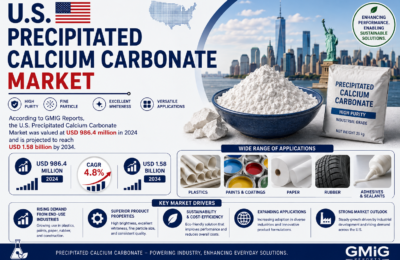
The United States precipitated calcium carbonate market was valued at USD 986.4 million in 2024 and is projected to grow at a compound annual growth rate (CAGR) of approximately 4.8%, reaching USD 1.58 billion by 2034, according to GMI Reports. Precipitated calcium carbonate, or PCC, is a synthetically manufactured mineral product produced through a controlled carbonation reaction of calcium hydroxide, delivering precisely controlled particle size, shape, morphology, and surface chemistry characteristics not achievable through natural ground calcium carbonate mining and processing.
The United States represents one of the world’s largest PCC consumption markets, reflecting the country’s substantial paper and pulp manufacturing industry historically the dominant PCC end-use sector, alongside large and diverse consumption across plastics, rubber, adhesives, sealants, paints and coatings, pharmaceutical, and food applications. PCC’s ability to deliver superior functional performance across brightness, opacity, surface smoothness, and rheological modification applications across these diverse end-use sectors sustains its position as an important specialty mineral within the US chemical and materials industry.
The market is navigating a significant structural transition, with the historical dominance of paper and printing grade PCC facing headwinds from continued US printing paper market volume decline, offset by growing demand from premium polymer and plastics compounding applications, pharmaceutical excipient and food-grade PCC demand growth, and emerging applications within lithium-ion battery electrolyte systems and carbon capture utilization processes.
Market Overview
The United States precipitated calcium carbonate market encompasses PCC manufactured across a range of particle size distributions, crystal morphologies including scalenohedral, rhombohedral, and prismatic forms, and surface treatment specifications, serving as a functional filler, pigment, coating pigment, and performance additive across paper, plastic, rubber, paint, adhesive, pharmaceutical, food, and specialty industrial applications. PCC is produced domestically both through standalone chemical processing facilities and increasingly through satellite production units co-located at paper mill sites for direct slurry supply to paper manufacturing processes.
PCC’s distinction from ground calcium carbonate lies in its precisely controlled manufacturing process, which enables specification of particle size typically ranging from 0.07 to 4 microns, narrow particle size distribution, controlled crystal shape affecting surface area and aspect ratio, and surface treatment with stearic acid and other coupling agents for polymer matrix compatibility. These controllable property profiles allow PCC to deliver functional performance advantages across specific applications that justify its premium pricing relative to ground calcium carbonate alternatives.
The satellite PCC production model, in which PCC production units are installed directly within or adjacent to paper mill facilities to supply freshly produced PCC slurry without drying, transportation, and redispersion losses, has been a significant structural feature of the US PCC industry. However, continued US printing paper production volume decline has created challenges for satellite unit utilization rates, prompting PCC manufacturers to evaluate redeployment toward alternative applications or facility consolidation strategies in affected paper production regions.
Market Size & Forecast
Market Driving Factors
1. Expanding Polymer and Plastics Compounding Applications
Growing PCC consumption within plastics and polymer compounding applications, where surface-treated PCC functions as a reinforcing filler, impact modifier, and processing aid in PVC, polypropylene, and polyethylene formulations, represents a significant and growing demand category offsetting declining paper application volumes. PCC’s controlled particle morphology and surface treatment compatibility with thermoplastic matrices delivers measurable mechanical property improvements and processing efficiency advantages over ground calcium carbonate alternatives in demanding polymer application specifications.
2. Pharmaceutical and Food Grade PCC Demand Growth
Growing demand for USP-grade and food-grade PCC within pharmaceutical tablet manufacturing, dietary calcium supplement formulation, food fortification applications, and antacid product manufacturing reflects expanding health supplement market growth and calcium fortification adoption across functional food and beverage categories. These pharmaceutical and food application segments command substantial price premiums over industrial PCC grades, improving overall market value growth independent of volume growth trends.
3. Paints, Coatings, and Sealant Application Demand
Sustained PCC consumption within architectural and industrial paints, coatings, caulks, and sealant formulations, where PCC functions as an extender pigment, rheology modifier, and surface smoothness enhancer, provides a stable and diversified demand base complementing cyclical paper and construction sector demand components. Growing US architectural coatings market activity driven by housing renovation and commercial construction supports continued PCC consumption within these application categories.
4. Carbon Capture and Utilization Technology Development
Emerging interest in carbon capture and utilization processes incorporating CO2 mineralization into PCC production, converting captured industrial CO2 emissions into commercially valuable PCC product through accelerated carbonation reactions, represents a potentially significant long-term market development opportunity. Several US demonstration projects and pilot-scale installations are evaluating CCU-PCC production economics, and successful scale-up could provide both new PCC supply and carbon emission reduction policy alignment advantages.
5. Adhesive and Sealant Industry Consumption Growth
Growing US adhesive and sealant industry consumption of PCC as a functional filler and thixotropic agent in construction adhesives, silicone sealants, and structural bonding applications reflects continued US construction activity and growing adhesive application penetration within building and industrial assembly processes substituting mechanical fastening. PCC’s particle size and surface treatment versatility enables performance optimization across diverse adhesive and sealant formulation chemistry requirements.
6. Rubber and Elastomer Compounding Demand
PCC consumption within rubber compounding applications, including specialty rubber products, gaskets, seals, and elastomeric components requiring controlled filler particle characteristics, provides a stable specialty demand category within the broader US PCC market. Growing automotive rubber component demand associated with electric vehicle platform transition, including battery pack sealing and thermal management component applications, creates incremental PCC demand within this sector.
Market Restraining Factors
1. Structural Decline in US Printing and Writing Paper Market
The continued structural decline of US printing and writing paper production volumes, driven by ongoing digital media substitution reducing demand for coated printing paper in which PCC has historically been a dominant filler and coating pigment component, represents the most significant long-term demand headwind facing the US PCC market. Satellite PCC unit closures or capacity idling following paper mill facility reductions or closures have created structural market adjustment requirements for affected PCC producers.
2. Competition from Ground Calcium Carbonate in Cost-Sensitive Applications
Ground calcium carbonate’s substantially lower cost relative to PCC creates competitive pressure in applications where functional performance differentiation is modest and cost minimization is the primary filler selection criterion. As PCC producers seek to grow market share in alternative application segments beyond paper, they encounter established ground calcium carbonate incumbent positions in many plastics, paint, and construction applications where price competition limits PCC penetration.
3. Raw Material and Energy Cost Exposure
PCC manufacturing’s dependence on lime, fuel for calcination, and CO2 as raw material inputs creates exposure to energy price volatility and limestone mining cost fluctuations affecting production economics. The energy-intensive quicklime production and hydration process preceding PCC synthesis means natural gas price movements have meaningful PCC production cost implications that can affect margin management and competitive positioning relative to lower-energy-intensity ground calcium carbonate alternatives.
4. Environmental Permitting and Mining Regulatory Considerations
PCC production, while a chemical synthesis process, depends on calcium hydroxide derived from limestone quarrying activities subject to environmental permitting, water management, and land use regulatory requirements that can affect raw material supply chain reliability and cost. Increasingly complex environmental regulatory requirements governing quarry operations in some US jurisdictions introduce supply chain compliance cost and lead time considerations for integrated PCC manufacturers maintaining captive limestone supply.
Market Segmentation
By Grade
Industrial grade PCC retains the dominant market share, serving paper, plastics, rubber, paints, and construction applications. However, food and pharmaceutical grade PCC are projected to gain proportional market share through the forecast period, driven by faster revenue growth in premium health supplement, food fortification, and pharmaceutical excipient applications commanding superior price points relative to industrial commodity PCC grade consumption.
By End-Use Industry
Paper and pulp retains the current leading end-use industry market share but is projected to lose significant proportion through the forecast period as US printing paper production continues its structural decline. Plastics and rubber is projected to emerge as the leading end-use sector by 2034, supported by growing surface-treated PCC adoption within demanding polymer compounding applications offering superior performance over ground calcium carbonate alternatives.
By Crystal Form
Competitive Landscape
The United States precipitated calcium carbonate market features a small number of major global mineral specialty companies with US production operations, alongside several regional producers serving specific end-use market segments. The market’s moderate concentration reflects both the capital intensity of PCC production facilities and the technical expertise required for specialized grade development and customer qualification processes.
Regional Analysis (Within the United States)
PCC market consumption and production within the United States exhibits regional concentration aligned with the geographic distribution of major end-use industry clusters, particularly paper and pulp production historically concentrated in the Southeast and Pacific Northwest, and plastics and chemical manufacturing clusters in the Gulf Coast and Midwest regions.
Emerging Market Trends
Battery Electrolyte and Lithium-Ion Application Development
Emerging research and early commercial development of ultra-high-purity PCC applications within lithium-ion battery electrolyte additive and solid-state electrolyte component formulations represents a potentially significant new specialty PCC demand category. Several battery materials companies are evaluating nano-sized PCC particles as electrolyte additive candidates aimed at improving ionic conductivity, thermal stability, and cycle life performance characteristics within next-generation battery chemistries.
Surface-Treated PCC for Engineering Polymer Applications
Growing development of sophisticated surface treatment chemistry for PCC particles, incorporating silane coupling agents, polymer grafting, and specialty fatty acid modifications enabling superior compatibility and interfacial adhesion within demanding engineering thermoplastic matrices, is creating new premium PCC application opportunities within automotive, electrical, and medical device polymer component manufacturing where functional filler performance requirements exceed conventional stearic acid-coated grades.
Carbon Capture Utilization and PCC Sustainability Positioning
Growing corporate sustainability commitment focus on industrial carbon capture and utilization is creating potential market differentiation opportunity for PCC producers capable of credibly positioning their product as incorporating captured CO2 within the mineral carbonation synthesis process. Several US PCC production facilities are evaluating CO2 source integration from adjacent industrial emitters as both a feedstock optimization strategy and sustainability credential development opportunity.
Packaging and Barrier Coating Application Development
Growing development of PCC-based barrier coating formulations for sustainable packaging applications, providing paper and board substrates with improved grease, moisture, and gas barrier performance as alternatives to traditional polyethylene coating systems, aligns with growing brand owner demand for recyclable paper-based packaging alternatives to plastic-coated barrier packaging formats in food and consumer goods packaging applications.
Nano-PCC and Ultra-Fine Grade Market Development
Continued development and commercialization of nano-scale and ultra-fine PCC particle grades, with controlled particle sizes below 100 nanometers enabling novel optical, barrier, and mechanical reinforcement performance within advanced polymer, coating, and pharmaceutical applications, is expanding the PCC product value ladder toward specialty chemical positioning and premium pricing beyond conventional industrial grade commodity market segments.
Key Companies in the US Precipitated Calcium Carbonate Market
-
Imerys S.A. (US Operations)
-
Minerals Technologies Inc. (Specialty Minerals)
-
Omya AG (US Operations)
-
Huber Engineered Materials
-
Mississippi Lime Company
-
Schaefer Kalk GmbH (US Distribution)
-
Maruo Calcium (US Distribution)
-
Solvay S.A. (US Operations)
-
Multimin USA
-
Regional and Specialty PCC Producers
Report Target Audience
-
PCC Manufacturers and Mineral Specialty Companies
-
Paper and Pulp Industry Procurement Teams
-
Plastics and Rubber Compounders
-
Pharmaceutical and Food Industry Procurement
-
Investment and Private Equity Firms
-
Paints, Coatings, and Adhesive Manufacturers
-
Management and Strategy Consultants
-
Academic and Chemical Engineering Research Institutions
Market Segmentation Summary
By Grade
-
Industrial Grade
-
Food Grade (FCC)
-
Pharmaceutical Grade (USP)
By End-Use Industry
-
Paper & Pulp
-
Plastics & Rubber
-
Paints & Coatings
-
Pharmaceutical
-
Food & Beverage
-
Adhesives & Sealants
By Crystal Form
-
Scalenohedral (Aragonite)
-
Rhombohedral (Calcite)
-
Prismatic
By Region (Within the US)
-
Southeast
-
Midwest
-
Gulf Coast
-
Pacific Northwest
-
Northeast
-
Other Regions
About GMI Reports
GMI Reports is a premier market intelligence and research organization providing data-driven insights and strategic analysis across global specialty chemicals, minerals, and industrial materials markets. Our research empowers manufacturers, end-users, and investors to navigate the evolving precipitated calcium carbonate landscape with confidence. For the United States Precipitated Calcium Carbonate Market report and related research, visit www.gmigreports.com or contact our research team for customized intelligence solutions.
www.gmigreports.com
© 2025 GMI Reports. All Rights Reserved. Unauthorized reproduction or distribution is strictly prohibited.