MARKET RESEARCH REPORT
Industrial Freezer Wheel Market
Global Insights, Analysis & Forecasts to 2034
Published by GMI Reports | www.gmigreports.com
Executive Summary
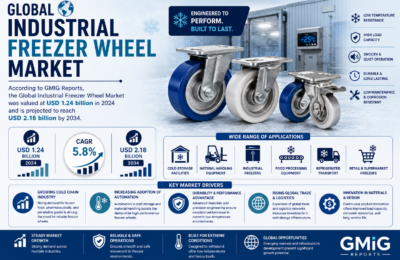
The global industrial freezer wheel market was valued at USD 1.24 billion in 2024 and is projected to grow at a compound annual growth rate (CAGR) of approximately 5.8%, reaching USD 2.18 billion by 2034, according to GMI Reports. Industrial freezer wheels, specifically engineered caster and wheel systems designed to maintain structural integrity, rolling performance, and load-bearing capacity under extreme sub-zero temperature operating conditions, represent a critical and often overlooked enabling component within the global cold storage, food processing, pharmaceutical cold chain, and industrial freezer facility infrastructure ecosystem.
Standard industrial casters and wheels manufactured for ambient temperature applications experience significant material performance degradation when subjected to freezer and cold storage operating temperatures ranging from 0°C to -40°C, with conventional lubricants solidifying, standard thermoplastic wheel compounds becoming brittle and prone to cracking, and bearing seal materials contracting and losing sealing effectiveness. Industrial freezer wheels address these performance failure modes through specialized material selection, bearing configuration, lubrication formulation, and seal design enabling reliable continuous operation across sustained extreme cold temperature cycling conditions.
The market is experiencing accelerating growth driven by rapid global cold chain infrastructure expansion, stringent food safety and pharmaceutical storage temperature compliance requirements, and growing e-commerce food delivery demand creating significant new cold storage facility investment across emerging market economies. The shift toward automated cold storage facilities incorporating automated guided vehicles and robotic picking systems is additionally driving demand for precision-engineered high-performance freezer wheel systems capable of supporting autonomous equipment operation requirements.
Market Overview
The global industrial freezer wheel market encompasses specialized caster assemblies, rigid and swivel wheel units, and associated mounting hardware specifically engineered for continuous operation in refrigerated and frozen storage environments. These products serve material handling equipment including pallet jacks, hand trucks, trolleys, racks, and automated guided vehicles operating within cold rooms, blast freezers, cryogenic storage facilities, and temperature-controlled pharmaceutical and food processing environments maintaining sustained temperatures from -5°C through -40°C and below.
Freezer wheel products are differentiated from standard industrial wheels across multiple engineering dimensions: wheel tread compound selection emphasizing low-temperature flexibility retention to prevent brittle fracture under load; bearing lubrication formulation using synthetic lubricants maintaining viscosity and protective film formation at sub-zero temperatures where conventional petroleum-based lubricants would solidify; bearing seal material selection using cold-temperature-stable elastomers preventing moisture ingress and ice formation within bearing raceways; and hub and bracket material specifications accommodating thermal contraction without mechanical interference or dimensional tolerance violation.
The market serves end-users across food processing and cold storage, pharmaceutical and biopharmaceutical cold chain, chemical and industrial refrigeration, and retail grocery cold chain applications, with facility operators and material handling equipment manufacturers as the primary purchasing decision-makers within the value chain. Growing regulatory emphasis on food safety temperature management and pharmaceutical cold chain GMP compliance requirements is elevating the technical specification rigor applied to cold storage material handling equipment, increasing demand for documented and validated cold-temperature-rated wheel and caster system performance.
Market Size & Forecast
Market Driving Factors
1. Rapid Global Cold Chain Infrastructure Expansion
Accelerating global investment in cold storage warehouse construction, driven by food safety regulation compliance requirements, pharmaceutical cold chain expansion, and e-commerce food delivery infrastructure development, is generating substantial and growing demand for industrial freezer wheels across new facility equipment outfitting and replacement purchasing cycles. Emerging market cold chain infrastructure buildout, particularly across India, Southeast Asia, and Latin America, is driving particularly significant incremental demand growth beyond established cold chain market replacement cycle activity.
2. Stringent Food Safety and Regulatory Compliance Requirements
Increasingly stringent global food safety regulatory requirements, including FDA Food Safety Modernization Act provisions, EU food hygiene regulation, and equivalent national food safety standards across major markets, mandate rigorous temperature management and material handling equipment hygiene standards within food processing and cold storage facilities. These regulatory requirements elevate the technical documentation and performance certification expectations applied to freezer wheel specifications, supporting demand for validated, documented cold-temperature-rated systems from established specialist manufacturers.
3. Pharmaceutical Cold Chain GMP Compliance Investment
The rapid expansion of pharmaceutical cold chain infrastructure supporting biologic drug, mRNA vaccine, and cell and gene therapy product distribution, combined with stringent GMP cold chain equipment qualification requirements, is driving significant demand for validated, documented pharmaceutical-grade freezer wheel and caster systems within cGMP cold storage facility environments. This pharmaceutical cold chain application represents a high-value, technically demanding market segment commanding premium pricing relative to food industry standard applications.
4. Automated Cold Storage and AGV Integration Demand
The accelerating adoption of automated storage and retrieval systems and autonomous guided vehicle technology within cold storage facilities is generating specialized demand for high-precision, high-durability freezer wheel systems capable of supporting autonomous equipment operational requirements, including precise dimensional tolerances, predictable rolling resistance characteristics, and extended service life enabling maintenance-interval planning within automated facility operation schedules.
5. E-Commerce Cold Chain and Last-Mile Refrigeration Growth
Explosive growth in e-commerce food and grocery delivery infrastructure, including temperature-controlled fulfillment centers, last-mile delivery vehicle refrigeration, and urban cold store micro-fulfillment facilities, has created significant new cold storage material handling equipment demand across a broad range of facility types and operational scales, generating corresponding industrial freezer wheel market demand across both high-volume standardized and custom-specified application categories.
6. Replacement and Maintenance Market Stability
The substantial global installed base of cold storage material handling equipment requiring periodic freezer wheel replacement due to normal wear, seal failure, and bearing degradation under demanding cold-cycling operation provides a stable and recurring aftermarket replacement demand stream that complements new facility equipment outfitting demand, supporting market revenue stability across periods of new construction activity fluctuation.
Market Restraining Factors
1. Premium Cost Relative to Standard Industrial Wheels
Specialized industrial freezer wheels carry meaningful price premiums relative to standard ambient-temperature industrial caster and wheel products, reflecting the additional engineering investment in cold-temperature-optimized materials, specialized lubricants, and enhanced seal specifications. This cost differential creates budget pressure within cold storage facility equipment procurement processes and can drive substitution toward standard wheels with inadequate cold-temperature performance in cost-sensitive applications, resulting in premature failure and higher total replacement cost over time.
2. Limited End-User Awareness of Specialized Cold-Temperature Requirements
Significant portions of cold storage facility operators and material handling equipment purchasers underestimate or are unaware of the specific engineering requirements for wheel and caster systems operating in sub-zero temperature environments, resulting in specification of standard industrial wheels that experience premature failure under cold-temperature operating conditions. This awareness gap creates both a market development education challenge and a barrier to replacing failed standard wheel installations with appropriately specified freezer wheel products.
3. Consolidation Among Material Handling Equipment OEMs
Ongoing consolidation among material handling equipment original equipment manufacturers, as major pallet jack, hand truck, and industrial trolley manufacturers concentrate purchasing through fewer qualified supplier relationships, can create market access barriers for smaller specialized freezer wheel manufacturers seeking OEM specification opportunities and reduce price competition within preferred supplier arrangements.
4. Supply Chain Disruptions Affecting Specialty Materials
Industrial freezer wheel manufacturing depends on specialty materials including high-performance synthetic lubricants, cold-temperature elastomer compounds for seals, and engineering thermoplastic compounds retaining flexibility at sub-zero temperatures, which can experience supply chain disruption and price volatility affecting production cost stability and product availability during periods of specialty chemical and polymer supply chain disruption.
Market Segmentation
By Wheel Type
Swivel caster freezer wheels retain the dominant market share, reflecting their essential role in maneuverability for hand trucks, trolleys, and mobile rack systems within cold storage operational environments requiring frequent directional change and tight-space navigation. Rigid caster freezer wheels provide directional stability for heavier load applications including pallet jack rear wheels and power equipment guidance wheel configurations.
By Material
Polyurethane remains the dominant wheel tread material for freezer applications, valued for its retention of elasticity and load-bearing compliance at sub-zero temperatures relative to harder thermoplastic compounds that become brittle and prone to cracking under cold and load-cycling conditions. Vulkollan and premium elastomer compounds command the highest pricing and are specified for the most demanding pharmaceutical and high-cycle industrial freezer applications.
By End-Use Industry
Competitive Landscape
The global industrial freezer wheel market features a combination of major diversified industrial caster and wheel manufacturers with dedicated cold-temperature product lines, specialized freezer wheel manufacturers focused exclusively on cold-storage applications, and regional manufacturers serving specific geographic and industry segment markets. Competitive differentiation centers on cold-temperature performance validation data, material certification documentation, custom specification capability, and distributor network accessibility.
Regional Analysis
Europe represents the largest industrial freezer wheel market, reflecting the region’s mature cold chain infrastructure, stringent food safety and pharmaceutical regulatory environment driving high-specification equipment adoption, and the concentration of major specialized caster and wheel manufacturing companies within Germany and surrounding countries. North America and Asia Pacific represent substantial and rapidly growing regional markets.
Emerging Market Trends
Stainless Steel and Hygienic Design Specification Growth
Growing demand for stainless steel bracket and housing freezer caster systems complying with hygienic design standards including EHEDG and NSF/ANSI 169, enabling effective cleaning and sanitization within food processing cold environments, reflects the increasing application of hygienic engineering principles to all material handling equipment components within HACCP-managed food processing and cold storage facilities, creating demand for premium stainless construction freezer wheel systems beyond the traditional steel and zinc-plated standard configurations.
Predictive Maintenance Integration for Cold Storage Automation
Growing integration of condition monitoring sensor capability within industrial freezer wheel and caster assemblies, enabling bearing temperature, vibration, and rolling resistance deviation detection supporting predictive maintenance scheduling within automated cold storage operations, represents an emerging technology development direction reflecting the broader industrial IoT and predictive maintenance trend within cold chain facility automation investment.
Ultra-Low Temperature and Cryogenic Application Development
Growing demand for specialized wheel and caster systems capable of operating reliably at cryogenic temperatures below -80°C, driven by expanding liquid nitrogen storage, ultra-low temperature pharmaceutical freezer, and LNG facility material handling requirements, is creating a specialized ultra-high-performance market segment requiring materials including PTFE and specialty stainless alloys maintaining mechanical properties at extreme cryogenic temperature conditions well beyond conventional freezer wheel operational ranges.
Sustainability and Longevity-Focused Procurement
Growing cold storage facility operator emphasis on total cost of ownership over product lifecycle and sustainability credential consideration in equipment procurement is supporting demand for premium-specification, longer-service-life industrial freezer wheel systems despite higher initial purchase cost, as procurement decision-makers increasingly quantify replacement frequency, labor cost of wheel change-outs, and production downtime costs in overall wheel system economic evaluation.
Emerging Market Cold Chain Infrastructure Standardization
Rapid cold chain infrastructure development across emerging markets in India, Southeast Asia, Latin America, and Africa is progressively adopting international food safety and GMP regulatory standards that elevate material handling equipment specification requirements toward established developed market benchmarks, driving demand for certified, documented industrial freezer wheel systems beyond the historically prevalent standard wheel substitution practice within these developing cold chain markets.
Key Companies in the Industrial Freezer Wheel Market
-
Blickle GmbH & Co. KG
-
Tente International GmbH
-
Colson Group USA
-
Darcor Casters & Wheels
-
RWM Casters
-
Hamilton Caster & Manufacturing
-
Wicke GmbH & Co. KG
-
Elesa+Ganter GmbH
-
Steinco Paul vom Stein GmbH
-
Vulkollan (Bayer MaterialScience licensed compounds)
-
Regional Asian Specialty Caster Manufacturers
Report Target Audience
-
Industrial Caster and Wheel Manufacturers
-
Cold Storage Facility Developers and Operators
-
Food Processing and Cold Chain Companies
-
Pharmaceutical and Biopharmaceutical Cold Chain Operators
-
Material Handling Equipment Manufacturers (OEMs)
-
Investment and Private Equity Firms
-
Industrial Distribution Companies
-
Management and Strategy Consultants
Market Segmentation Summary
By Wheel Type
-
Swivel Caster Freezer Wheels
-
Rigid Caster Freezer Wheels
-
Fixed Axle Freezer Wheels
By Material
-
Polyurethane (PU)
-
Nylon/Polyamide
-
Vulkollan/Premium Elastomer
-
Polypropylene
By End-Use Industry
-
Food Processing & Cold Storage
-
Pharmaceutical & Biopharmaceutical
-
Retail Grocery Cold Chain
-
Chemical & Industrial Refrigeration
By Region
-
Europe
-
North America
-
Asia Pacific
-
Latin America
-
Middle East & Africa
About GMI Reports
GMI Reports is a premier market intelligence and research organization providing data-driven insights and strategic analysis across global industrial components, cold chain, and material handling markets. Our research empowers manufacturers, distributors, and investors to navigate the evolving industrial freezer wheel market landscape with confidence. For the Industrial Freezer Wheel Market report and related research, visit www.gmigreports.com or contact our research team for customized intelligence solutions.
www.gmigreports.com
© 2025 GMI Reports. All Rights Reserved. Unauthorized reproduction or distribution is strictly prohibited.