MARKET RESEARCH REPORT
Recumbent Bicycle Market
Global Insights, Analysis & Forecasts to 2034
Published by GMI Reports | www.gmigreports.com
Executive Summary
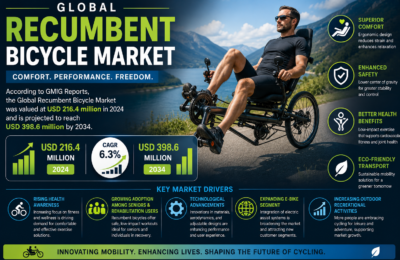
The global recumbent bicycle market was valued at USD 216.4 million in 2024 and is projected to grow at a compound annual growth rate (CAGR) of approximately 6.3%, reaching USD 398.6 million by 2034, according to GMI Reports. Recumbent bicycles, characterized by their reclining seating position that distributes rider weight across a larger contact area compared to conventional upright bicycles, occupy a specialized and growing niche within the broader global cycling market, appealing to riders prioritizing ergonomic comfort, reduced joint stress, and aerodynamic performance advantages over traditional bicycle configurations.
The recumbent bicycle market has experienced renewed growth momentum driven by several converging trends including an aging global population increasingly seeking low-impact cycling alternatives that accommodate musculoskeletal limitations, growing rehabilitation and adaptive cycling awareness supporting recumbent bicycle adoption within therapeutic and mobility assistance contexts, and the expanding electric bicycle integration opportunity enabling electrified recumbent configurations that significantly extend practical range and accessibility for older and physically limited riders.
Europe, particularly the Netherlands, Germany, and Scandinavia, represents the largest and most established recumbent bicycle market globally, reflecting these regions’ deep cycling culture, flat terrain favorable to recumbent configurations, and strong consumer openness toward cycling innovation. North America represents a significant secondary market anchored by an enthusiastic recumbent cycling community, growing adaptive cycling program adoption, and emerging mainstream interest in ergonomic cycling alternatives.
Market Overview
The global recumbent bicycle market encompasses two-wheeled recumbent bicycles, three-wheeled recumbent tricycles, and tandem recumbent configurations, spanning conventional human-powered and increasingly significant electrically-assisted recumbent variants. The market serves recreational cycling enthusiasts, long-distance touring riders, competitive recumbent racing participants, rehabilitation and adaptive mobility users, and increasingly commuters seeking ergonomically comfortable bicycle alternatives for urban and suburban travel.
Recumbent bicycles differ fundamentally from conventional upright bicycles in their seating geometry, with the rider positioned in a semi-reclined or fully reclined posture with the pedals at approximately the same height or above the rider’s seat. This geometry delivers several measurable performance and comfort advantages, including reduced wind resistance through improved aerodynamic body positioning, distribution of rider weight across the back and buttocks rather than the perineal region, reduced wrist and neck strain, and lower center of gravity stability benefits particularly relevant for tricycle configurations.
The recumbent bicycle market remains a specialized segment within the broader cycling industry, characterized by a relatively small number of dedicated manufacturers, a passionate and technically engaged consumer community, premium pricing relative to equivalent conventional bicycle categories, and limited mainstream retail distribution compared to conventional bicycle channels. This specialization creates both market development challenges and meaningful barriers to entry that have historically supported the viability of niche-focused manufacturers serving a committed enthusiast and therapeutic user base.
Market Size & Forecast
Market Driving Factors
1. Aging Population and Low-Impact Cycling Demand
The global demographic aging trend, particularly pronounced within Europe, North America, and Japan, is creating significant structural demand growth for recumbent bicycles as older adults with musculoskeletal limitations, reduced core strength, or joint discomfort seek cycling alternatives that enable continued physical activity engagement without the postural strain associated with conventional upright bicycle configurations. Recumbent bicycles’ ergonomic advantages are particularly compelling for aging cyclists maintaining active outdoor recreation lifestyles.
2. Electric Recumbent Bicycle Integration Expanding Accessibility
The integration of electric pedal-assist systems into recumbent bicycle configurations has substantially expanded the practical accessibility and appeal of recumbent cycling for riders who might otherwise find sustained pedaling effort on recumbent configurations challenging. Electric-assist recumbent bicycles address range anxiety, headwind performance, and gradient climbing limitations, enabling older and less physically conditioned riders to enjoy recumbent cycling’s comfort advantages without performance compromise relative to conventional electric bicycle alternatives.
3. Rehabilitation and Adaptive Cycling Awareness Growth
Growing healthcare provider awareness of cycling’s rehabilitation benefits for cardiovascular health maintenance, lower limb strength development, and mobility restoration has increased recumbent bicycle prescription and recommendation within physiotherapy, cardiac rehabilitation, and adaptive sports program contexts. Recumbent tricycle configurations are particularly valued within rehabilitation settings given their inherent stability, which eliminates balance skill requirements that can exclude patients with neurological or vestibular function limitations from cycling participation.
4. Long-Distance Touring and Cycling Tourism Enthusiasm
The global growth of long-distance cycling tourism and bikepacking culture has introduced recumbent bicycles to adventurous touring cyclists attracted by their superior long-distance comfort characteristics, aerodynamic efficiency advantages reducing energy expenditure over multi-day journeys, and load-carrying capacity that accommodates touring luggage configurations. Online communities and high-profile recumbent touring journey documentation have raised the technology’s profile among cycling enthusiasts considering transcontinental and extended touring adventures.
5. Cycling Infrastructure Expansion in Key Markets
Continued expansion of dedicated cycling infrastructure including protected bicycle lanes, multi-use paths, and cycling-friendly urban design across European and increasingly North American cities is improving recumbent bicycle practical usability within urban and suburban environments, addressing some of the road-sharing visibility and traffic integration challenges that have historically limited recumbent adoption in bicycle-hostile infrastructure environments.
6. Growing E-Commerce and Direct-to-Consumer Market Access
The expansion of e-commerce distribution channels has substantially improved recumbent bicycle market accessibility for consumers in regions without dedicated recumbent specialty retailers, enabling direct-to-consumer purchasing from specialist manufacturers and reducing the geographic constraint that historically limited recumbent bicycle market development outside areas with physical specialty retail infrastructure.
Market Restraining Factors
1. Visibility and Traffic Safety Perception Concerns
Recumbent bicycles’ lower riding height relative to conventional upright bicycles creates genuine and perceived traffic visibility concerns among prospective riders evaluating road cycling safety, particularly in mixed-traffic environments without dedicated cycling infrastructure. This visibility consideration requires active mitigation through flag and lighting accessories and remains a meaningful adoption barrier for consumers prioritizing perceived road safety in bicycle purchase decisions.
2. Premium Pricing and Limited Mass Market Accessibility
Quality recumbent bicycles command substantial price premiums relative to equivalent conventional bicycle categories, reflecting low manufacturing volume economics, specialized component requirements, and the limited competitive pressure associated with a niche market structure served by a small number of dedicated manufacturers. This premium pricing constrains recumbent bicycle adoption among price-sensitive consumers who might otherwise benefit from the ergonomic advantages the technology delivers.
3. Limited Mainstream Retail Availability and Test-Ride Opportunity
The absence of recumbent bicycle inventory within mainstream bicycle retail channels in most markets, and the resulting limited consumer opportunity to test-ride recumbent configurations before purchasing, creates a significant awareness and trial barrier. Many consumers remain unfamiliar with recumbent bicycle handling characteristics that differ meaningfully from conventional bicycle experience, and purchase commitment without physical trial evaluation is a meaningful consumer hesitancy factor.
4. Storage, Transportation, and Urban Practicality Limitations
Recumbent bicycles’ generally longer overall length relative to conventional bicycles creates storage and urban transportation challenges, including difficulty with standard bicycle parking infrastructure, public transit cycle carriage restrictions, and apartment storage space constraints that reduce practical appeal for urban dwellers without dedicated bicycle storage space. Folding and compact recumbent designs partially address these constraints but represent a small fraction of total market offering.
Market Segmentation
By Type
Two-wheeled recumbent bicycles retain the largest market share, appealing to performance-oriented and sport touring riders valuing aerodynamic efficiency and lightweight configurations. Recumbent tricycles are projected to gain proportional market share, driven by growing adoption within older adult, rehabilitation, and adaptive cycling segments where the tricycle’s inherent three-point stability eliminates balance skill requirements and significantly broadens practical user accessibility.
By Drive Type
Conventional human-powered recumbent bicycles retain the majority market share within the established enthusiast and performance segment. Electric-assist recumbent configurations represent the fastest-growing drive type category, driven by the intersection of expanding electric bicycle adoption trends with recumbent cycling’s particular appeal to older and less physically conditioned rider demographics for whom pedal-assist functionality provides compelling practical value.
By Application
Competitive Landscape
The global recumbent bicycle market is characterized by a small number of specialist manufacturers with deep engineering expertise and dedicated customer communities, alongside a handful of broader cycling companies with recumbent product lines. The market’s niche nature has historically sustained a craftsmanship-oriented manufacturer ecosystem where brand loyalty, technical reputation, and community engagement are central competitive differentiators.
Regional Analysis
Europe represents the largest and most established recumbent bicycle market globally, reflecting the continent’s deep cycling culture, extensive dedicated cycling infrastructure, and strong consumer openness toward cycling innovation particularly within the Netherlands, Germany, and Scandinavia. North America represents a significant secondary market with passionate enthusiast communities and growing adaptive cycling program adoption.
Emerging Market Trends
Electric Recumbent Tricycle for Older Adult Mobility
Electric-assist recumbent tricycles are emerging as a significant mobility solution for older adults seeking to maintain active outdoor transportation independence beyond the practical usability limit of conventional upright cycling. Several European and North American manufacturers have developed dedicated older adult-oriented electric recumbent trike product lines featuring step-through accessibility, automatic stability, and simplified controls specifically addressing older rider ergonomic and usability requirements.
Velomobile and Fully Faired Recumbent Development
Growing interest in fully faired recumbent velomobiles, enclosing the rider within an aerodynamic shell for all-weather cycling capability, is attracting growing consumer interest as a genuine car-replacement urban mobility solution for committed cycling commuters. Velomobile manufacturers including Alleweder, Quattrovelo, and WAW are expanding production capacity in response to growing order backlogs reflecting increasing velomobile market interest.
Recumbent Bicycle Rental and Tourism Program Expansion
Growing cycling tourism destination development of recumbent bicycle rental programs, offering visitors the experience of flat-terrain cycling on recumbent configurations without requiring personal ownership, is building broader consumer familiarity with recumbent cycling’s comfort advantages, serving as an effective conversion pathway toward eventual ownership consideration among consumers introduced to recumbent cycling through rental trial.
Adaptive Recumbent Cycling Paralympic and Paracycling Growth
Growing investment in Paralympic and paracycling program development, including competitive recumbent handcycle and tricycle categories, is raising recumbent cycling’s visibility and cultural profile within adaptive sports communities. Increased media coverage of competitive recumbent adaptive cycling events supports broader awareness and aspiration within disability sport participation communities.
Carbon Fiber and Lightweight Material Innovation
Continued material science advancement applied to recumbent bicycle frame construction, including growing adoption of carbon fiber composite frame manufacturing and titanium tubing alternatives to traditional steel and aluminum construction, is enabling meaningful weight reduction that partially addresses the weight disadvantage recumbent configurations have historically carried relative to lightweight conventional bicycle alternatives, expanding performance appeal among weight-conscious touring and sport riders.
Key Companies in the Recumbent Bicycle Market
-
HP Velotechnik
-
Hase Bikes
-
ICE (Inspired Cycle Engineering)
-
Catrike
-
TerraTrike
-
Challenge Recumbents
-
M5 Ligfietsen
-
RANS Bikes
-
Performer Recumbents
-
Bacchetta Bicycles
-
Velokraft
Report Target Audience
-
Recumbent Bicycle Manufacturers and Component Suppliers
-
Specialty Bicycle Retailers and Distributors
-
Investment and Private Equity Firms
-
Rehabilitation and Adaptive Sports Organizations
-
Cycling Tourism and Recreation Program Operators
-
E-Bike and Micro-Mobility Technology Companies
-
Management and Strategy Consultants
-
Academic Researchers in Ergonomics, Sports Science, and Mobility
Market Segmentation Summary
By Type
-
Two-Wheeled Recumbent Bicycle
-
Three-Wheeled Recumbent Tricycle
-
Tandem Recumbent
By Drive Type
-
Conventional (Human-Powered)
-
Electric-Assist (E-Recumbent)
By Application
-
Recreation & Leisure
-
Long-Distance Touring
-
Rehabilitation & Adaptive
-
Commuting
By Region
-
Europe
-
North America
-
Asia Pacific
-
Rest of World
About GMI Reports
GMI Reports is a premier market intelligence and research organization providing data-driven insights and strategic analysis across global cycling, mobility, and consumer goods markets. Our research empowers manufacturers, retailers, and investors to navigate the evolving recumbent bicycle market landscape with confidence. For the Recumbent Bicycle Market report and related research, visit www.gmigreports.com or contact our research team for customized intelligence solutions.
www.gmigreports.com