MARKET RESEARCH REPORT
Construction Equipment Repair & Maintenance Service Market
Global Insights, Analysis & Forecasts to 2034
Published by GMI Reports | www.gmigreports.com
Executive Summary
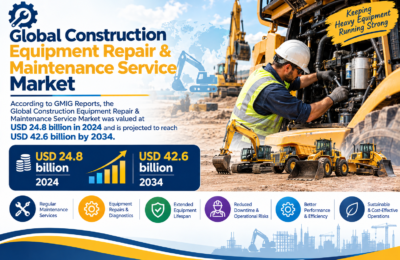
The global construction equipment repair and maintenance service market was valued at USD 24.8 billion in 2024 and is projected to grow at a compound annual growth rate (CAGR) of approximately 5.5%, reaching USD 42.6 billion by 2034, according to GMI Reports. The construction equipment repair and maintenance service market encompasses a broad spectrum of preventive maintenance programs, corrective repair services, parts replacement, component overhaul, telematics-based condition monitoring, and fleet management services delivered across the global construction equipment installed base of earthmoving, lifting, material handling, road building, and concrete equipment.
The market benefits from a uniquely favorable structural dynamic: the global construction equipment installed base is both large and aging, with equipment replacement cycles extending as operators seek to maximize returns on existing fleet investment amid elevated new equipment acquisition costs and supply chain-driven delivery lead times. This fleet age extension trend directly amplifies repair and maintenance service demand, as older equipment requires progressively higher maintenance intensity and more frequent corrective repair intervention to sustain operational availability.
Technological transformation is reshaping the market’s competitive landscape, as telematics-enabled predictive maintenance platforms, remote diagnostics capabilities, and AI-assisted failure prediction tools shift service delivery from reactive breakdown response toward proactive, data-driven preventive intervention that reduces unplanned downtime, extends component life, and improves total fleet operating cost economics for construction equipment owners and fleet operators.
Market Overview
The global construction equipment repair and maintenance service market encompasses OEM dealer service networks, independent service providers, equipment rental company in-house maintenance operations, and contractor-operated fleet maintenance programs delivering scheduled preventive maintenance, breakdown repair, hydraulic system service, engine overhaul, undercarriage replacement, electrical diagnostics, and component rebuild services across excavators, bulldozers, cranes, loaders, graders, compactors, concrete equipment, and aerial work platforms.
Service delivery models span traditional workshop-based repair at dealer service centers, mobile field service teams conducting on-site preventive maintenance and breakdown response, remote diagnostics and telematics monitoring center operations, and increasingly sophisticated predictive maintenance programs integrating real-time machine health data from embedded telematics systems with AI-powered failure prediction algorithms enabling proactive intervention before equipment failure occurs. These data-driven service models represent the market’s most significant structural evolution.
The market’s competitive structure reflects a three-tier provider landscape: OEM-affiliated dealer service networks delivering warranty and post-warranty service with proprietary parts and diagnostic tool access advantages; independent service providers competing on price, flexibility, and geographic accessibility outside dealer network coverage areas; and growing specialized fleet management and maintenance outsourcing companies providing comprehensive equipment lifecycle management programs to large construction companies and infrastructure developers seeking to outsource fleet maintenance complexity.
Market Size & Forecast
Market Driving Factors
1. Aging Global Construction Equipment Installed Base
The global construction equipment installed base is aging, with average fleet age increasing across major markets as elevated new equipment prices, extended OEM delivery lead times, and operator focus on maximizing existing asset returns delay replacement purchasing cycles. This aging fleet dynamic directly drives increasing repair and maintenance service demand intensity, as equipment beyond the five-year age threshold typically requires 30-50% higher annual maintenance expenditure than newer equipment to sustain comparable operational availability.
2. Construction Activity Growth Across Emerging Markets
Sustained construction and infrastructure development activity across Asia Pacific, the Middle East, Africa, and Latin America is expanding the global construction equipment installed base supporting long-term service market demand growth. Major infrastructure investment programs including India’s National Infrastructure Pipeline, Southeast Asian transport corridor development, Middle Eastern megaproject activity, and African road network expansion are generating both new equipment deployment and associated service demand across these rapidly developing construction markets.
3. Telematics and Predictive Maintenance Adoption
Rapid adoption of telematics-enabled machine health monitoring, remote diagnostics, and predictive maintenance platforms across major OEM and large fleet operator service programs is transforming service delivery economics and value proposition. Predictive maintenance programs demonstrating 20-30% reduction in unplanned downtime and 15-25% maintenance cost reduction versus reactive service models create compelling ROI justification for service contract adoption while shifting market revenue mix toward higher-value data-driven service programs.
4. Equipment Rental Fleet Maintenance Demand
The global construction equipment rental market’s continued expansion, with rental companies operating large and rapidly depreciating equipment fleets requiring intensive preventive maintenance programs to sustain utilization rates and asset residual value, generates substantial and growing repair and maintenance service demand. Rental companies’ disciplined asset management approach and high equipment utilization intensity create proportionally elevated service expenditure relative to contractor-owned fleet operators.
5. Infrastructure Upgrade and Maintenance Program Investment
Growing government investment in road network rehabilitation, bridge inspection and repair, water infrastructure maintenance, and aging urban infrastructure upgrade programs across both developed and developing markets creates sustained construction equipment deployment demand in maintenance and rehabilitation applications that require high equipment reliability and generate consistent service demand distinct from new infrastructure construction project cycles.
6. Skilled Technician Shortage Driving Outsourced Service Adoption
Widespread skilled heavy equipment technician shortage affecting construction companies’ in-house maintenance capability across major markets is driving growing adoption of outsourced maintenance service contracts with OEM dealer networks and independent service providers. This talent shortage creates commercial opportunity for specialist service providers while elevating the strategic importance of technician recruitment, training, and retention as a core competitive capability within the repair and maintenance service market.
Market Restraining Factors
1. Counterfeit and Non-OEM Parts Market Competition
The widespread availability of counterfeit and low-cost non-OEM replacement parts, particularly prevalent within emerging market service ecosystems, creates meaningful price competition pressure and margin erosion risk within the parts supply component of the repair and maintenance service value chain. Non-OEM parts adoption can compromise equipment reliability and safety outcomes while reducing legitimate parts supplier and OEM dealer revenue from parts margin contribution.
2. In-House Maintenance Capability Among Large Contractors
Many large construction companies and infrastructure operators maintain substantial in-house equipment maintenance capability, employing dedicated fleet technicians, operating company-owned service workshops, and managing proprietary parts inventory programs that reduce dependence on external service providers for routine maintenance and common repair work categories. This in-house capability concentration among the largest and most valuable fleet operator market segments limits external service addressable market penetration.
3. Cyclical Construction Market Revenue Sensitivity
Construction equipment service market revenue exhibits meaningful sensitivity to construction activity cycle fluctuations, as equipment utilization rate reduction during construction sector downturns translates into reduced maintenance frequency, deferred non-critical repair work, and extended service interval stretching among cost-pressured operators seeking to reduce operating expenditure during periods of reduced project revenue. These cyclical demand moderation patterns introduce revenue variability risk within service provider financial planning.
4. Remote Location Service Access Challenges
Construction projects in remote, geographically challenging, or politically complex operating environments create meaningful logistical difficulty for timely equipment service delivery, requiring service providers to maintain mobile service unit capability, manage complex parts logistics to remote locations, and retain technicians willing to work in challenging field service contexts. These remote access challenges can result in extended equipment downtime and elevated service delivery cost in affected markets.
Market Segmentation
By Service Type
Preventive maintenance retains the dominant service type market share and is projected to further strengthen this position as telematics-enabled predictive maintenance programs shift service expenditure from reactive breakdown response toward proactive scheduled intervention. Corrective repair is projected to decline proportionally as predictive maintenance adoption reduces unplanned equipment failure frequency. Telematics and diagnostic services represent the fastest-growing service type, driven by OEM and independent provider investment in data-driven service platform development.
By Equipment Type
Earthmoving equipment retains the dominant service revenue share, reflecting the category’s position as the largest global construction equipment fleet segment by unit count. Lifting equipment generates proportionally elevated service revenue per unit relative to fleet size, reflecting the safety-critical nature of crane and aerial work platform inspection and certification requirements mandating regular formal service intervention independent of equipment condition.
By Provider Type
Competitive Landscape
The global construction equipment repair and maintenance service market features OEM manufacturer dealer service network programs as the dominant service delivery channel for warranty and near-warranty equipment, complemented by extensive independent service provider ecosystems competing across geographic coverage, pricing flexibility, and multi-brand service capability. Growing fleet management outsourcing specialists are developing as a significant third competitive category.
Regional Analysis
Asia Pacific represents the largest and fastest-growing regional construction equipment repair and maintenance service market, reflecting the region’s massive construction equipment installed base across China, India, and Southeast Asia and substantial ongoing infrastructure development activity driving high equipment utilization and service intensity. North America and Europe represent mature and technologically sophisticated service markets with high OEM dealer penetration.
Emerging Market Trends
AI-Powered Predictive Failure Analytics
Leading OEMs and independent service technology companies are investing significantly in AI and machine learning-powered equipment failure prediction platforms, analyzing telematics sensor data streams including oil pressure, temperature, vibration, and hydraulic pressure patterns to identify early failure precursor signatures enabling proactive component replacement before functional failure occurs. These platforms are demonstrating meaningful reduction in unplanned downtime and maintenance cost outcomes that are driving rapid adoption among fleet-intensive equipment operators.
Augmented Reality Remote Diagnostic Assistance
Growing deployment of augmented reality remote diagnostic assistance platforms, enabling experienced service engineers to provide real-time visual guidance to less experienced field technicians through connected smart glasses or tablet interfaces, is improving first-time repair success rates, reducing technician experience requirement for complex diagnostic work, and enabling service coverage extension into geographic areas lacking locally available specialist technician expertise.
Electric Construction Equipment Service Ecosystem Development
The emerging adoption of electric and hybrid construction equipment across compact machinery categories is requiring service network investment in electric powertrain diagnostic capability, battery health monitoring expertise, and high-voltage safety training for service technicians. OEM dealer networks and independent service providers are proactively investing in electric equipment service capability development anticipating the growing service revenue opportunity associated with expanding electric construction equipment fleet volumes through the forecast period.
Fleet Management Outsourcing and Total Cost of Ownership Programs
Growing construction company and contractor adoption of comprehensive fleet management outsourcing programs, transferring total equipment lifecycle management responsibility — including maintenance scheduling, repair authorization, parts procurement, and asset disposal — to specialist fleet management service providers, is creating significant market revenue expansion opportunity for service providers capable of delivering comprehensive, outcome-guaranteed fleet performance programs beyond traditional time-and-materials service delivery models.
Mobile Workshop and On-Site Service Unit Deployment Growth
Investment in advanced mobile workshop vehicle capability, incorporating comprehensive diagnostic equipment, essential parts inventory, and tooling enabling complex repair work completion at remote construction sites, is improving service responsiveness and reducing equipment transportation cost for breakdown and major maintenance work previously requiring workshop-based service. Mobile service capability has become a key competitive differentiator for service providers serving large civil infrastructure and mining-adjacent construction projects.
Key Companies in the Construction Equipment R&M Service Market
-
Caterpillar Inc. (Cat Dealer Network)
-
Komatsu Ltd. (KOMTRAX & Dealer Services)
-
Volvo Construction Equipment (Volvo CE Care)
-
Hitachi Construction Machinery (ConSite)
-
Liebherr Group
-
Doosan Bobcat
-
United Rentals (Fleet Maintenance)
-
Herc Rentals (Fleet Maintenance)
-
Genie / Terex Service Programs
-
XCMG Group (China Service Network)
-
Independent Regional Heavy Equipment Service Providers
Report Target Audience
-
Construction Equipment OEMs and Dealer Networks
-
Independent Equipment Service Providers
-
Construction Equipment Rental Companies
-
Large Construction and Infrastructure Contractors
-
Investment and Private Equity Firms
-
Fleet Management Technology Companies
-
Management and Strategy Consultants
-
Academic and Construction Engineering Research Institutions
Market Segmentation Summary
By Service Type
-
Preventive Maintenance
-
Corrective/Breakdown Repair
-
Component Overhaul & Rebuild
-
Telematics & Diagnostic Services
By Equipment Type
-
Earthmoving Equipment
-
Lifting Equipment (Cranes & AWPs)
-
Road Building Equipment
-
Concrete & Material Handling Equipment
By Provider Type
-
OEM Dealer Service Networks
-
Independent Service Providers
-
Rental Company In-House Maintenance
By Region
-
Asia Pacific
-
North America
-
Europe
-
Middle East & Africa
-
Latin America
About GMI Reports
GMI Reports is a premier market intelligence and research organization providing data-driven insights and strategic analysis across global construction, industrial equipment, and aftermarket services markets. Our research empowers OEMs, service providers, and investors to navigate the evolving construction equipment maintenance landscape with confidence. For the Construction Equipment Repair & Maintenance Service Market report and related research, visit www.gmigreports.com or contact our research team for customized intelligence solutions.
www.gmigreports.com