MARKET RESEARCH REPORT
Modular & Prefabricated Construction Market
Global Insights, Analysis & Forecasts to 2034
Published by GMI Reports | www.gmigreports.com
Executive Summary
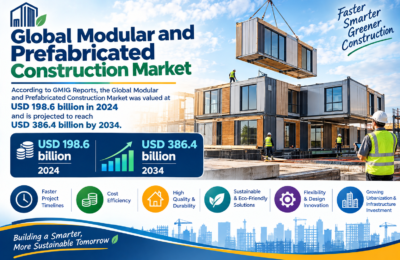
The global modular and prefabricated construction market was valued at USD 198.6 billion in 2024 and is projected to grow at a compound annual growth rate (CAGR) of approximately 6.9%, reaching USD 386.4 billion by 2034, according to GMI Reports. The modular and prefabricated construction market encompasses volumetric modular construction, panelized prefabrication, pre-engineered building systems, and hybrid construction methods where significant building components are manufactured off-site in factory-controlled environments and subsequently assembled on-site, delivering compressed project timelines, improved construction quality, reduced site labor requirements, and enhanced sustainability performance relative to conventional on-site construction methods.
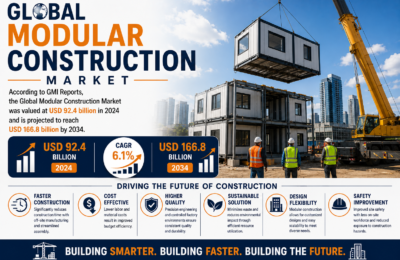
Note: This report specifically covers the broader modular and prefabricated construction market, distinct from the Modular Construction Market report previously published by GMI Reports (covering permanent and relocatable modular construction at USD 92.4 billion in 2024). This report encompasses the full spectrum of prefabrication methodologies including volumetric modular, panelized systems, pre-engineered metal buildings, precast concrete systems, and hybrid DfMA approaches across all building and infrastructure application categories, providing a more comprehensive scope.
The market is at an inflection point driven by the construction industry’s urgent need to address simultaneous challenges of skilled labor shortage, project timeline compression demands, sustainability performance requirements, and affordable housing supply deficits. Modular and prefabricated construction methods offer compelling responses to each of these pressures, positioning the sector for sustained above-industry-average growth across multiple application and geographic market categories through the forecast period.
Market Overview
The global modular and prefabricated construction market encompasses five principal construction methodology categories: volumetric or three-dimensional modular construction, where fully fitted-out room modules are manufactured and transported to site for crane-assisted stacking and connection; panelized construction, where flat structural and enclosure panel elements including wall, floor, and roof panels are factory-manufactured and site-assembled; pre-engineered metal building systems, delivering complete structural steel framing and cladding packages for industrial, commercial, and agricultural buildings; precast concrete construction, using factory-manufactured concrete structural and architectural elements; and hybrid Design for Manufacture and Assembly approaches combining multiple prefabrication methods within integrated project delivery.
The market’s competitive and technological landscape is evolving rapidly, driven by digitalization enabling tighter integration between BIM-based design and factory manufacturing execution, robotic manufacturing automation improving production throughput and precision beyond traditional manual prefabrication methods, and growing developer and government client sophistication in evaluating and specifying prefabricated construction delivery within infrastructure and building procurement frameworks.
Prefabricated construction’s sustainability credentials are increasingly central to its market positioning, as the methodology delivers documented reductions in construction waste generation through optimized factory material utilization, reduced embodied carbon through material efficiency and potential for sustainably sourced timber structural systems, lower site energy consumption and associated emissions, and improved building thermal performance through factory-controlled insulation and airtightness installation relative to variable on-site construction conditions.
Market Size & Forecast
Market Driving Factors
1. Global Skilled Construction Labor Shortage
Persistent and intensifying skilled construction labor shortages across major construction markets globally, driven by aging workforce demographics, declining trade apprenticeship participation, and competition from other industries for available labor, represent the most powerful structural demand driver for modular and prefabricated construction’s factory manufacturing model. Factory-based prefabrication concentrates skilled labor requirements within controlled manufacturing environments while substantially reducing on-site skilled trade hours, directly addressing the labor availability constraint limiting conventional construction project delivery capacity.
2. Affordable Housing Supply Deficit and Speed-to-Market Pressure
Severe affordable housing supply deficits affecting major urban housing markets across North America, Europe, Australia, and increasingly Asia Pacific are driving government and developer urgency for faster housing delivery methodologies. Modular and prefabricated construction’s capacity to compress residential project timelines by 30-50% relative to conventional construction, through parallel site preparation and factory module manufacturing, directly addresses the speed-to-occupancy requirement central to affordable housing delivery programs and represents a compelling value proposition for housing-focused government procurement.
3. Construction Sustainability and Embodied Carbon Requirements
Rapidly tightening whole-life carbon and embodied carbon requirements within construction project specification, driven by net-zero building policy frameworks, green financing conditions, and developer ESG commitment, are creating growing demand for construction methodologies delivering documented sustainability performance advantages. Prefabricated construction’s waste reduction, material efficiency, and mass timber structural system compatibility collectively support strong embodied carbon and construction waste performance relative to conventional construction alternatives.
4. Digitalization and Manufacturing Technology Integration
Accelerating integration of digital design, BIM-to-manufacturing connectivity, robotic fabrication automation, and IoT-enabled quality management within prefabrication factory operations is improving production throughput, dimensional precision, and cost competitiveness, progressively closing the historical cost premium gap between prefabricated and conventional construction that has historically constrained broader adoption. These technology advances are enabling more architecturally complex and specification-demanding building types to be feasibly delivered through prefabrication methodologies.
5. Healthcare, Education, and Data Center Construction Demand
Growing construction demand for healthcare facilities, education buildings, and particularly data center infrastructure across global markets is creating substantial prefabricated construction demand within these application categories where compressed delivery timelines, controlled quality outcomes, and minimal operational disruption during construction are particularly high-priority client requirements. Data center MEP prefabrication and modular data center unit delivery have become established best practices within the hyperscale data center construction sector.
6. Emerging Market Urbanization and Infrastructure Investment
Rapid urbanization and infrastructure investment across Asia Pacific, Africa, and the Middle East is creating enormous construction volume demand that conventional on-site construction methods face challenges addressing at required scale and timeline. Prefabricated construction methods, particularly pre-engineered metal building systems and precast concrete infrastructure elements, offer practical solutions for meeting construction volume requirements within constrained timeframes and skilled labor availability contexts characteristic of rapidly urbanizing developing economy construction markets.
Market Restraining Factors
1. High Manufacturing Facility Capital Investment
Establishing volumetric modular or advanced panelized prefabrication manufacturing capability requires substantial upfront capital investment in factory facilities, specialized manufacturing equipment, transportation infrastructure, and trained workforce that represents meaningful market entry barriers and constrains existing participants’ capacity expansion pace relative to market demand growth. This capital intensity creates financing risk and return-on-investment uncertainty that moderates investment commitment particularly during periods of construction market cyclical uncertainty.
2. Transportation Logistics and Module Dimension Constraints
Volumetric modular construction’s transportation logistics requirements impose practical constraints on module dimensions and weight that limit architectural design flexibility and complicate project delivery for sites with restricted access, distance from manufacturing facilities, or transportation routes with height, width, or weight restrictions. These logistics constraints increase in significance for high-rise and complex architectural applications where transportation dimension limitations require module subdivision affecting manufacturing efficiency.
3. Regulatory and Planning Framework Complexity
Modular and prefabricated building approval pathways within many jurisdictions’ building regulatory frameworks involve complex multi-authority coordination requirements, particularly where manufacturing facilities and project sites span different regulatory jurisdictions with varying building code interpretation and third-party inspection requirements for off-site manufactured components. These regulatory complexity factors add project delivery timeline risk and compliance cost that partially offset prefabricated construction’s inherent timeline advantages.
4. Market Perception and Design Flexibility Limitations
Persistent market perception challenges regarding prefabricated construction’s architectural design limitation and quality relative to bespoke conventional construction, rooted in historical associations with lower-specification temporary or social housing applications, continue to moderate adoption among certain developer, architect, and end-user segments despite substantial contemporary capability advancement. Overcoming entrenched quality and design perception barriers requires sustained demonstration investment and high-profile project reference development.
Market Segmentation
By Construction Type
Pre-engineered metal buildings retain the largest market share, reflecting their long-established global adoption across industrial, commercial, and agricultural building applications. Volumetric modular construction is projected to achieve the most significant proportional market share growth through the forecast period, driven by residential, hospitality, student accommodation, and healthcare application adoption accelerating across North America, Europe, and Asia Pacific as technology maturity and cost competitiveness improve.
By Material
Steel retains the dominant structural material market share across prefabricated construction applications given its structural efficiency, factory fabrication precision compatibility, and broad application versatility. Mass timber and wood-based prefabricated systems represent the fastest-growing material category, supported by their superior embodied carbon performance, strong sustainability narrative, and growing mid-rise residential and commercial building application adoption within sustainability-conscious markets.
By Application
Competitive Landscape
The global modular and prefabricated construction market features diversified competition across construction type and geographic market segments, with major diversified construction companies developing or acquiring prefabricated construction capability, specialist modular manufacturers serving specific application niches, pre-engineered building system companies with global distribution networks, and technology-forward startups introducing innovative manufacturing and design approaches.
Regional Analysis
Asia Pacific represents the largest global modular and prefabricated construction market, driven by China’s massive pre-engineered building and precast concrete infrastructure investment volumes and rapidly growing volumetric modular adoption, alongside substantial prefabricated construction activity across Japan, South Korea, and increasingly India and Southeast Asia. North America and Europe represent sophisticated markets with strong growth in volumetric modular residential and mass timber prefabricated construction.
Emerging Market Trends
Mass Timber and Cross-Laminated Timber Structural Prefabrication
Cross-laminated timber and glulam structural prefabrication is experiencing exceptional growth momentum across North America, Europe, and Australia, driven by mass timber’s compelling embodied carbon performance, biogenic carbon sequestration credentials, and growing regulatory acceptance for mid-rise and high-rise structural timber applications. CLT prefabricated floor, wall, and roof panel systems are becoming established standard specification within sustainability-committed residential and commercial building projects in markets with developed mass timber supply chains.
Data Center Modular and MEP Prefabrication Surge
The global data center construction boom, driven by AI infrastructure demand and cloud computing expansion requiring unprecedented pace of new capacity delivery, has elevated modular and prefabricated construction to the industry standard delivery methodology for hyperscale data center development. Modular data center units, prefabricated power and cooling mechanical skids, and prefabricated electrical distribution assemblies are enabling data center operators to compress delivery timelines from conventional 24-36 months toward 12-18 months for equivalent capacity.
Robotic and Automated Factory Manufacturing Investment
Major prefabricated construction manufacturers are investing significantly in robotic manufacturing automation within factory operations, including automated timber frame fabrication, robotic steel subassembly welding, CNC panel cutting and routing, and automated quality inspection systems. These automation investments improve production throughput, dimensional consistency, and labor efficiency within manufacturing operations, progressively improving prefabricated construction’s cost competitiveness relative to on-site conventional construction.
Affordable and Social Housing Government Procurement Programs
Governments across the UK, Australia, Canada, Singapore, and several US states are implementing dedicated procurement frameworks and funding programs specifically targeting modular and prefabricated construction for affordable and social housing delivery, recognizing the methodology’s timeline compression and quality consistency advantages for achieving housing supply commitments. These government procurement programs are creating substantial, policy-supported demand that directly stimulates modular manufacturing capacity investment.
Design for Manufacture and Assembly Platform Standardization
Growing adoption of standardized Design for Manufacture and Assembly platforms by major construction clients and developers, establishing repeatable building typology templates optimized for specific prefabrication manufacturing processes, is creating more predictable and efficient project delivery pipelines that improve manufacturing utilization rates, reduce design coordination cost, and enable construction productivity improvement through accumulated production learning across repeated project delivery.
Key Companies in the Modular & Prefabricated Construction Market
-
Skanska AB
-
Laing O’Rourke
-
BlueScope Buildings (Butler Buildings)
-
Nucor Building Systems
-
Volumetric Building Companies (VBC)
-
BROAD Sustainable Building
-
ATCO Ltd.
-
Seele Group
-
Algeco Group
-
Modulaire Group
-
Katerra (Legacy / Successor Entities)
-
Regional and Specialist Prefabricated Constructors
Report Target Audience
-
Modular and Prefabricated Construction Companies
-
Real Estate Developers and Housing Associations
-
Architecture and Engineering Firms
-
Investment and Private Equity Firms
-
Government Housing and Infrastructure Agencies
-
Building Material and Component Manufacturers
-
Management and Strategy Consultants
-
Academic and Construction Research Institutions
Market Segmentation Summary
By Construction Type
-
Pre-Engineered Metal Buildings
-
Precast Concrete Systems
-
Volumetric Modular Construction
-
Panelized Construction Systems
-
Hybrid/DfMA Systems
By Material
-
Steel
-
Concrete (Precast)
-
Wood/Mass Timber
-
Other/Composite
By Application
-
Residential
-
Commercial & Retail
-
Industrial & Warehousing
-
Healthcare & Education
-
Infrastructure
By Region
-
Asia Pacific
-
North America
-
Europe
-
Middle East & Africa
-
Latin America
About GMI Reports
GMI Reports is a premier market intelligence and research organization providing data-driven insights and strategic analysis across global construction, real estate, and infrastructure markets. Our research empowers manufacturers, developers, and investors to navigate the evolving modular and prefabricated construction landscape with confidence. For the Modular & Prefabricated Construction Market report and related research, visit www.gmigreports.com or contact our research team for customized intelligence solutions.
www.gmigreports.com