MARKET RESEARCH REPORT
Fog Irrigation System Market
Global Insights, Analysis & Forecasts to 2034
Published by GMI Reports | www.gmigreports.com
Executive Summary
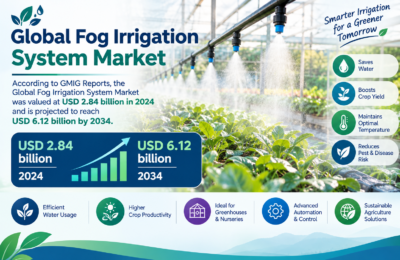
The global fog irrigation system market was valued at USD 2.84 billion in 2024 and is projected to grow at a compound annual growth rate (CAGR) of approximately 7.9%, reaching USD 6.12 billion by 2034, according to GMI Reports. Fog irrigation systems, which generate ultra-fine water droplets typically ranging from 1 to 50 microns in diameter through high-pressure nozzle technology, deliver water directly into the plant canopy microclimate as a suspended mist that plants absorb through both foliar uptake and soil surface infiltration, achieving water use efficiency advantages of up to 50% compared to conventional drip and sprinkler irrigation methods.
The global fog irrigation system market is experiencing accelerating growth driven by converging pressures of freshwater scarcity intensification, expanding precision agriculture adoption, and growing greenhouse and controlled environment agriculture investment globally. Fog irrigation’s unique combination of ultra-low water application volume, simultaneous humidity elevation, microclimate temperature reduction, and foliar nutrient delivery capability provides a multi-functional agronomic value proposition that positions it favorably across a wide range of high-value crop and controlled environment agriculture applications.
Beyond agricultural applications, fog irrigation systems have established significant market positions within greenhouse climate control, poultry and livestock cooling, industrial dust suppression, outdoor cooling in hospitality and commercial environments, and horticultural nursery applications, creating a diversified multi-sector demand base that contributes to market resilience and growth breadth beyond the core agricultural irrigation application category.
Market Overview
The global fog irrigation system market encompasses high-pressure fog systems operating at 70-140 bar generating droplets below 10 microns, medium-pressure misting systems operating at 7-70 bar, and low-pressure fog systems for specific humidity control and cooling applications, alongside associated pumping stations, filtration systems, stainless steel or polymer distribution tubing, and fog nozzle arrays. The market serves agricultural, horticultural, greenhouse, livestock, industrial, and commercial end-use sectors across arid, semi-arid, and controlled environment cultivation contexts globally.
Fog irrigation technology operates on a fundamentally different water application principle from conventional irrigation methods. Rather than saturating root zone soil, fog systems apply water as an atmospheric suspension that plants intercept through leaf surface stomata and fine root hairs near the soil surface, mimicking the natural fog and dew moisture collection mechanisms exploited by plants in coastal fog-belt ecosystems. This application principle enables meaningful water savings relative to conventional surface or sprinkler irrigation while simultaneously providing evaporative cooling, humidity elevation, and foliar nutrient delivery benefits that conventional ground-applied irrigation cannot replicate.
The market is particularly well established within greenhouse and controlled environment agriculture, where fog systems function as integrated climate control infrastructure managing temperature, humidity, and evaporative cooling simultaneously within enclosed growing environments. Israel, Netherlands, Spain, and the United States have been leading fog irrigation technology development and adoption markets, with significant and rapidly growing adoption now occurring across India, China, and the broader Middle East region driven by water scarcity intensification and high-value horticultural investment growth.
Market Size & Forecast
Market Driving Factors
1. Global Freshwater Scarcity and Water-Efficient Irrigation Demand
Intensifying global freshwater scarcity, driven by climate change-induced precipitation pattern shifts, groundwater depletion from over-extraction, and growing agricultural, industrial, and municipal water demand competition, is elevating the policy and economic imperative for water-efficient irrigation technology adoption. Fog irrigation’s documented water use efficiency advantages of 30-50% relative to conventional irrigation methods position it as a strategically important technology within national and regional water conservation policy frameworks across water-stressed agricultural economies.
2. Greenhouse and Controlled Environment Agriculture Expansion
Rapid global expansion of greenhouse and controlled environment agriculture investment, driven by food security imperatives, climate resilience requirements for crop production, and premium horticultural crop demand growth, creates substantial and growing fog irrigation system demand as an integral climate control and irrigation infrastructure component within modern greenhouse facility design. Fog systems are specified as standard equipment in high-technology greenhouse designs across the Netherlands, Israel, Spain, and increasingly China and India.
3. High-Value Horticultural Crop Production Growth
Growing global production of high-value horticultural crops including berries, specialty herbs, microgreens, cut flowers, and premium vegetables within climate-controlled or semi-protected cultivation environments creates strong demand for fog irrigation’s precision water and climate management capability. These high-value crop production contexts justify fog system capital investment through improved yield quality, extended growing season capability, and reduced water and energy cost relative to alternative climate control approaches.
4. Livestock and Poultry Heat Stress Mitigation Demand
Growing recognition of heat stress as a major animal productivity, welfare, and mortality risk within commercial poultry and livestock production, intensified by global temperature elevation increasing peak summer heat event frequency and severity, is driving significant fog cooling system adoption within poultry houses, pig barns, and dairy cattle facilities. Fog cooling systems demonstrate documented productivity improvement and mortality reduction outcomes that support strong return on investment justification for commercial livestock producers.
5. Precision Agriculture and Smart Irrigation Technology Integration
Growing integration of fog irrigation systems with precision agriculture sensor networks, IoT monitoring platforms, and automated climate control systems enables data-driven fog application optimization based on real-time plant water stress indicators, microclimate temperature and humidity monitoring, and weather forecast integration. This smart fog irrigation technology convergence enhances system water efficiency, crop production outcomes, and operational management convenience, strengthening the technology’s value proposition within precision agriculture investment frameworks.
6. Industrial Dust Suppression and Outdoor Cooling Applications
Substantial and growing fog system demand within industrial dust suppression applications including mining, construction, quarrying, and waste management facilities, alongside outdoor hospitality and commercial space cooling applications in hot climate regions, provides significant demand diversification beyond agricultural and greenhouse applications. These non-agricultural market segments contribute meaningful revenue and market growth breadth to the overall fog irrigation system market.
Market Restraining Factors
1. High Capital Investment and System Complexity
High-pressure fog irrigation systems require substantial capital investment in pumping station infrastructure, high-grade stainless steel or specialized polymer tubing, precision fog nozzle arrays, and filtration systems to prevent nozzle clogging, creating meaningful initial investment barriers particularly for smallholder farmers and small-scale horticultural producers in emerging markets. System installation and commissioning complexity additionally requires specialized technical expertise that may not be readily available in all target market geographies.
2. Water Quality Requirements and Maintenance Demands
Fog irrigation systems’ extremely fine nozzle orifices require high-quality, low-mineral-content water supply to prevent nozzle clogging and mineral deposit accumulation that degrades fog droplet generation performance and system operating efficiency. These water quality requirements necessitate water treatment infrastructure investment in regions with hard water supplies and impose ongoing filter maintenance and nozzle inspection requirements that add to total system operating cost relative to simpler conventional irrigation methods.
3. Wind Sensitivity and Outdoor Application Limitations
Fog irrigation systems’ ultra-fine droplet generation is sensitive to wind disturbance, which can deflect fog away from target crop canopies, reduce effective water application efficiency, and limit system performance in exposed outdoor field locations without windbreak protection. This wind sensitivity constrains fog irrigation’s applicability in open-field agricultural settings relative to sheltered greenhouse and tunnel cultivation environments where wind disturbance is managed by enclosed structure design.
4. Limited Smallholder Farmer Awareness and Technical Capacity
Awareness of fog irrigation technology’s agronomic benefits and familiarity with system design, installation, and maintenance requirements remains limited among smallholder farming populations in many key emerging market agricultural economies, creating adoption friction that requires substantial farmer education, demonstration plot investment, and extension service engagement to overcome at the pace required for broad smallholder market penetration.
Market Segmentation
By System Type
High-pressure fog systems retain the dominant and expanding market share, delivering the finest droplet sizes achievable with the highest evaporative cooling efficiency and water application precision, making them the preferred specification for greenhouse climate control and high-value precision agriculture applications. Medium-pressure misting systems maintain substantial market share across livestock cooling, outdoor commercial cooling, and general horticultural irrigation applications where ultra-fine droplet specification is less critical.
By Application
Greenhouse and horticulture retains the dominant application share and is projected to strengthen this position, reflecting continued global greenhouse infrastructure investment growth and fog systems’ integral role as climate management infrastructure within modern controlled environment agriculture. Open field agriculture represents the application with the highest untapped growth potential given the enormous global drip and sprinkler irrigation installed base offering conversion opportunity.
By Component
Competitive Landscape
The global fog irrigation system market features a combination of specialized fog and misting system manufacturers with deep nozzle technology expertise, broader irrigation system companies with fog product line extensions, and regional manufacturers serving specific geographic markets. Competition centers on fog droplet size consistency, nozzle clogging resistance, system energy efficiency, and application engineering support capability.
Regional Analysis
Asia Pacific represents the fastest-growing and increasingly largest regional fog irrigation market, driven by rapid greenhouse agriculture expansion in China and India, combined with the latter’s substantial government investment in micro-irrigation technology adoption. The Middle East and North Africa region represents a strategically significant market given extreme water scarcity conditions elevating water-efficient irrigation technology priority across all agricultural applications.
Emerging Market Trends
Solar-Powered Fog Irrigation for Off-Grid Agricultural Applications
Growing development of solar-powered fog irrigation systems, integrating photovoltaic panels with high-efficiency pump technology and smart controllers, is expanding fog irrigation’s practical applicability across off-grid agricultural settings in water-scarce regions of sub-Saharan Africa, South Asia, and the Middle East where grid electricity unreliability has historically constrained adoption of high-pressure irrigation technology. This solar integration represents a significant market development opportunity in regions with both acute water scarcity and abundant solar resource availability.
IoT-Enabled Smart Fog System Automation
Rapid advancement in IoT sensor integration within fog irrigation systems, enabling automated fog application scheduling based on real-time microclimate monitoring, soil moisture sensing, plant stress indicators, and weather forecast data integration, is transforming fog irrigation from manually scheduled fixed-cycle systems toward continuously adaptive, data-driven precision water and climate management platforms delivering improved crop outcomes and further enhanced water efficiency relative to timer-based operation.
Vertical Farming and Indoor Agriculture Integration
The rapid expansion of vertical farming and indoor agriculture facilities globally is creating significant new fog irrigation demand as these cultivation environments require precise humidity management, root zone moisture delivery, and foliar misting capability within densely planted, energy-efficient growing system architectures where conventional irrigation approaches are impractical. Fog systems are increasingly recognized as integral infrastructure within vertical farming facility design.
Nanobubble and Oxygenated Water Fog System Innovation
Emerging integration of nanobubble technology within fog irrigation water supply systems, delivering oxygen-supersaturated water through fog application to enhance plant root zone dissolved oxygen availability and promote beneficial microbial activity, represents a frontier technology innovation combining fog irrigation’s precision application capability with advanced water treatment benefits for accelerated plant growth and disease suppression outcomes in high-value crop production environments.
Deficit Irrigation and Regulated Water Stress Application
Growing agronomic adoption of deliberate regulated deficit irrigation strategies, applying precisely controlled mild water stress at specific crop development stages to improve fruit quality attributes including sugar content, color development, and flavor concentration in wine grapes, berries, and tree fruits, is creating demand for the precise, controllable low-volume water application capability that high-pressure fog systems deliver more precisely than conventional irrigation alternatives.
Key Companies in the Fog Irrigation System Market
-
Fogco Systems
-
Mee Industries (MeeFog)
-
Idrotech S.r.l.
-
Netafim (Rivulis)
-
Jain Irrigation Systems
-
EuroFog
-
Amigo Fog Systems
-
Orbit Irrigation Products
-
Adiabatic Group
-
Lubing System (Germany)
-
Regional Asian Fog System Manufacturers
Report Target Audience
-
Fog and Misting System Manufacturers
-
Greenhouse and Controlled Environment Agriculture Operators
-
Agricultural Irrigation Equipment Distributors
-
Investment and Private Equity Firms
-
Government Agricultural and Water Resource Agencies
-
Livestock and Poultry Farm Operators
-
Management and Strategy Consultants
-
Academic and Agricultural Engineering Research Institutions
Market Segmentation Summary
By System Type
-
High-Pressure Fog Systems (70–140 bar)
-
Medium-Pressure Misting Systems (7–70 bar)
-
Low-Pressure Fog Systems (below 7 bar)
By Application
-
Greenhouse & Horticulture
-
Livestock & Poultry Cooling
-
Open Field Agriculture
-
Industrial Dust Suppression
-
Outdoor Commercial Cooling
By Component
-
Pumping Stations & Controllers
-
Fog Nozzles & Emitters
-
Distribution Tubing & Fittings
-
Filtration Systems
By Region
-
Asia Pacific
-
Europe
-
North America
-
Middle East & Africa
-
Latin America
About GMI Reports
GMI Reports is a premier market intelligence and research organization providing data-driven insights and strategic analysis across global agriculture, irrigation technology, and water management markets. Our research empowers manufacturers, investors, and policymakers to navigate the evolving fog irrigation system market landscape with confidence. For the Fog Irrigation System Market report and related research, visit www.gmigreports.com or contact our research team for customized intelligence solutions.
www.gmigreports.com