MARKET RESEARCH REPORT
Regenerative Agriculture Market
Global Insights, Analysis & Forecasts to 2034
Published by GMI Reports | www.gmigreports.com
Executive Summary
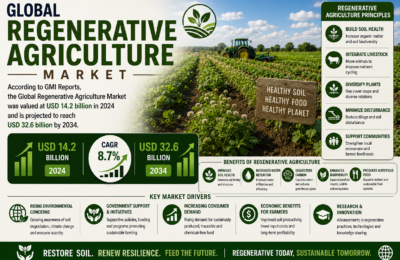
The global regenerative agriculture market was valued at USD 14.2 billion in 2024 and is projected to grow at a compound annual growth rate (CAGR) of approximately 8.7%, reaching USD 32.6 billion by 2034, according to GMI Reports. Regenerative agriculture, encompassing farming practices and associated input products and services designed to restore soil health, enhance biodiversity, and sequester atmospheric carbon while maintaining or improving agricultural productivity, has emerged as one of the most strategically significant sustainability themes within global agriculture and food supply chains.
Market growth is propelled by accelerating corporate carbon neutrality commitments among major food and beverage companies, growing carbon credit market development specifically targeting agricultural soil carbon sequestration, and increasing grower recognition of regenerative practices’ long-term soil health and input cost reduction benefits. Major food companies have substantially expanded regenerative agriculture sourcing commitments and grower incentive program investment, reflecting strategic supply chain resilience and sustainability positioning objectives.
North America and Europe currently represent the largest regional markets for regenerative agriculture adoption and associated commercial activity, supported by established carbon credit market infrastructure and substantial corporate sustainability commitment activity, while emerging agricultural economies increasingly represent significant growth opportunity as international supply chain sustainability requirements extend regenerative practice adoption expectations to global commodity sourcing regions.
Market Overview
The regenerative agriculture market encompasses the products, services, and associated commercial ecosystem supporting farming practices including reduced or no-till cultivation, diverse cover cropping, integrated livestock grazing management, and reduced synthetic input usage designed to restore and enhance soil health, biodiversity, and carbon sequestration capacity while maintaining agricultural productivity and farm economic viability.
Regenerative agriculture market activity spans multiple commercial categories including specialized seed and cover crop products, soil health monitoring and measurement technology, carbon credit verification and trading platforms, grower technical advisory and certification services, and food and beverage company-sponsored grower incentive and sourcing programs. This diverse commercial ecosystem reflects regenerative agriculture’s position at the intersection of agricultural production practice, environmental sustainability policy, and food supply chain commercial strategy.
The market benefits from accelerating corporate food and beverage company sustainability commitment implementation, with major companies increasingly establishing specific regenerative agriculture sourcing targets and grower financial incentive programs as core components of broader scope three greenhouse gas emissions reduction strategies. This corporate-driven demand pull operates alongside genuine grower-level interest in regenerative practices’ long-term soil health and input cost reduction benefits, creating a multi-faceted demand foundation for continued market expansion.
Market Size & Forecast
Market Driving Factors
1. Corporate Scope Three Emissions Reduction Commitments
Major global food and beverage companies face mounting pressure to address agricultural supply chain emissions, which typically represent the largest component of total corporate scope three greenhouse gas emissions for food sector companies. Regenerative agriculture sourcing commitments and grower incentive programs have become a central strategic response to this pressure, driving substantial corporate investment in regenerative practice adoption support across supplier farming operations.
2. Agricultural Carbon Credit Market Development
Continued development and maturation of agricultural soil carbon credit markets, supported by improving measurement, reporting, and verification methodology standardization, has created genuine new revenue opportunity for growers adopting regenerative practices that demonstrably enhance soil carbon sequestration. This carbon credit revenue opportunity provides meaningful additional economic incentive for regenerative practice adoption beyond input cost reduction and yield resilience benefits alone.
3. Long-Term Input Cost Reduction and Soil Health Economic Benefits
Growing grower recognition and increasingly robust agronomic research documentation of regenerative practices’ long-term synthetic fertilizer and pesticide input cost reduction potential, achieved through enhanced soil biological activity and nutrient cycling efficiency, provides a genuine economic foundation for regenerative agriculture adoption independent of corporate sustainability program participation or carbon credit revenue considerations.
4. Climate Resilience and Drought/Flood Tolerance Improvement
Regenerative practices’ demonstrated capacity to improve soil water retention capacity and overall crop resilience to drought and excess precipitation events has elevated grower interest in regenerative adoption as a climate risk management strategy, particularly across regions experiencing increasingly variable and extreme weather pattern impacts on conventional farming system productivity and reliability.
5. Consumer Demand for Sustainably Produced Food Products
Growing consumer awareness and purchasing preference for sustainably and regeneratively produced food products has supported the development of premium regenerative-certified product categories and retailer sourcing commitments, creating downstream market demand pull that reinforces upstream grower-level regenerative practice adoption incentive structures throughout the food supply chain.
6. Government and Policy Support for Soil Health and Conservation Practices
Numerous governments across major agricultural economies have introduced or expanded conservation and soil health-focused agricultural policy support programs, including financial incentive payments and technical assistance specifically supporting regenerative practice adoption. These policy frameworks provide meaningful complementary support to corporate and market-driven regenerative agriculture demand drivers.
Market Restraining Factors
1. Transition Period Yield and Income Risk
The multi-year transition period typically required for soil health and biological activity improvement to fully manifest agronomic and economic benefits creates genuine yield and income risk exposure for growers during the initial regenerative practice adoption period. This transition risk represents a significant adoption barrier, particularly for growers operating with limited financial reserves or significant existing debt service obligations.
2. Inconsistent Carbon Credit Measurement and Verification Standards
Despite continued improvement, agricultural soil carbon measurement, reporting, and verification methodology standards remain somewhat inconsistent across different carbon credit market programs and geographic regions, creating uncertainty regarding the reliability and comparability of carbon credit revenue opportunities available to growers considering regenerative practice adoption for carbon market participation purposes.
3. Limited Grower Technical Knowledge and Extension Support Access
Effective regenerative agriculture practice implementation requires substantial agronomic knowledge and technical skill development that many growers, particularly those without access to specialized extension services or peer farmer network support, may lack. This technical knowledge gap constrains broader regenerative agriculture adoption beyond growers with access to adequate technical support infrastructure and agronomic education resources.
4. Scale and Equipment Compatibility Challenges for Large Commercial Operations
Certain regenerative practices, particularly those involving diverse cover cropping rotations or integrated livestock grazing management, can present meaningful operational complexity and equipment compatibility challenges for large-scale commercial farming operations optimized around conventional monoculture production systems and associated specialized equipment investment, complicating practice adoption beyond smaller and more operationally flexible farming operations.
Market Segmentation
By Practice Type
Cover cropping and diversified crop rotation practices retain the leading market share, reflecting their broad applicability across virtually all farming systems and relatively lower implementation complexity compared to more operationally intensive practices such as integrated livestock grazing management. Integrated livestock grazing is projected to gain proportional market share, supported by growing recognition of its soil health and carbon sequestration benefits among both row crop and dedicated grazing operations.
By Farm Size
Large commercial farming operations retain the leading revenue share, benefiting from greater capacity to absorb transition period risk, participate in corporate sourcing incentive programs at meaningful scale, and access carbon credit market opportunities requiring substantial enrolled acreage for cost-effective measurement and verification implementation.
By Crop Type
Competitive Landscape
The global regenerative agriculture market features a diverse competitive ecosystem encompassing major food and beverage companies sponsoring grower incentive programs, specialized seed and input companies developing regenerative-focused products, carbon credit platform developers, and agricultural technology companies providing soil health monitoring and measurement capability.
Regional Analysis
North America represents the largest regenerative agriculture market, supported by substantial corporate food company sourcing program activity and established carbon credit market infrastructure, while Europe represents a significant market benefiting from robust government policy support and carbon market development. Asia Pacific and Latin America are exhibiting the fastest growth rates as international supply chain sustainability requirements extend regenerative adoption expectations into these major commodity sourcing regions.
Emerging Market Trends
Satellite and Remote Sensing-Based Carbon Measurement
Continued advancement in satellite and remote sensing-based soil carbon and practice verification technology is substantially reducing the cost and complexity of regenerative agriculture measurement, reporting, and verification processes, addressing one of the most significant historical barriers to scalable carbon credit market participation and corporate sourcing program verification requirements.
Blended Finance and Outcome-Based Payment Model Innovation
Growing development of blended finance structures combining corporate sourcing program payments, carbon credit revenue, and government conservation incentive payments into integrated outcome-based grower payment models is helping address transition period economic risk, providing growers with more substantial and diversified financial support during the multi-year regenerative practice adoption transition period.
Supply Chain Traceability and Verification Technology Integration
Major food and beverage companies are increasingly investing in enhanced supply chain traceability technology enabling verified attribution of regenerative agriculture practice adoption to specific sourced commodity volumes, supporting more credible and granular sustainability claims while providing growers with more direct connection between practice adoption and downstream commercial value capture.
Regenerative Livestock Integration and Holistic Grazing Management
Growing interest in integrated crop-livestock systems and holistic planned grazing management is expanding regenerative agriculture’s commercial scope beyond row crop-focused practices into more comprehensive whole-farm system redesign approaches, reflecting growing recognition of livestock integration’s significant soil health and carbon sequestration contribution potential within regenerative farming system design.
Standardization and Certification Scheme Consolidation
The regenerative agriculture market is experiencing gradual movement toward greater standardization and certification scheme consolidation, as numerous previously fragmented corporate and third-party regenerative certification standards begin converging around more widely recognized verification frameworks, supporting improved market transparency and reduced grower compliance complexity across multiple program participation.
Key Companies in the Regenerative Agriculture Market
-
General Mills, Inc.
-
Cargill, Incorporated
-
Indigo Agriculture
-
Nutrien Ltd.
-
Danone S.A.
-
PepsiCo, Inc.
-
Land O’Lakes (Truterra)
-
Soil Capital
-
Regrow Ag
-
Continuum Ag
-
Specialized Regenerative Seed and Input Companies
Report Target Audience
-
Food and Beverage Companies
-
Agricultural Input and Seed Companies
-
Carbon Credit and MRV Technology Platforms
-
Commercial Farming Operations and Cooperatives
-
Investment and Private Equity Firms
-
Government Agricultural and Environmental Policy Agencies
-
Sustainability and ESG Consulting Firms
-
Academic and Soil Science Research Institutions
Market Segmentation Summary
By Practice Type
-
Cover Cropping & Crop Rotation
-
No-Till/Reduced-Till Cultivation
-
Integrated Livestock Grazing
-
Reduced Synthetic Input Management
By Farm Size
-
Large Commercial Farms (500+ acres)
-
Mid-Size Farms (100-500 acres)
-
Smallholder Farms (Under 100 acres)
By Crop Type
-
Row Crops (Corn, Soy, Wheat)
-
Specialty Crops (Fruits/Vegetables)
-
Forage & Pasture
-
Other Crop Types
By Region
-
North America
-
Europe
-
Latin America
-
Asia Pacific
-
Middle East & Africa
About GMI Reports
GMI Reports is a premier market intelligence and research organization providing data-driven insights and strategic analysis across global agriculture, sustainability, and food supply chain markets. Our research empowers companies, growers, and investors to navigate the evolving regenerative agriculture landscape with confidence. For the Regenerative Agriculture Market report and related research, visit www.gmigreports.com or contact our research team for customized intelligence solutions.
www.gmigreports.com