MARKET RESEARCH REPORT
Agricultural Biologicals Market
Global Insights, Analysis & Forecasts to 2034
Published by GMI Reports | www.gmigreports.com
Executive Summary
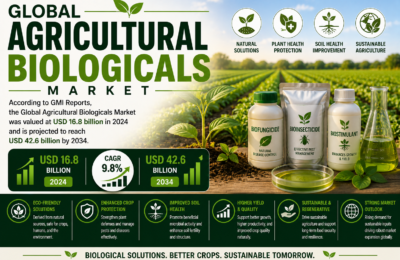
The global agricultural biologicals market was valued at USD 16.8 billion in 2024 and is projected to grow at a compound annual growth rate (CAGR) of approximately 9.8%, reaching USD 42.6 billion by 2034, according to GMI Reports. Agricultural biologicals, encompassing biopesticides, biostimulants, and biofertilizers derived from naturally occurring microorganisms, plant extracts, and biochemical substances, have emerged as one of the fastest-growing segments within the broader global crop protection and crop nutrition industry.
Market growth is propelled by intensifying regulatory restrictions on synthetic agrochemicals across major agricultural economies, rising consumer demand for sustainably produced food, and growing grower recognition of biologicals’ complementary role alongside conventional crop input programs in integrated pest and nutrient management strategies. Major agrochemical companies have substantially expanded biologicals research and development investment and acquired specialized biologicals innovators, reflecting strategic industry-wide repositioning toward sustainable crop input portfolios.
North America and Europe currently represent the largest regional markets, supported by established regulatory pathways and grower sustainability commitments, while Asia Pacific and Latin America are emerging as the fastest-growing regional markets, driven by expanding commercial agriculture intensification and increasing government support for sustainable farming practice adoption.
Market Overview
The agricultural biologicals market encompasses biopesticides (biological insecticides, fungicides, and nematicides), biostimulants (substances enhancing plant nutrition efficiency, abiotic stress tolerance, and crop quality), and biofertilizers (microbial inoculants enhancing nutrient availability and uptake) derived from living organisms, naturally occurring substances, or biochemical extracts rather than synthetic chemical compounds.
Agricultural biologicals serve as both standalone crop input solutions and increasingly as complementary components within integrated crop management programs combining biological and conventional synthetic inputs. This complementary positioning, often termed integrated pest management or biological-chemical stacking, has accelerated mainstream grower adoption by addressing efficacy and reliability concerns that historically constrained biologicals’ competitive position relative to established synthetic alternatives.
The market benefits from a maturing regulatory landscape across major agricultural economies, with regulatory authorities increasingly establishing streamlined approval pathways recognizing biologicals’ generally favorable environmental and human health safety profiles relative to synthetic chemical alternatives. This regulatory evolution has meaningfully reduced commercialization timelines and costs for new biological product introductions, supporting accelerated innovation pipeline development across the industry.
Market Size & Forecast
Market Driving Factors
1. Intensifying Regulatory Restrictions on Synthetic Agrochemicals
Regulatory authorities across the European Union, North America, and increasingly across Asia Pacific markets continue to restrict, phase out, or impose stricter approval requirements on numerous conventional synthetic pesticide active ingredients due to environmental and human health safety concerns. This intensifying regulatory pressure has created substantial commercial opportunity for biological alternatives capable of addressing the same pest management and crop nutrition needs while satisfying evolving regulatory and retailer sustainability requirements.
2. Consumer Demand for Sustainably Produced Food
Growing global consumer preference for food produced with reduced synthetic chemical input, supported by expanding organic and sustainably certified food market growth, has driven food retailer and processor sustainability sourcing requirements that directly translate into grower-level demand for biological crop input adoption. Major food and beverage companies have increasingly incorporated biological input usage into supply chain sustainability commitments, creating downstream demand pull throughout the agricultural value chain.
3. Integration with Conventional Crop Input Programs
The growing adoption of integrated biological-synthetic crop management programs, wherein biologicals complement rather than replace conventional agrochemical inputs, has substantially expanded the addressable grower market for biological products. This complementary positioning addresses historical grower concerns regarding biological product efficacy consistency relative to synthetic alternatives, supporting accelerated mainstream commercial agriculture adoption beyond historically niche organic farming applications.
4. Major Agrochemical Company Strategic Investment and Acquisition
Leading global agrochemical and seed companies have substantially increased biologicals research and development investment while pursuing strategic acquisitions of specialized biologicals innovators, reflecting industry-wide recognition of biologicals’ long-term strategic importance within sustainable agriculture input portfolios. This major company investment has accelerated biologicals product pipeline development, improved formulation stability and field performance consistency, and expanded global distribution reach for biological products.
5. Soil Health and Microbiome Science Advancement
Continued scientific advancement in understanding soil microbiome composition and its relationship to plant health, nutrient cycling, and stress resilience has driven significant innovation in biofertilizer and biostimulant product development. Growing grower and agronomist appreciation for soil health as a foundational driver of long-term yield sustainability has supported increased biological input adoption as part of broader regenerative and sustainable soil management practice implementation.
6. Government Support for Sustainable Agriculture Practice Adoption
Numerous governments across major agricultural economies have introduced targeted subsidy programs, research funding initiatives, and sustainable agriculture policy frameworks explicitly supporting biological crop input adoption as part of broader agricultural sustainability and climate resilience objectives. The European Union’s Farm to Fork strategy and similar policy initiatives across other major agricultural economies have provided meaningful market development tailwinds for the biologicals industry.
Market Restraining Factors
1. Variable Field Performance and Efficacy Consistency Concerns
Agricultural biologicals’ field performance can exhibit greater variability relative to synthetic chemical alternatives due to sensitivity to environmental conditions, application timing, and product storage and handling requirements. This performance variability continues to present adoption barriers among growers prioritizing predictable, consistent crop protection and nutrition outcomes, particularly within high-value commercial agriculture operations with limited risk tolerance for yield variability.
2. Higher Per-Unit Cost Relative to Conventional Alternatives
Many biological crop input products carry higher per-unit costs compared to established synthetic chemical alternatives, reflecting more complex manufacturing processes, smaller production scale economics, and specialized formulation and stabilization technology requirements. This cost differential can present adoption barriers for cost-sensitive commodity crop growers operating within narrow profit margin environments, particularly in regions with less developed sustainability premium market mechanisms.
3. Complex and Fragmented Global Regulatory Pathways
Despite generally favorable regulatory trends, agricultural biologicals continue to face fragmented and inconsistent regulatory approval pathways across different international markets, complicating global product registration and commercialization strategies for biologicals companies seeking multi-market launch coordination. This regulatory fragmentation increases compliance costs and extends commercialization timelines relative to more harmonized regulatory frameworks governing conventional agrochemicals in some jurisdictions.
4. Limited Grower Awareness and Technical Knowledge Gaps
Many growers, particularly within smaller-scale and developing market agricultural operations, possess limited awareness or technical understanding regarding appropriate biological product selection, application timing, and integration with existing crop management practices. This knowledge gap necessitates substantial agronomic education and technical support investment from biologicals companies and distribution partners to support successful product adoption and effective field performance realization.
Market Segmentation
By Product Type
Biostimulants represent the largest and fastest-growing product category, reflecting strong grower demand for products enhancing crop stress resilience, nutrient use efficiency, and overall yield quality amid increasingly variable climate conditions. Biopesticides maintain substantial market share, supported by accelerating regulatory restriction of synthetic alternatives and improving biological pest control efficacy through advanced formulation technology.
By Source
Microbial-sourced biologicals maintain the leading market position, leveraging extensive scientific research into beneficial bacterial and fungal species’ plant growth promotion, nutrient solubilization, and pathogen suppression capabilities. This source category benefits from relatively mature manufacturing scale-up technology and established regulatory familiarity across major agricultural markets.
By Crop Type
Competitive Landscape
The global agricultural biologicals market features a combination of major diversified agrochemical and seed companies that have substantially expanded biologicals portfolios through acquisition and internal development, alongside numerous specialized pure-play biologicals innovators. Market competition increasingly centers on field performance consistency, formulation technology differentiation, and integrated crop management program development capability.
Regional Analysis
North America and Europe collectively represent the largest share of the global agricultural biologicals market, supported by established regulatory pathways, mature grower sustainability commitments, and substantial biologicals company research infrastructure presence. Asia Pacific and Latin America are exhibiting the fastest regional growth rates, driven by expanding commercial agriculture intensification and increasing government sustainable agriculture policy support.
Emerging Market Trends
AI-Driven Microbial Strain Discovery
Biologicals companies are increasingly deploying artificial intelligence and machine learning technologies to accelerate beneficial microbial strain discovery and optimization, significantly compressing research and development timelines relative to traditional screening methodologies. This technology-accelerated discovery approach is enabling more rapid biological product pipeline development tailored to specific crop, soil, and climate condition combinations.
Precision Application Technology Integration
Growing integration of agricultural biologicals with precision agriculture application technology, including variable-rate application systems and soil and plant health sensing platforms, is enhancing biological product field performance consistency by optimizing application timing and placement relative to specific field conditions and crop development stages. This integration directly addresses historical biological product performance variability concerns.
Climate Resilience and Stress Tolerance Positioning
Biologicals companies are increasingly positioning biostimulant products specifically around climate resilience and abiotic stress tolerance benefits, including drought, heat, and salinity stress mitigation, responding to growing grower concern regarding increasingly variable and extreme weather pattern impacts on crop yield stability. This climate resilience positioning represents a significant differentiated value proposition relative to conventional synthetic crop input alternatives.
Carbon Farming and Regenerative Agriculture Integration
The growing development of carbon farming and regenerative agriculture incentive programs, often linked to soil carbon sequestration measurement and verification, is creating additional commercial value propositions for biological crop input products that support soil health improvement and microbiome enhancement objectives central to regenerative farming practice frameworks.
Consolidation and Strategic Partnership Acceleration
Continued merger and acquisition activity, alongside strategic partnership and licensing agreement development between major agrochemical companies and specialized biologicals innovators, is reshaping competitive market structure. This consolidation trend reflects major companies’ strategic recognition that internal biologicals development alone cannot match the pace of innovation achievable through acquiring or partnering with specialized pure-play biologicals technology companies.
Key Companies in the Agricultural Biologicals Market
-
Bayer CropScience
-
Syngenta Group
-
BASF SE
-
Corteva Agriscience
-
UPL Limited
-
Marrone Bio Innovations (Bioceres Group)
-
Novozymes A/S
-
Koppert Biological Systems
-
Valent BioSciences
-
FMC Corporation
-
Specialized Biologicals Startups and Innovators
Report Target Audience
-
Agrochemical and Seed Companies
-
Biologicals and Biotechnology Innovators
-
Agricultural Input Distributors and Retailers
-
Commercial Farming Operations and Grower Cooperatives
-
Investment and Private Equity Firms
-
Government Agricultural and Environmental Policy Agencies
-
Food and Beverage Companies with Sustainability Sourcing Commitments
-
Management and Strategy Consultants
-
Academic and Agronomic Research Institutions
Market Segmentation Summary
By Product Type
-
Biostimulants
-
Biopesticides
-
Biofertilizers
By Source
-
Microbial (Bacteria, Fungi)
-
Biochemical (Plant/Animal Extracts)
-
Macrobial (Beneficial Insects/Nematodes)
-
Semiochemicals (Pheromones)
By Crop Type
-
Cereals & Grains
-
Fruits & Vegetables
-
Oilseeds & Pulses
-
Turf & Ornamentals
-
Other Crop Types
By Region
-
North America
-
Europe
-
Asia Pacific
-
Latin America
-
Middle East & Africa
About GMI Reports
GMI Reports is a premier market intelligence and research organization providing data-driven insights and strategic analysis across global agriculture, agrochemical, and biotechnology markets. Our research empowers manufacturers, growers, and investors to navigate the evolving sustainable agriculture landscape with confidence. For the Agricultural Biologicals Market report and related research, visit www.gmigreports.com or contact our research team for customized intelligence solutions.
www.gmigreports.com