MARKET RESEARCH REPORT
South Korea Furniture Market
Insights, Analysis & Forecasts to 2034
Published by GMI Reports | www.gmigreports.com
Executive Summary
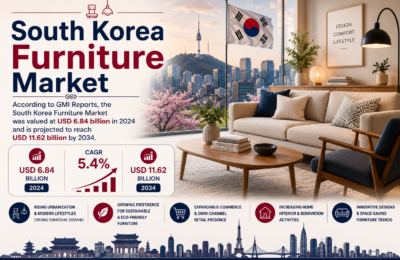
The South Korea furniture market was valued at USD 6.84 billion in 2024 and is projected to grow at a compound annual growth rate (CAGR) of approximately 5.4% between 2025 and 2034, reaching an estimated USD 11.62 billion by 2034, according to GMI Reports. Market growth is being driven by rising urban household formation, a sustained boom in residential redevelopment and apartment construction, and a fast-growing appetite among Korean consumers for design-forward, space-efficient furniture solutions.
South Korea’s furniture market is distinguished by its unique blend of high-density urban living patterns, strong digital retail infrastructure, and a consumer base highly responsive to interior design trends amplified through social media and content platforms. The proliferation of one-person and two-person households, now representing a substantial share of total national households, is reshaping demand toward compact, modular, and multi-functional furniture formats.
The online distribution channel has emerged as a critical growth engine, with platforms such as Coupang, Ohou (오늘의집), and Hyundai Livart’s e-commerce arm enabling rapid furniture discovery, financing, and delivery. Meanwhile, domestic manufacturers including Hanssem and Livart continue to compete vigorously against an expanding presence of international entrants such as IKEA Korea, leveraging localized design sensibilities and after-sales installation services as key differentiators.
Market Overview
The South Korea furniture market encompasses residential, commercial, and institutional furniture products spanning living room, bedroom, kitchen, office, and outdoor categories, manufactured and distributed through both wood-based and modern composite material formats. The market’s structural characteristics are heavily influenced by Korea’s apartment-dominated housing stock, where standardized unit layouts have historically driven demand toward built-in and space-optimized furniture configurations.
Seoul and the broader Gyeonggi metropolitan region constitute the single largest demand concentration nationally, reflecting population density, new apartment complex completions, and concentrated purchasing power. However, furniture demand growth is increasingly diffusing toward secondary cities including Busan, Incheon, and Daegu as redevelopment projects extend nationally and online retail erodes the historical advantage of metropolitan showroom access.
South Korea’s furniture industry is also notable for the depth of its built-in and renovation-linked furniture segment, commonly associated with comprehensive interior renovation packages (인테리어 패키지) offered by major retailers. This bundled commercial model, combining furniture, fixtures, flooring, and design consultation, differentiates the Korean market from many other Asia-Pacific furniture markets that remain more transactionally fragmented.
Market Size & Forecast
Market Driving Factors
1. Sustained Apartment Construction and Housing Redevelopment
South Korea continues to undergo extensive urban redevelopment, with large-scale apartment reconstruction projects (재건축) and new town developments generating consistent demand for both built-in and freestanding furniture. Government housing supply initiatives targeting the Seoul metropolitan area are expected to sustain elevated furniture demand linked to new household formation throughout the forecast period.
2. Growth of Single and Small-Household Demographics
The proportion of one-person households in South Korea has risen substantially over the past decade, now representing a significant share of total households nationally. This demographic shift is driving strong demand for compact, multi-functional, and modular furniture designed for smaller living spaces, including convertible sofa-beds, foldable desks, and stackable storage systems tailored to studio and one-room apartment formats.
3. Digital-First Retail and Interior Design Platforms
The rise of dedicated interior design and furniture discovery platforms, most notably Ohou (오늘의집), has transformed how Korean consumers research, visualize, and purchase furniture. These platforms integrate user-generated interior photos, direct e-commerce purchasing, and renovation contractor matching, creating a highly influential digital ecosystem that accelerates trend adoption and shortens the furniture replacement cycle among younger consumers.
4. Premiumization and Design-Led Consumption
Korean consumers, particularly within the Millennial and Gen Z cohorts, increasingly view furniture as an expression of personal identity and lifestyle aspiration, often described locally as part of the broader ‘self-interior’ (셀프 인테리어) trend. This has driven strong growth in premium and designer furniture segments, alongside rising demand for Scandinavian-influenced minimalist aesthetics and Korean modern hanok-inspired design fusion products.
5. Commercial and Hospitality Sector Expansion
Growth in Korea’s café culture, co-working space sector, and boutique hospitality industry is generating substantial incremental demand for commercial furniture. Themed cafés and design-forward commercial spaces, heavily promoted through social media content, have become significant showcases and demand drivers for distinctive furniture pieces, indirectly influencing residential consumer preferences as well.
Market Restraining Factors
1. Raw Material Import Dependency
South Korea’s furniture manufacturing sector relies significantly on imported timber, engineered wood panels, and upholstery materials, given limited domestic forestry resources. This import dependency exposes manufacturers to global commodity price volatility and currency fluctuation risk, periodically compressing margins and contributing to retail price increases that can dampen consumer demand.
2. Intensifying Price Competition from Low-Cost Imports
The market faces growing competitive pressure from low-cost furniture imports, particularly from China, distributed through cross-border e-commerce platforms. This trend has intensified price competition at the value end of the market, squeezing margins for domestic mass-market furniture manufacturers and prompting some producers to shift focus toward premium and design-differentiated product segments less exposed to direct price competition.
3. Slowing New Housing Completions in Certain Periods
Cyclical slowdowns in new apartment completions, influenced by interest rate conditions and government real estate policy adjustments, can create periodic softness in furniture demand tied to new household move-ins. Given the close linkage between Korea’s housing market cycle and furniture purchasing patterns, policy-driven housing market volatility represents a recurring risk factor for market participants.
4. Environmental and Safety Regulation Compliance
Increasingly stringent regulations regarding formaldehyde emissions, flame retardant chemical use, and sustainable forestry sourcing certification are raising compliance costs for furniture manufacturers operating in South Korea. While these regulations support consumer safety and environmental objectives, smaller domestic manufacturers face proportionally higher compliance burdens relative to larger, better-resourced competitors.
Market Segmentation
By Product Type
Living room furniture retained the largest revenue share in 2024, supported by sustained sofa, TV unit, and storage furniture replacement demand linked to renovation activity. The office furniture segment is exhibiting the fastest relative growth, reflecting the expansion of Korea’s co-working and home-office furniture markets following sustained shifts toward hybrid work arrangements among Korean corporations.
By Material
By Distribution Channel
Online retail has rapidly approached parity with specialty showrooms as a primary distribution channel, a structural shift accelerated by the integration of furniture sales within broader interior design content platforms. The growth of augmented reality visualization tools, enabling consumers to preview furniture within their actual living spaces prior to purchase, is further strengthening the online channel’s competitive position relative to traditional showroom visits.
By End-User
Competitive Landscape
The South Korea furniture market features a competitive landscape led by established domestic conglomerate-affiliated manufacturers with strong renovation-bundle business models, alongside an increasingly influential presence of international furniture retailers and a vibrant ecosystem of independent design-focused furniture brands.
Regional Analysis (Within South Korea)
Furniture demand within South Korea is heavily concentrated in the Seoul Capital Area, reflecting the country’s pronounced metropolitan population concentration. However, redevelopment activity and rising disposable incomes in secondary metropolitan centers are gradually broadening the geographic distribution of market demand.
Emerging Market Trends
AI-Powered Interior Visualization and Customization
Korean furniture retailers and platforms are increasingly deploying AI-powered room visualization tools that allow consumers to preview furniture arrangements within photographs of their own homes. This technology is reducing purchase hesitation, particularly for higher-value items, and is becoming a standard competitive feature among leading e-commerce and showroom-based furniture retailers.
Subscription and Furniture Rental Models
Furniture and home goods subscription rental services, an extension of Korea’s broader appliance and home goods rental culture pioneered by companies such as Coway, are gaining traction particularly among younger renters and short-term residents. This model lowers the upfront cost barrier to premium furniture access and is creating new recurring-revenue business models within the furniture distribution ecosystem.
Sustainability and Eco-Certified Materials
Consumer and regulatory attention toward sustainable sourcing is driving increased adoption of FSC-certified wood, recycled materials, and low-emission adhesives among Korean furniture manufacturers. Several leading domestic brands have introduced dedicated eco-friendly product lines, responding to both regulatory direction and a growing segment of environmentally conscious younger consumers.
Modular and Convertible Furniture Innovation
Given persistent space constraints in Korean urban housing, furniture manufacturers continue to innovate around modular and convertible designs, including wall-bed systems, expandable dining tables, and stackable modular shelving. This product innovation trend is particularly pronounced within the one-person household demographic and is increasingly being incorporated into new apartment developer furniture packages.
Key Companies in the South Korea Furniture Market
-
Hanssem Co., Ltd.
-
Hyundai Livart Co., Ltd.
-
IKEA Korea
-
FURSYS Inc.
-
Eden Furniture
-
Ohouse Inc. (Ohou Platform)
-
Coway Living Design
-
Jangin Furniture
-
Edward Bell Furniture
-
Hyundai Department Store Furniture Division
-
Other Independent and Boutique Design Brands
Report Target Audience
-
Furniture Manufacturers and Designers
-
Interior Design and Renovation Service Providers
-
E-Commerce and Retail Platform Operators
-
Real Estate Developers and Construction Firms
-
Private Equity and Strategic Investors
-
Government Housing and Trade Policy Bodies
-
Management and Strategy Consulting Firms
-
Academic Researchers in Consumer and Retail Markets
Market Segmentation Summary
By Product Type
-
Living Room Furniture
-
Bedroom Furniture
-
Kitchen & Dining Furniture
-
Office Furniture
-
Outdoor & Other Furniture
By Material
-
Wood & Engineered Wood
-
Metal
-
Plastic & Composite
-
Upholstered/Fabric & Leather
By Distribution Channel
-
Specialty Furniture Stores & Showrooms
-
Online Retail & E-Commerce
-
Hypermarkets & Department Stores
-
Interior/Renovation Package Bundles
By End-User
-
Residential
-
Commercial
By Region (Within South Korea)
-
Seoul
-
Gyeonggi Province
-
Busan & Gyeongnam
-
Incheon
-
Daegu & Gyeongbuk
-
Other Regions
About GMI Reports
GMI Reports is a leading market intelligence and research firm delivering actionable insights across a broad spectrum of industries globally. Our rigorous research methodologies, extensive primary and secondary data sources, and sector-specialist analysts enable our clients to make informed strategic decisions in complex and fast-evolving markets.
For further information, customized research, or licensing inquiries regarding the South Korea Furniture Market report, please visit www.gmigreports.com or contact our research team directly.
www.gmigreports.com