MARKET RESEARCH REPORT
Farm Equipment Market
Global Insights, Analysis & Forecasts to 2034
Published by GMI Reports | www.gmigreports.com
Executive Summary
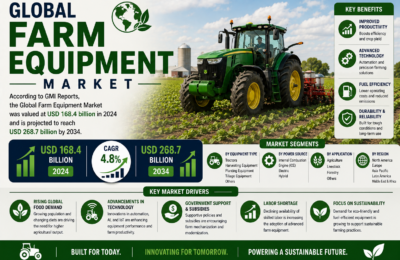
The global farm equipment market was valued at USD 168.4 billion in 2024 and is projected to grow at a compound annual growth rate (CAGR) of approximately 4.8%, reaching USD 268.7 billion by 2034, according to GMI Reports. The farm equipment market continues to benefit from sustained global agricultural mechanization expansion, particularly across emerging agricultural economies, alongside accelerating precision agriculture technology integration and autonomous equipment innovation within mature agricultural markets.
Tractors remain the dominant farm equipment product category globally, reflecting their foundational role across virtually every farming operation scale and crop production system worldwide. Continued technology advancement in precision agriculture capability, including GPS-guided steering, variable-rate application systems, and increasingly autonomous operation features, is reshaping farm equipment value proposition beyond basic mechanical capability toward sophisticated data-driven farm management platforms.
Emerging agricultural markets across Asia Pacific, Latin America, and Africa continue to drive substantial farm equipment demand growth as agricultural mechanization rates increase from comparatively low historical bases, while mature agricultural markets across North America and Europe increasingly emphasize replacement cycle purchasing, precision technology upgrade adoption, and autonomous equipment innovation as primary market growth drivers.
Market Overview
The global farm equipment market encompasses tractors, harvesting equipment, planting and seeding machinery, irrigation equipment, and a broad range of specialized implements and attachments supporting field preparation, planting, crop maintenance, and harvesting operations across virtually every major agricultural production system worldwide. The market serves farming operations ranging from smallholder operations in emerging agricultural economies to large-scale commercial farming operations across major agricultural exporting nations.
Farm equipment market dynamics are fundamentally shaped by the dual forces of continued mechanization expansion within emerging agricultural economies, where mechanization rates remain considerably below mature market benchmarks, and accelerating precision agriculture and autonomous technology adoption within already substantially mechanized mature agricultural markets. This dual dynamic creates distinct growth driver profiles across different regional markets while collectively sustaining robust global farm equipment market expansion.
The market continues to benefit from sustained global food demand growth, driven by population growth and rising per-capita consumption levels across developing economies, which in turn drives continued agricultural production intensification and associated farm equipment investment. Climate variability and increasingly stringent agricultural labor availability constraints across major agricultural economies further reinforce farm equipment’s role as an essential agricultural productivity and resilience-supporting technology category.
Market Size & Forecast
Market Driving Factors
1. Continued Agricultural Mechanization Expansion in Emerging Markets
Substantial agricultural mechanization expansion potential remains across numerous emerging agricultural economies in Asia Pacific, Africa, and Latin America, where current mechanization rates remain considerably below mature market benchmarks. Continued economic development, agricultural commercialization, and government mechanization support programs across these regions sustain robust new-adopter farm equipment demand growth complementing replacement-driven demand within already mechanized markets.
2. Precision Agriculture Technology Integration
Accelerating integration of precision agriculture capability, including GPS-guided steering, variable-rate input application, and yield mapping technology, continues to drive premium equipment segment growth and replacement cycle acceleration within mature agricultural markets. This technology integration trend has fundamentally repositioned modern farm equipment as sophisticated data-generating and farm management-enabling platforms rather than purely mechanical implements.
3. Persistent Agricultural Labor Shortage
Widespread agricultural labor shortage conditions across numerous major agricultural economies, driven by demographic shifts, urbanization trends, and declining rural workforce availability, continue to elevate farm equipment’s role in sustaining agricultural production capacity. This labor constraint dynamic has accelerated both conventional mechanization adoption in less-mechanized markets and advanced automation technology investment within already substantially mechanized agricultural systems.
4. Rising Global Food Demand and Production Intensification
Sustained global population growth and rising per-capita food consumption levels, particularly across developing economies experiencing income growth and dietary pattern shifts, continue to drive agricultural production intensification requirements that directly support sustained farm equipment investment across both mechanization expansion and productivity-enhancing technology upgrade demand categories.
5. Government Agricultural Modernization Policy Support
Numerous governments across both emerging and mature agricultural economies maintain targeted agricultural modernization policy support, including equipment purchase subsidy programs, financing support mechanisms, and precision agriculture technology adoption incentives. This policy support provides meaningful market development tailwinds complementing organic commercial demand drivers across the global farm equipment market.
6. Climate Resilience and Sustainable Farming Practice Equipment Demand
Growing emphasis on climate-resilient and sustainable farming practices, including reduced tillage systems, precision input application minimizing environmental impact, and water-efficient irrigation technology, is driving specialized equipment category demand growth as growers adapt farming practices to address both climate variability challenges and evolving sustainability policy and market requirements.
Market Restraining Factors
1. High Equipment Cost and Farmer Financing Constraints
Modern farm equipment, particularly advanced precision agriculture-enabled and autonomous equipment categories, commands substantial purchase prices that present meaningful adoption barriers for smaller-scale and capital-constrained farming operations, particularly across emerging agricultural economies where farmer financing access remains limited relative to mature agricultural credit market infrastructure.
2. Agricultural Commodity Price Volatility Affecting Capital Investment
Farm equipment purchasing decisions remain closely linked to prevailing agricultural commodity price conditions and farmer income expectations, with periods of depressed commodity pricing historically corresponding with reduced farm equipment capital investment activity. This commodity price sensitivity introduces meaningful cyclicality into farm equipment market demand independent of underlying structural mechanization and technology adoption trends.
3. Complex Multi-Jurisdiction Regulatory and Emissions Compliance Requirements
Farm equipment manufacturers face increasingly complex and varied emissions and safety regulatory requirements across different international markets, complicating global product development and necessitating substantial engineering investment to achieve multi-market regulatory compliance. This regulatory complexity particularly affects engine and powertrain technology development costs across the equipment manufacturing value chain.
4. Used Equipment Market Competition and Extended Replacement Cycles
The availability of a substantial and well-developed used farm equipment market provides farmers with lower-cost alternatives to new equipment purchase, particularly during periods of constrained farm income, extending typical equipment replacement cycles and moderating new equipment sales volume growth relative to the underlying total equipment fleet size and utilization trends.
Market Segmentation
By Product Type
Tractors retain the dominant product category market share, reflecting their foundational and versatile role across virtually every farming operation worldwide, from basic field preparation through implement-powered specialized tasks. Harvesting equipment represents the second-largest category and is projected to gain proportional market share, supported by continued combine harvester and specialty crop harvesting technology advancement and emerging market mechanization expansion.
By Application
Land development and cultivation applications retain the leading revenue share given tractors’ central role across this application category and their broad utilization across virtually all farming operation types and scales globally. Harvesting applications represent a significant and growing revenue category, supported by continued combine harvester technology advancement and expanding mechanized harvesting adoption for previously hand-harvested specialty crops.
By Power Output
Competitive Landscape
The global farm equipment market features a combination of major multinational equipment manufacturers with extensive global dealer networks and diversified product portfolios, alongside significant regional manufacturers serving specific emerging market mechanization needs. Competitive differentiation increasingly centers on precision agriculture technology integration, dealer service network quality, and total cost of ownership value proposition.
Regional Analysis
Asia Pacific represents the largest global farm equipment market by unit volume, driven by substantial smallholder and mid-scale farming mechanization demand across India, China, and Southeast Asian markets, while North America and Europe represent the largest markets by revenue value, reflecting higher average equipment price points associated with large-scale commercial farming operation requirements.
Emerging Market Trends
Autonomous Tractor and Equipment Commercialization
Following initial commercial launches of fully autonomous tractor platforms by leading manufacturers, the farm equipment industry continues to expand autonomous capability across additional field operation types, reflecting growing manufacturer confidence in autonomous equipment reliability and accelerating grower interest in addressing persistent agricultural labor availability constraints through automation technology adoption.
Electrification of Farm Equipment Powertrains
Growing manufacturer investment in electric and hybrid-electric farm equipment powertrain development, particularly for smaller and mid-size equipment categories suited to current battery technology limitations, reflects both sustainability policy considerations and total cost of ownership advantages associated with electric powertrain operating cost profiles relative to conventional diesel alternatives for appropriate application categories.
Subscription and Equipment-as-a-Service Business Model Expansion
Growing availability of equipment leasing, rental, and subscription-based access models is expanding farm equipment accessibility for capital-constrained farming operations, particularly within emerging agricultural markets and among smaller-scale operations seeking access to advanced equipment capability without substantial upfront capital investment requirements.
Connected Equipment and Farm Management Software Integration
Continued integration of connected equipment telematics with comprehensive farm management software platforms is enabling increasingly sophisticated fleet management, predictive maintenance, and field operation optimization capability, transforming farm equipment value proposition toward integrated digital farm management ecosystem participation rather than standalone mechanical equipment functionality.
Emerging Market Localized Manufacturing Expansion
Major global farm equipment manufacturers continue to expand localized manufacturing capacity within key emerging agricultural markets, reducing import cost barriers and enabling product configuration tailored to specific regional farming practice requirements, supporting continued mechanization expansion adoption across these high-growth potential agricultural economies.
Key Companies in the Farm Equipment Market
-
Deere & Company
-
CNH Industrial
-
AGCO Corporation
-
Kubota Corporation
-
Mahindra & Mahindra
-
CLAAS Group
-
Kverneland Group (Kubota)
-
YTO Group Corporation
-
TAFE (Tractors and Farm Equipment)
-
SDF Group (Same Deutz-Fahr)
-
Other Regional and Specialized Equipment Manufacturers
Report Target Audience
-
Farm Equipment Manufacturers and OEM Suppliers
-
Agricultural Equipment Dealers and Distributors
-
Commercial Farming Operations and Cooperatives
-
Investment and Private Equity Firms
-
Government Agricultural Policy and Mechanization Agencies
-
Agricultural Equipment Financing and Leasing Companies
-
Management and Strategy Consultants
-
Academic and Agricultural Engineering Research Institutions
Market Segmentation Summary
By Product Type
-
Tractors
-
Harvesting Equipment
-
Planting & Seeding Equipment
-
Irrigation Equipment
-
Other Implements & Attachments
By Application
-
Land Development & Cultivation
-
Planting & Fertilizing
-
Harvesting
-
Irrigation & Crop Protection
By Power Output
-
Below 40 HP
-
40–100 HP
-
Above 100 HP
By Region
-
Asia Pacific
-
North America
-
Europe
-
Latin America
-
Middle East & Africa
About GMI Reports
GMI Reports is a premier market intelligence and research organization providing data-driven insights and strategic analysis across global agriculture, machinery, and industrial equipment markets. Our research empowers manufacturers, dealers, and investors to navigate the evolving farm equipment landscape with confidence. For the Farm Equipment Market report and related research, visit www.gmigreports.com or contact our research team for customized intelligence solutions.
www.gmigreports.com