MARKET RESEARCH REPORT
Precision Farming Market
Global Insights, Analysis & Forecasts to 2034
Published by GMI Reports | www.gmigreports.com
Executive Summary
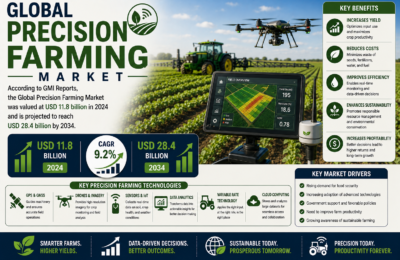
The global precision farming market was valued at USD 11.8 billion in 2024 and is projected to grow at a compound annual growth rate (CAGR) of approximately 9.2%, reaching USD 28.4 billion by 2034, according to GMI Reports. Precision farming, encompassing GPS-guided equipment systems, variable-rate input application technology, remote sensing and satellite imagery analytics, and integrated farm management software platforms, continues to represent one of the most commercially significant technology adoption categories within global agriculture.
Market growth is driven by sustained farmer recognition of precision farming’s input cost reduction and yield optimization benefits, continued technology cost decline making precision capability accessible to a broader range of farm sizes, and accelerating integration of artificial intelligence and machine learning analytics capability into precision farming software platforms. Major agricultural equipment manufacturers and specialized agtech companies continue to expand precision farming product portfolios and platform interoperability capability.
North America retains the largest precision farming market position, reflecting the region’s large-scale commercial farming operation structure and early technology adoption history, while Europe, Latin America, and increasingly Asia Pacific represent significant and accelerating growth markets as precision farming technology costs decline and government agricultural modernization policy support expands across these regions.
Market Overview
The global precision farming market encompasses guidance and steering systems, variable-rate application technology, remote sensing and satellite/drone-based crop monitoring platforms, yield mapping and monitoring systems, and integrated farm management software solutions enabling data-driven, site-specific agricultural input application and management decision-making. The market serves farming operations across virtually every major agricultural production system and farm size category globally.
Precision farming technology fundamentally enables farmers to optimize input application, including seed, fertilizer, and crop protection products, at a sub-field or even individual plant level of resolution, replacing historical uniform whole-field application approaches with site-specific application calibrated to actual soil conditions, yield potential, and crop requirement variability within individual fields. This capability delivers both meaningful input cost reduction and yield optimization benefits that collectively drive the compelling economic value proposition underlying continued precision farming market growth.
The market continues to evolve from its historical foundation in GPS-guided equipment steering and basic yield mapping toward increasingly sophisticated integrated platforms combining satellite and drone-based remote sensing, soil and plant health analytics, weather data integration, and artificial intelligence-driven decision support capability. This platform sophistication evolution is transforming precision farming from a discrete technology category toward a comprehensive digital farm management ecosystem encompassing the full agricultural production decision-making process.
Market Size & Forecast
Market Driving Factors
1. Input Cost Reduction and Return on Investment Realization
Precision farming technology’s demonstrated capacity to reduce seed, fertilizer, and crop protection input costs through site-specific application optimization continues to provide a compelling and increasingly well-documented return on investment case driving sustained grower adoption. As input costs have risen substantially across major agricultural input categories, the relative value proposition of precision application optimization technology has correspondingly strengthened.
2. Declining Technology Costs Broadening Accessibility
Continued technology cost decline across GPS guidance systems, sensors, and software platform subscription pricing has progressively broadened precision farming accessibility beyond large-scale commercial operations toward mid-sized and increasingly smaller farming operations. This accessibility expansion has substantially broadened the addressable precision farming market beyond its historical concentration among the largest and most well-capitalized farming operations.
3. Artificial Intelligence and Machine Learning Analytics Integration
Accelerating integration of artificial intelligence and machine learning-driven analytics capability into precision farming software platforms is substantially enhancing decision support sophistication, enabling more accurate yield prediction, pest and disease risk identification, and input application optimization recommendations. This analytics sophistication evolution continues to strengthen precision farming’s value proposition and is driving premium platform subscription and service revenue growth.
4. Satellite and Drone-Based Remote Sensing Technology Advancement
Continued advancement and cost reduction in satellite imagery resolution and availability, combined with expanding commercial drone-based crop monitoring service availability, has substantially improved the frequency, resolution, and actionability of remote sensing-derived crop and soil condition data available to support precision farming decision-making, expanding both the technical capability and commercial accessibility of remote sensing-based precision farming applications.
5. Agricultural Labor Shortage Driving Automation and Efficiency Technology Adoption
Persistent agricultural labor shortage conditions across numerous major agricultural economies have elevated grower interest in precision farming technology’s capacity to enhance operational efficiency and reduce labor requirements through automated guidance, variable-rate application, and integrated farm management capability, positioning precision farming adoption as both an efficiency and labor constraint management strategy.
6. Government Agricultural Technology Adoption Policy Support
Numerous governments across both mature and emerging agricultural economies maintain targeted policy support for precision farming technology adoption, including equipment subsidy programs, rural broadband infrastructure investment supporting connected agriculture technology functionality, and technical extension services promoting precision farming practice education and adoption among target grower populations.
Market Restraining Factors
1. High Initial Capital Investment and Technology Integration Costs
Comprehensive precision farming technology adoption, encompassing guidance systems, variable-rate equipment, sensors, and software platform subscriptions, requires meaningful capital investment that presents adoption barriers for smaller-scale farming operations, particularly across emerging agricultural economies where farmer capital access and financing infrastructure remain less developed relative to mature agricultural credit markets.
2. Rural Connectivity and Data Infrastructure Limitations
Many agricultural production regions globally continue to experience limited broadband and cellular connectivity infrastructure necessary for supporting data-intensive precision farming applications, including real-time field data transmission, cloud-based analytics platform access, and remote equipment monitoring capability. This connectivity gap constrains precision farming technology functionality and value realization across significant portions of the global addressable agricultural market.
3. Data Ownership, Privacy, and Interoperability Concerns
Persistent grower concerns regarding agricultural data ownership, privacy, and the proprietary, often poorly interoperable nature of different precision farming technology platforms and equipment manufacturer ecosystems continue to create adoption hesitancy and complicate multi-vendor technology integration for farming operations seeking to combine precision farming capabilities across different equipment and software providers.
4. Technical Knowledge and Skill Requirements for Effective Utilization
Realizing the full economic benefit potential of precision farming technology investment requires meaningful agronomic and technical skill development for effective data interpretation and decision-making application, presenting an adoption and utilization barrier for growers lacking access to adequate technical training resources or specialized agronomic consulting support necessary for sophisticated precision farming platform utilization.
Market Segmentation
By Technology
Guidance and steering systems retain a substantial market share given their foundational and broadly adopted role across precision farming implementation, though this category’s proportional share is gradually declining as more advanced analytics and remote sensing technology categories experience faster growth. Remote sensing and imagery analytics represent the fastest-growing technology category, benefiting from continued satellite and drone technology cost decline and analytical sophistication advancement.
By Offering
Hardware components retain the leading offering category market share, reflecting the substantial equipment and sensor infrastructure investment required for precision farming implementation. Software and analytics platforms represent the fastest-growing offering category, as increasing data volume and analytical sophistication shifts value capture increasingly toward the decision-support software layer rather than foundational hardware components alone.
By Farm Size
Competitive Landscape
The global precision farming market features a combination of major agricultural equipment manufacturers with integrated precision technology offerings, specialized precision agriculture technology companies, and satellite and remote sensing data providers. Competitive differentiation increasingly centers on platform interoperability, analytics sophistication, and integrated farm management ecosystem breadth.
Regional Analysis
North America represents the largest precision farming market, reflecting the region’s large-scale commercial farming operation structure, established technology adoption history, and substantial agricultural equipment manufacturer presence. Europe, Latin America, and Asia Pacific represent significant and increasingly fast-growing markets as precision farming technology accessibility expands.
Emerging Market Trends
AI-Powered Predictive Analytics and Decision Support Evolution
Precision farming software platforms are increasingly incorporating sophisticated artificial intelligence-driven predictive analytics capability, moving beyond historical data visualization toward proactive yield prediction, pest and disease risk forecasting, and optimized input application timing recommendations. This analytical sophistication evolution represents a significant value proposition enhancement driving premium platform subscription growth.
Platform Interoperability and Open Data Standard Development
Growing industry initiative toward improved precision farming platform interoperability and open agricultural data standard development is gradually addressing historical data silo and proprietary ecosystem fragmentation challenges, enabling growers to more effectively integrate precision farming capabilities across multiple equipment manufacturers and software providers within unified farm management workflows.
Autonomous Equipment and Precision Technology Convergence
Continued convergence between precision farming data and analytics capability and autonomous farm equipment operation is enabling increasingly sophisticated automated, data-driven field operation execution, where precision farming-derived insights directly inform and optimize autonomous equipment task execution without requiring manual operator intervention or decision-making.
Carbon and Sustainability Reporting Integration
Precision farming platforms are increasingly incorporating carbon footprint calculation and sustainability reporting capability, leveraging the detailed field-level input application and practice data already captured through precision farming systems to support growing corporate supply chain sustainability documentation and carbon credit market participation requirements.
Subscription-Based and Outcome-Based Pricing Model Expansion
Growing adoption of subscription-based software pricing models and emerging outcome-based pricing structures, where precision farming technology costs are tied to realized yield improvement or input cost savings, is expanding precision farming accessibility for growers seeking to manage adoption risk while aligning technology provider incentives with realized grower economic outcomes.
Key Companies in the Precision Farming Market
-
Deere & Company
-
Trimble Inc.
-
AGCO Corporation
-
CNH Industrial
-
Climate LLC (Bayer)
-
Topcon Positioning Systems
-
Raven Industries (CNH)
-
Planet Labs PBC
-
Taranis
-
Hexagon Agriculture
-
Specialized Regional Precision Agriculture Technology Providers
Report Target Audience
-
Agricultural Equipment Manufacturers
-
Precision Agriculture Technology and Software Companies
-
Commercial Farming Operations and Cooperatives
-
Investment and Private Equity Firms
-
Satellite and Remote Sensing Data Providers
-
Government Agricultural Technology and Policy Agencies
-
Agricultural Equipment Dealers and Distributors
-
Management and Strategy Consultants
-
Academic and Agricultural Engineering Research Institutions
Market Segmentation Summary
By Technology
-
Guidance & Steering Systems
-
Variable-Rate Application Technology
-
Remote Sensing & Imagery Analytics
-
Yield Monitoring & Mapping
-
Other Precision Technologies
By Offering
-
Hardware (Sensors, Guidance, Equipment)
-
Software & Analytics Platforms
-
Services (Consulting, Support)
By Farm Size
-
Large Commercial Farms
-
Mid-Size Farms
-
Small/Smallholder Farms
By Region
-
North America
-
Europe
-
Latin America
-
Asia Pacific
-
Middle East & Africa
About GMI Reports
GMI Reports is a premier market intelligence and research organization providing data-driven insights and strategic analysis across global agriculture technology and digital farming markets. Our research empowers manufacturers, technology providers, and investors to navigate the evolving precision farming landscape with confidence. For the Precision Farming Market report and related research, visit www.gmigreports.com or contact our research team for customized intelligence solutions.
www.gmigreports.com