India Cosmetics Market Size & Overview
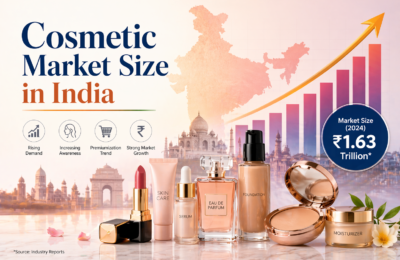
The cosmetic market size in India was valued at approximately USD 21.8 billion in 2024 and is projected to reach USD 72.4 billion by 2035, growing at a robust CAGR of 11.5% during the forecast period. This positions India as the fastest-growing major cosmetics market globally, surpassing the growth rates of China (8.4%), the United States (4.2%), and the European Union (3.8%) over the same period.
India’s cosmetics and personal care market stands at a historic inflection point — powered by the world’s largest youth demographic, a surging digital economy, rapidly expanding e-commerce penetration in Tier-2 and Tier-3 cities, and a fundamental shift in Indian consumer aspirations toward premium and science-backed beauty. The Indian cosmetics industry is transforming from a predominantly mass-market consumer goods sector into one of the world’s most dynamic and strategically significant beauty markets.
The market encompasses all commercially sold products applied to the external human body — skin, hair, nails, lips, and eyes — for cleansing, conditioning, protecting, perfuming, or altering appearance, including both conventional synthetic cosmetics and Ayurvedic/herbal personal care products.
Analyst Headline: India is not merely a high-growth emerging market for cosmetics — it is becoming a global innovation hub for Ayurvedic beauty science, clean formulation, and digital-first brand building. The 2025–2030 period represents the optimal entry or expansion window for brands seeking to secure long-term leadership in the world’s third-largest beauty market.
India in Global Context
| Country/Region | Market Size (2024) | CAGR (2025–35) | Global Rank | Key Differentiator |
|---|---|---|---|---|
| United States | $98.4B | 4.2% | 1st | Premiumization; DTC digital brands; mass luxury |
| China | $74.2B | 8.4% | 2nd | K-beauty influence; digital ecosystems; domestic giants |
| India | $21.8B | 11.5% | 3rd (vol.) | Fastest growth; Ayurvedic USP; Gen Z digital natives; DTC boom |
| Japan | $34.6B | 2.8% | 4th | Anti-aging science; functional skincare; domestic brand dominance |
| Brazil | $18.6B | 6.8% | 6th | Largest LatAm; hair care specialty; direct sales |
| South Korea | $14.8B | 5.2% | 7th | K-beauty innovation hub; global trend exporter |
Key Market Trends
Rising Preference for Ayurvedic & Herbal Beauty
The global clean beauty movement has merged with India’s ancient Ayurvedic tradition to create a uniquely Indian competitive advantage. Post-COVID-19, consumer preference for ‘natural,’ ‘herbal,’ and ‘chemical-free’ formulations surged across all consumer demographics, with 72% of Indian cosmetics consumers surveyed indicating preference for products with natural/herbal ingredients (Nielsen India, 2023). The Patanjali Ayurved revolution validated mass-market demand at scale, while premium brands like Forest Essentials and Kama Ayurveda established that Ayurvedic beauty can command luxury price points both domestically and internationally.
Digital Commerce & Social Commerce Revolution
India’s digital revolution — anchored by 800M+ smartphone users, 650M+ internet users, and the world’s cheapest mobile data (avg. INR 9/$0.11 per GB) — has created the infrastructure for a digital-first cosmetics economy. E-commerce accounted for 18.7% of cosmetics sales in 2024 — up from 8.2% in 2019 — growing at a 24.2% CAGR. Nykaa alone commands over 30% of India’s online beauty market with 20M+ monthly active users and 4,000+ brand partnerships. Quick commerce platforms (Blinkit, Zepto, Swiggy Instamart) are enabling 10-minute cosmetics delivery in urban India, creating impulse purchase behavior previously confined to physical retail.
Men’s Grooming Normalisation
India is experiencing a fundamental cultural shift in male attitudes toward personal grooming. Celebrity endorsements, OTT content normalizing male skincare routines, and K-pop/K-drama aesthetics among Gen Z men are dismantling historical social taboos. The men’s grooming market at USD 1.82 billion (2024) is growing at 16.4% CAGR — nearly 1.5x the overall market rate — and is expected to reach USD 9.2 billion by 2035.
Premiumization & Ingredient-Led Purchasing
India has emerged as one of the world’s most ingredient-literate beauty consumer markets. 64% of urban consumers aged 18–35 research specific cosmetics ingredients before purchasing. Google searches for niacinamide grew 840% between 2018–2024 in India — the highest growth of any major market globally. This ingredient literacy drives premiumization, with the ‘masstige’ segment (INR 400–1,500, or $5–$18) being the fastest-growing price tier.
Market Size & Forecast (2024–2035)
The cosmetic market size in India demonstrated remarkable resilience over the 2018–2024 period. COVID-19 caused a temporary contraction in 2020, particularly in color cosmetics, but skincare and haircare surged during lockdowns. The subsequent recovery (2022–2024) was the strongest in the market’s history, fueled by pent-up demand, digital commerce acceleration, and the Ayurvedic beauty wave.
Historical Market Size (2018–2024)
| Year | Market Size (USD B) | YoY Growth | INR Equivalent | Key Driver |
|---|---|---|---|---|
| 2018 | $12.4B | — | INR 86,800 Cr | Modern retail expansion; early digital penetration |
| 2019 | $14.2B | +14.5% | INR 99,400 Cr | E-commerce acceleration; Nykaa growth; Ayurvedic wave |
| 2020 | $12.8B | -9.9% | INR 89,600 Cr | COVID-19; color cosmetics collapse; skincare resilience |
| 2021 | $14.4B | +12.5% | INR 1,00,800 Cr | Recovery; at-home beauty; DTC brand explosion |
| 2022 | $17.1B | +18.8% | INR 1,19,700 Cr | Post-COVID revenge spending; premiumization surge |
| 2023 | $19.6B | +14.6% | INR 1,37,200 Cr | Rural expansion; men’s grooming; DTC IPO wave |
| 2024E | $21.8B | +11.2% | INR 1,52,600 Cr | Ayurvedic mainstream; beauty tech; intl. brand influx |
Market Forecast (2025–2035)
| Year | Market Size (USD B) | YoY Growth | INR Equivalent (Cr) | Primary Forecast Driver |
|---|---|---|---|---|
| 2025F | $24.4B | +11.9% | INR 1,70,800 Cr | Digital commerce deepening; rural premiumization; men’s grooming |
| 2026F | $27.2B | +11.5% | INR 1,90,400 Cr | Ayurvedic export markets; Gen Z spending power |
| 2027F | $30.4B | +11.8% | INR 2,12,800 Cr | Premium skincare democratization; beauty-tech AI |
| 2028F | $34.0B | +11.8% | INR 2,38,000 Cr | India cosmetics exports; luxury tier expansion |
| 2030F | $42.8B | +12.6% | INR 2,99,600 Cr | Middle class expansion; smart beauty products |
| 2032F | $53.2B | +11.3% | INR 3,72,400 Cr | Biotech beauty; personalization at scale |
| 2035F | $72.4B | +10.7% | INR 5,06,800 Cr | Full market maturation; Ayurvedic export hub |
Product Segmentation Analysis
The India cosmetics market is analyzed across seven primary product segments. Skincare is the dominant segment by value, while Ayurvedic/herbal beauty represents the fastest-growing category when assessed as a cross-cutting influence across all segments.
Market Share by Product Segment (2024)
| Product Segment | Revenue (USD M) | Market Share | CAGR 2025–35 | Growth Stage |
|---|---|---|---|---|
| Skincare | $6,190M | 28.4% | 13.2% | High Growth |
| Haircare | $5,014M | 23.0% | 9.8% | Growth |
| Color Cosmetics | $3,924M | 18.0% | 11.8% | High Growth |
| Fragrances & Deodorants | $2,398M | 11.0% | 9.4% | Moderate Growth |
| Oral Care | $1,852M | 8.5% | 7.6% | Mature Growth |
| Men’s Grooming | $1,816M | 8.3% | 16.4% | Very High Growth |
| Ayurvedic/Herbal Beauty | $654M | 3.0% | 19.8% | Hypergrowth |
| TOTAL | $21,800M | 100% | 11.5% | — |
Note on Ayurvedic Segment: The 3.0% standalone share understates the category’s true impact. When Ayurvedic-positioned products within skincare, haircare, and color cosmetics are aggregated, the ‘Ayurvedic influence market’ accounts for approximately 34–38% of total India cosmetics revenue in 2024 — the defining structural difference between India and all other major cosmetics markets globally.
Skincare — The Dominant & Fastest-Growing Segment
India’s skincare segment (USD 6.19 billion; 28.4% share) is being reshaped by three megatrends: science-backed ingredient consciousness (niacinamide, hyaluronic acid, retinol), sun protection mainstreaming driven by dermatologist education, and the explosion of the ‘glass skin’ aesthetic popularized by Korean beauty content. The traditional fairness cream category is undergoing repositioning toward ‘glow,’ ‘radiance,’ and ‘skin health’ narratives following regulatory and social pressure.
Men’s Grooming — The Breakthrough Category
Men’s grooming (USD 1.82 billion; 8.3% share) is India’s most dynamic transformation story, growing at 16.4% CAGR — expected to reach USD 9.2 billion by 2035. Indian male cosmetics spend (USD 31/year) remains dramatically below comparable Asian markets — USD 68 in China, USD 112 in South Korea — representing a structural underpenetration opportunity of 2–3x. The beard care sub-segment is the fastest-growing at 22.4% CAGR, driven by India’s 210M+ Muslim population alongside broader Gen Z male grooming normalization.
Distribution Channel Analysis
| Channel | 2024 Revenue | Share | CAGR 2025–35 | Key Dynamic |
|---|---|---|---|---|
| General Trade (Kirana/Traditional) | $7,196M | 33.0% | 7.8% | Rural & semi-urban dominance; sachets critical |
| Modern Trade (Supermarkets) | $3,924M | 18.0% | 10.2% | Urban; beauty aisles expanding; private label emergence |
| E-Commerce Marketplaces | $2,616M | 12.0% | 22.8% | Nykaa, Amazon, Flipkart, Meesho; largest growth vector |
| D2C Brand Websites | $1,526M | 7.0% | 26.4% | Mamaearth, WOW, Sugar; highest margin channel |
| Pharmacy/Chemist Channels | $1,744M | 8.0% | 12.4% | Dermatologist-recommended; sunscreen/skincare; trust |
| Beauty Specialty Stores | $654M | 3.0% | 11.4% | Nykaa offline; MAC; Sephora (limited) |
| Direct Sales/MLM | $588M | 2.7% | 5.2% | Oriflame, Avon, Modicare; declining relevance |
End-User & Consumer Demographics
India’s cosmetics consumer landscape is uniquely shaped by the country’s demographic structure — the youngest large-country demographic profile globally, with a median age of 28.4 years (2024) and 600+ million people under 25. This creates structural demand fundamentally different from mature markets like Japan, Germany, and the United States.
| Consumer Segment | Population (2024) | Avg. Annual Spend | Market Share | CAGR 2025–35 |
|---|---|---|---|---|
| Gen Z Female (16–28) | 142M | INR 4,200 ($50) | 16.8% | 18.4% |
| Millennial Female (29–43) | 168M | INR 6,800 ($82) | 24.2% | 12.8% |
| Gen X Female (44–58) | 88M | INR 5,400 ($65) | 12.4% | 8.4% |
| Gen Z Male (16–28) | 148M | INR 1,800 ($22) | 7.2% | 22.4% |
| Millennial Male (29–43) | 174M | INR 2,600 ($31) | 12.4% | 16.8% |
| Children (personal care) | 284M | INR 800 ($10) | 9.2% | 7.8% |
| Rural Consumer (cross-gender) | 900M | INR 680 ($8) | 8.2% | 11.8% |
Demographic Insight: India adds more new cosmetics consumers each year than the total population of Germany. The 350M Gen Z cohort entering their peak beauty years between 2025–2035 will drive volume growth that no other global market can replicate. This demographic dividend is India’s deepest competitive moat.
Growth Drivers & Market Dynamics
- India’s Demographic Dividend — The Structural Growth EngineWith 600M+ people under 25 and a median age of 28.4 years, India has a disproportionately large cohort entering peak cosmetics-spending years (22–40) over the next decade. The addition of 120–140 million new cosmetics consumers annually from Gen Z reaching adult purchase age is an organic demand tailwind with no historical parallel in any market.
- Digital Commerce & Smartphone Penetration (800M+ Users)India’s UPI payment infrastructure (8B+ monthly transactions in 2024), 650M+ internet users, and world’s cheapest mobile data have created the infrastructure for digital-first cosmetics. E-commerce growing at 24.2% CAGR; Nykaa’s 20M+ MAUs; social commerce on Instagram (300M+ users) and YouTube (450M+ viewers) driving ingredient-aware, digitally informed purchase decisions.
- Rising Female Workforce Participation (37.0% in 2024, up from 26.3% in 2018)40–50 million women added to India’s formal workforce between 2019–2024. Working women represent the highest-value cosmetics customer segment with independent income, professional appearance consciousness, and greater social media exposure to beauty trends.
- Premiumization Trend — Income Growth & Middle Class ExpansionIndia’s per capita GDP crossed USD 2,500 in 2023; the middle class is expected to double from 300M to 600M by 2030. The masstige segment (INR 400–1,500) is the fastest-growing price tier, with ingredient-literate consumers trading up to clinically validated formulations.
- Ayurvedic Renaissance & Clean Beauty Convergence72% of Indian cosmetics consumers prefer products with natural/herbal ingredients (Nielsen India, 2023). The Ayurvedic beauty segment growing at 19.8% CAGR represents India’s unique global competitive moat — aligning perfectly with the global clean beauty movement and India’s indigenous formulation heritage.
- Government Policy Support — Make in India, PLI & Digital IndiaPLI schemes for specialty chemicals providing 10–12% financial incentives for domestic production; PMGSY rural road connectivity expanding distribution reach; UPI digital payments enabling cashless cosmetics commerce in previously cash-dependent rural markets. India-EFTA FTA (signed March 2024) opening European luxury brand access and Indian export pathways.
Restraints & Risk Factors
| Restraint | Impact Level | Mitigation Outlook |
|---|---|---|
| Price Sensitivity & Affordability Barrier ~70% of India’s population on HHI below INR 6 lakh/year; premium products unaffordable without sachet formats. |
High | Sachet innovation; masstige bridges the gap; income growth 2025–2030 |
| Regulatory Complexity — D&C Act 1940 Overhaul Import licensing takes 6–18 months; proposed New Cosmetics Bill adding mandatory product registration. |
High | Long-term positive for quality; compliance investment required 2025–2027 |
| Counterfeit & Grey Market Products Estimated USD 1.2–1.8B annually (5.5–8.3% of organized market); 15–22% of unverified e-commerce sellers. |
Moderate–High | QR code authentication; blockchain supply chain; marketplace quality gates |
| Rupee Depreciation & Import Cost Inflation INR depreciated ~28% vs USD over 2014–2024; 64–82% import dependence for UV filters, specialty actives. |
Moderate | Domestic specialty chemical scale-up; PLI-incentivized raw material localization |
| Infrastructure Gaps in Rural Markets Cold chain limitations; power reliability; last-mile distribution costs limit premium product range in rural India. |
Moderate | PMGSY road connectivity; mobile-first e-commerce penetration via Meesho, JioMart |
| Raw Material Quality & Ayurvedic Ingredient Traceability Adulteration of herbal extracts; inconsistent active concentrations; GACP adoption limited for export compliance. |
Low–Moderate | TKDL framework; GI tagging scheme; blockchain traceability investment by premium brands |
Scenario Analysis — Bull, Base & Bear Cases
| Scenario | 2035 Market Size | CAGR | Key Assumptions | Probability |
|---|---|---|---|---|
| Bull Case | $89.6 Billion | 13.8% | Full GST rationalization; India-EFTA trade deal enabling premium brand expansion; Ayurvedic exports triple; UPI-enabled rural e-commerce reaches 600M users; strong rupee stability | 20% |
| Base Case | $72.4 Billion | 11.5% | Steady digital commerce growth; continued DTC brand proliferation; moderate regulatory tightening; stable macroeconomics; normal monsoon cycles supporting rural income | 55% |
| Bear Case | $52.8 Billion | 8.6% | Prolonged rupee depreciation; GST rate increase on premium cosmetics; global recession reducing discretionary spend; safety scandal causing category trust erosion | 25% |
Regional & State-Level Analysis
The cosmetic market size in India exhibits pronounced regional variation driven by differences in income levels, building energy codes, pharmaceutical concentration, and cultural beauty traditions. West India leads by market share, while South India commands the highest per capita cosmetics spend.
| Region | 2024 Market Size | Share | CAGR | Primary Categories | Key Driver |
|---|---|---|---|---|---|
| West India MH, GJ, GOA, RJ, MP, CG |
$5,894M | 27.0% | 11.8% | Premium skincare; color; men’s grooming | Mumbai financial hub; Bollywood; Ahmedabad commercial |
| South India KA, TN, AP, TS, KL |
$5,240M | 24.0% | 12.4% | Skincare; haircare; Ayurvedic; premium fragrances | Highest per capita; IT economy; Bengaluru/Hyderabad |
| North India DL NCR, UP, HR, PB, HP, JK |
$4,590M | 21.0% | 10.8% | Haircare; fragrances; bridal; men’s grooming | Bridal/wedding market; Delhi premium; largest rural volume |
| East India WB, BR, JH, OD, NE States |
$2,834M | 13.0% | 10.4% | Haircare; basic skincare; mass; Ayurvedic | Kolkata trading hub; growing rural penetration |
| Northeast India AS, ML, MN, NL, MZ, TR, AR, SK |
$1,308M | 6.0% | 13.2% | K-beauty; skincare; color cosmetics | K-beauty gateway; unique skin characteristics; digital access |
State-Level Highlights
Maharashtra (Mumbai): India’s largest state cosmetics market at ~$3,490M, driven by Bollywood beauty culture, India’s highest luxury retail concentration, and the DTC brand headquarters ecosystem. Per capita spend INR 2,770 — 4th highest nationally.
Delhi NCR: Highest per capita cosmetics spend in India at INR 3,806, driven by media industry, luxury retail, and India’s most developed bridal cosmetics market. Premium fragrance and color cosmetics over-indexed vs national average.
Karnataka (Bengaluru): India’s IT capital with highest online cosmetics penetration nationally. Leading adoption of K-beauty and international skincare actives. Male grooming market driven by young tech professional demographic.
Kerala: India’s Ayurvedic heartland with premium Ayurvedic beauty tourism. Unique demand for traditional Kerala herbal cosmetics and coconut-based personal care. Highest literary rate correlates with highest ingredient awareness.
Northeast India — K-Beauty Gateway: Geographic proximity to Southeast and East Asia creates 2–3x higher K-beauty penetration vs national average. Manipur and Assam are organically India’s entry points for Korean beauty products and trends.
Competitive Landscape & Key Players
India’s cosmetics competitive landscape is characterized by two-tier competition between established multinational FMCG giants (HUL, L’Oréal, P&G) and a rapidly scaling ecosystem of Indian DTC digital-native brands (Mamaearth, WOW, Sugar, Minimalist) that have captured significant market share in premium and masstige segments within 5–8 years of launch.
| Company | Category | Est. India Revenue (2024) | Market Share | Key Brands |
|---|---|---|---|---|
| Hindustan Unilever Ltd (HUL) | Diversified FMCG | $3,720M | 17.1% | Lakme, Dove, Ponds, Sunsilk, Indulekha, Glow & Lovely |
| L’Oréal India | Beauty specialist | $1,860M | 8.5% | L’Oréal Paris, Garnier, Maybelline, Kiehl’s, NYX, Kerastase |
| Marico India | Hair & skin | $1,248M | 5.7% | Parachute, Saffola, Set Wet, Beardo, Nihar |
| Dabur India | Ayurvedic FMCG | $1,092M | 5.0% | Vatika, DermoViva, Fem, Gulabari |
| Emami Group | Ayurvedic/mass | $874M | 4.0% | Fair & Handsome, Kesh King, Navratna, BoroPlus |
| Procter & Gamble India | FMCG | $786M | 3.6% | Pantene, Head & Shoulders, Olay, Gillette |
| Mamaearth (Honasa Consumer) | DTC natural beauty | $626M | 2.9% | Mamaearth, Derma Co., Aqualogica, Dr. Sheth’s |
| ITC Limited (FMCG) | Diversified FMCG | $568M | 2.6% | Fiama, Engage, Vivel |
| WOW Skin Science | DTC natural | $382M | 1.8% | WOW ACV, WOW Vitamin C, WOW Onion |
| Sugar Cosmetics | DTC color cosmetics | $284M | 1.3% | Sugar Cosmetics (full color range), Scratch (nail) |
| Other Players (300+ brands) | Various | $9,450M | 43.3% | Forest Essentials, Minimalist, Plum, mCaffeine, K-beauty imports |
Future Outlook & Analyst Recommendations
By 2035, India’s cosmetics market will be fundamentally transformed — not in scale alone (USD 72.4 billion vs USD 21.8 billion today) but in structure, sophistication, and global positioning. Five transformations will define the market:
- India as Global Ayurvedic Beauty Standard-SetterIndian brands will establish premium positions in the most sophisticated global markets (USA, France, Japan, South Korea), setting global standards for Ayurvedic cosmetics quality, ingredient traceability, and clinical evidence. Ayurvedic exports are projected to exceed USD 8 billion by 2035.
- Gen Z Consumer Dominance by 2030350 million young adults with digital-native shopping behavior, global beauty awareness, and increasing purchasing power will demand unprecedented personalization, ingredient transparency, and sustainability credentials — reshaping the entire market’s product development and communication approach.
- Male Beauty Mainstreaming — USD 9.2B Market by 2035The social stigma around male beauty care will have been eroded by a decade of Gen Z cultural normalization, creating the world’s largest untapped male beauty market after China. Men’s grooming becomes a core cosmetics category, no longer a niche.
- Digital Commerce Dominance — 38–45% of Sales by 2035Online channels will dominate cosmetics sales by 2035, with quick commerce (10–60 minute delivery) enabling impulse purchase dynamics across Tier-1 and Tier-2 cities. Physical retail restructures around experiential and professional services.
- Beauty Tech Revolution — USD 3–5B Sub-Market by 2035AI-personalized formulations, at-home skin analysis devices, smart beauty tools, and biotechnology-derived ingredients constitute a significant beauty technology sub-market, with smartphone-based skin analysis used by 100M+ Indian consumers by 2028.
Technology Milestone Timeline
| Year | Projected Milestone | Confidence | Commercial Impact |
|---|---|---|---|
| 2025 | India-EFTA FTA reduces cosmetics import duties; European luxury brands accelerate India expansion | High | Luxury cosmetics market acceleration; Indian Ayurvedic brands gain Swiss market access |
| 2025–26 | New Drugs, Medical Devices & Cosmetics Bill enacted; new regulatory framework for cosmetics | High | Compliance investment surge; quality improvement; barrier to counterfeit entry |
| 2026 | India’s Gen Z cohort reaches 25+ years; peak spending age cohort exceeds 150M consumers | Certain | Structural demand acceleration across premium and color categories |
| 2027 | Ayurvedic cosmetics GI tagging scheme operational; export standardization framework live | Moderate–High | Indian Ayurvedic export premium pricing; USD 2B+ export milestone |
| 2028 | AI skin analysis mainstream; 100M+ Indian consumers using smartphone-based skin diagnostics | Moderate | Personalized skincare market; recommendation commerce integration |
| 2029 | India’s cosmetics market crosses USD 38 billion; overtakes Japan as Asia’s second-largest market | Moderate–High | Strategic priority elevation for all global beauty corporations |
| 2030 | Male grooming market reaches USD 6B; largest Asian male grooming market after China | Moderate | Major Western male beauty brands commit India as primary growth market |
| 2035 | India cosmetics crosses USD 72.4 billion; 4th globally; Ayurvedic export exceeds USD 8B | Base Case | India established as global beauty market leader by volume growth |
Final Analyst Assessment: India’s cosmetics market is the most compelling medium-term growth opportunity in global beauty — combining demographic inevitability, cultural uniqueness (Ayurvedic heritage), digital infrastructure maturity, and an emerging class of globally competitive domestic brands. The 2025–2030 investment window is critical: brands, investors, and retail partners that commit to India during this period will benefit disproportionately from the USD 50 billion in market growth expected between 2024 and 2035.