MARKET RESEARCH REPORT
Agriculture Robots Market
Global Insights, Analysis & Forecasts to 2034
Published by GMI Reports | www.gmigreports.com
Executive Summary
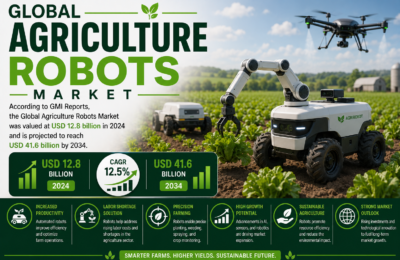
The global agriculture robots market was valued at USD 12.8 billion in 2024 and is projected to grow at a compound annual growth rate (CAGR) of approximately 12.5%, reaching USD 41.6 billion by 2034, according to GMI Reports. This robust growth trajectory reflects the convergence of acute global agricultural labor shortages, rising adoption of precision farming practices, and continued technological maturation of autonomous navigation, computer vision, and robotic manipulation systems suited to demanding outdoor agricultural environments.
Autonomous tractors and unmanned aerial vehicles collectively represent the largest product categories within the market, reflecting their relatively mature commercial deployment status and broad applicability across diverse crop types and farm operations. Harvesting robots, while representing a comparatively smaller current market share, are exhibiting the fastest growth rate as computer vision and robotic gripping technology increasingly achieves the dexterity required for delicate fruit and vegetable harvesting applications previously considered automation-resistant.
North America and Europe currently represent the largest regional markets, supported by large-scale commercial farming operations, sustained agricultural technology investment, and significant farm labor cost and availability pressures. The Asia Pacific region is exhibiting the fastest growth rate, driven by aggressive government agricultural modernization initiatives, particularly across China, Japan, and South Korea, where demographic decline within farming communities has created urgent automation necessity.
Market Overview
The agriculture robots market encompasses autonomous and semi-autonomous robotic systems designed to perform agricultural tasks including planting, weeding, spraying, harvesting, sorting, and field monitoring across both outdoor field crop and controlled-environment agriculture applications. The market spans ground-based robotic platforms, unmanned aerial vehicles, and robotic systems integrated within broader precision agriculture technology ecosystems incorporating GPS guidance, computer vision, and data analytics capabilities.
Agriculture robots address a fundamental and intensifying global challenge: declining agricultural workforce availability amid rising food production demand from a growing global population. Rural-to-urban migration trends, demographic aging within farming communities across developed and increasingly developing economies, and growing reluctance among younger generations to pursue traditional farm labor occupations have collectively created sustained commercial justification for agricultural automation investment across virtually all major farming regions globally.
Technological maturation across several foundational capabilities, including GPS and RTK positioning accuracy, computer vision-based crop and weed identification, machine learning-driven yield prediction, and increasingly dexterous robotic manipulation systems, has progressively expanded the range of agricultural tasks amenable to automation. This expanding capability envelope continues to drive new product category development and broaden the addressable market beyond historically automation-friendly tasks such as tractor guidance toward more complex applications including selective harvesting and precision weeding.
Market Size & Forecast
Market Driving Factors
1. Global Agricultural Labor Shortage
Persistent and intensifying agricultural labor shortages across major farming regions globally, driven by rural population decline, demographic aging within farming communities, and reduced younger generation interest in agricultural labor occupations, represent the foundational driver of agriculture robots market growth. This labor availability constraint affects virtually all major global farming regions, creating sustained and geographically broad-based commercial justification for robotic automation investment.
2. Precision Agriculture Adoption Acceleration
Growing farmer adoption of precision agriculture practices, leveraging GPS guidance, variable rate application technology, and data-driven decision support systems, has created a natural technology adoption pathway toward increasingly autonomous robotic field operations. Farmers already invested in precision agriculture data infrastructure represent a receptive customer base for agriculture robots that can further enhance the precision and efficiency benefits delivered by existing technology investments.
3. Rising Input Cost Pressures and Resource Optimization Needs
Escalating costs associated with fertilizer, pesticide, water, and fuel inputs have intensified farmer focus on precision resource application technologies capable of minimizing waste while maintaining or improving crop yield outcomes. Agriculture robots equipped with computer vision and targeted application capabilities enable significantly more precise input application compared to conventional broadcast application methods, generating compelling input cost savings justification for automation investment.
4. Computer Vision and AI Technology Maturation
Continued advancement in computer vision, machine learning, and sensor fusion technologies has progressively expanded agriculture robots’ capability to perform increasingly complex tasks including selective fruit harvesting, weed-versus-crop differentiation, and real-time crop health assessment. This technological maturation continues to broaden the range of commercially viable agriculture robot applications, expanding the market’s addressable scope beyond historically automation-friendly tasks.
5. Government Agricultural Modernization Policy Support
Numerous national governments have implemented targeted agricultural technology modernization policies, including direct subsidies, tax incentives, and research funding support for agriculture robotics adoption. These policy initiatives, particularly prominent across East Asian markets facing acute farming demographic challenges and within the European Union’s broader sustainable agriculture policy framework, provide meaningful market growth tailwinds beyond pure commercial adoption economics.
6. Sustainability and Reduced Chemical Input Demand
Growing consumer and regulatory pressure toward reduced agricultural chemical input usage has elevated interest in robotic weeding and precision spraying technologies capable of achieving effective pest and weed management with substantially reduced herbicide and pesticide application volumes. This sustainability-driven demand provides agriculture robots with an increasingly important value proposition beyond pure labor cost substitution, appealing to environmentally conscious farming operations and food supply chain sustainability commitments.
Market Restraining Factors
1. High Upfront Capital Investment Costs
Agriculture robots typically require substantial upfront capital investment relative to conventional farming equipment, presenting meaningful adoption barriers particularly for small and medium-sized farming operations with constrained capital availability. While total cost of ownership calculations frequently favor automation over extended operational periods, the significant initial investment requirement continues to constrain broader market penetration beyond larger, well-capitalized commercial farming operations.
2. Technical Limitations in Variable Field Conditions
Agriculture robots continue to face meaningful technical performance limitations when operating across highly variable field terrain, weather conditions, and crop variety characteristics. Robotic systems optimized for specific crop types or field conditions may demonstrate reduced reliability or effectiveness when deployed across the diverse and often unpredictable conditions characteristic of real-world farming operations, constraining universal applicability.
3. Farmer Technology Adoption and Digital Literacy Barriers
Adoption of sophisticated agriculture robotics technology requires meaningful farmer technical proficiency and comfort with digital interfaces, data analytics platforms, and robotic system operation and maintenance procedures. Generational and educational variation in farmer technology comfort levels, particularly within smaller and family-operated farming businesses, can constrain adoption rates despite favorable underlying automation economics.
4. Connectivity and Infrastructure Limitations in Rural Areas
Many agriculture robot systems rely on reliable internet connectivity, GPS positioning accuracy, and supporting digital infrastructure that remains inconsistently available across rural farming regions globally, particularly within developing agricultural economies. This infrastructure limitation constrains agriculture robots’ practical deployment viability in certain geographic markets despite otherwise favorable labor shortage and adoption economics.
Market Segmentation
By Product Type
Autonomous tractors and ground vehicles retain the leading product category position, reflecting their relatively mature commercial deployment history and broad applicability across field preparation, planting, and general field operation tasks. Harvesting robots represent the fastest-growing product category, driven by accelerating computer vision and robotic manipulation technology advancement enabling increasingly capable selective and delicate crop harvesting automation.
By Application
Field crop farming applications retain the dominant revenue share, supported by the scale and standardization advantages of large-acreage grain and row crop operations that favor automation economics. Fruit and vegetable production applications are experiencing the fastest growth, as harvesting robot technology increasingly achieves the dexterity and visual recognition accuracy required for commercially viable automated harvesting of delicate, high-value specialty crops.
By Farm Size
Competitive Landscape
The agriculture robots market features a combination of established global agricultural equipment manufacturers expanding into robotics capabilities, specialized agriculture robotics startups pursuing focused application innovation, and major drone and robotics technology companies entering the agricultural automation space. Competitive differentiation increasingly centers on application-specific performance validation, total cost of ownership economics, and after-sales service and support infrastructure.
Regional Analysis
The agriculture robots market exhibits distinct regional adoption patterns shaped by farm size structure, labor cost dynamics, and government policy support. North America and Europe currently lead in market revenue given their large-scale commercial farming operations and sustained agricultural technology investment, while Asia Pacific is emerging as the fastest-growing region.
Emerging Market Trends
Multi-Robot Fleet Coordination and Swarm Farming
Advancing capability in multi-robot fleet coordination is enabling agricultural operations to deploy coordinated swarms of smaller, specialized robots working collaboratively across large field areas, rather than relying on single large autonomous machines. This swarm farming approach offers potential advantages in deployment flexibility, redundancy, and the ability to perform multiple simultaneous tasks across different field sections.
AI-Powered Predictive and Prescriptive Field Analytics
Agriculture robots are increasingly integrated with advanced AI-driven predictive analytics capabilities, enabling systems to anticipate crop health issues, optimize harvest timing, and prescribe precise input application strategies based on continuously collected field data. This evolution toward prescriptive, data-driven agricultural decision-making represents a significant value-add beyond pure task automation, enhancing overall farm management sophistication.
Modular and Multi-Purpose Robotic Platform Development
Equipment manufacturers are increasingly developing modular robotic platforms capable of supporting multiple interchangeable task-specific attachments, enabling a single robotic base platform to perform planting, weeding, spraying, and monitoring functions through attachment swapping. This modular approach improves capital utilization efficiency and broadens the addressable customer base among farms seeking versatile automation investment.
Robotics-as-a-Service and Subscription Adoption Models
Subscription-based and pay-per-use agriculture robotics service models are gaining traction, particularly among small and medium-sized farming operations seeking automation benefits without substantial upfront capital investment. These flexible business models, often delivered through agricultural technology service providers and equipment cooperatives, are expanding agriculture robots’ addressable market beyond large, well-capitalized commercial farming operations.
Integration with Carbon Farming and Regenerative Agriculture Practices
Growing interest in carbon farming and regenerative agriculture practices is driving development of specialized agriculture robots capable of supporting precision cover cropping, reduced-tillage operations, and soil health monitoring functions. This trend reflects the broader convergence between agriculture automation technology and sustainability-focused farming practice adoption, supported by emerging carbon credit and sustainable agriculture certification market incentives.
Key Companies in the Agriculture Robots Market
-
Deere & Company
-
AGCO Corporation
-
CNH Industrial
-
Naio Technologies
-
Lely Industries
-
DJI Agriculture
-
XAG Co., Ltd.
-
Harvest Automation
-
Small Robot Company
-
FarmWise Labs
-
Other Specialized Agriculture Robotics Startups
Report Target Audience
-
Agricultural Equipment Manufacturers
-
Agriculture Robotics and AgTech Startups
-
Large-Scale Commercial Farming Operations
-
Investment and Venture Capital Firms
-
Government Agricultural Policy and Subsidy Agencies
-
Agricultural Cooperatives and Equipment Dealers
-
Management and Strategy Consultants
-
Academic and Agricultural Research Institutions
Market Segmentation Summary
By Product Type
-
Autonomous Tractors & Ground Vehicles
-
Unmanned Aerial Vehicles (Drones)
-
Harvesting Robots
-
Robotic Milking Systems
-
Weeding & Spraying Robots
By Application
-
Field Crop Farming
-
Dairy & Livestock
-
Fruit & Vegetable Production
-
Greenhouse & Indoor Farming
By Farm Size
-
Large Commercial Farms (500+ acres)
-
Medium Farms (50-500 acres)
-
Small Farms (Under 50 acres)
By Region
-
North America
-
Europe
-
Asia Pacific
-
Latin America
-
Middle East & Africa
About GMI Reports
GMI Reports is a premier market intelligence and research organization providing data-driven insights and strategic analysis across global agricultural technology and industrial automation markets. Our research empowers manufacturers, technology providers, and investors to navigate the evolving agricultural automation landscape with confidence. For the Agriculture Robots Market report and related research, visit www.gmigreports.com or contact our research team for customized intelligence solutions.
www.gmigreports.com