MARKET RESEARCH REPORT
CRISPR Technology Market
Global Insights, Analysis & Forecasts to 2034
Published by GMI Reports | www.gmigreports.com
Executive Summary
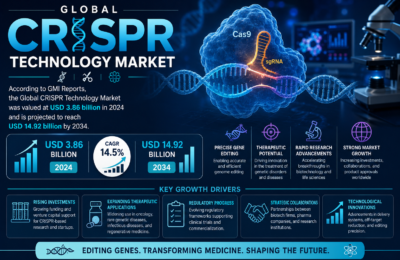
The global CRISPR technology market was valued at USD 3.86 billion in 2024 and is projected to grow at a compound annual growth rate (CAGR) of approximately 14.5%, reaching USD 14.92 billion by 2034, according to GMI Reports. CRISPR-Cas9 and its derivative genome editing systems have fundamentally transformed the life sciences landscape since their development as a precision editing tool, enabling targeted, programmable modification of DNA sequences across virtually every biological system with unprecedented precision, efficiency, and accessibility compared to earlier gene editing platforms.
The global CRISPR technology market stands at an inflection point driven by the landmark regulatory approval of the first CRISPR-based human therapeutic, Casgevy, for sickle cell disease and beta-thalassemia in the United States and United Kingdom in late 2023, establishing definitive proof-of-concept for CRISPR’s clinical translational potential and catalyzing substantial accelerated investment across the broader CRISPR therapeutic development pipeline. This approval milestone has materially reaffirmed investor confidence and strategic corporate partnership interest in CRISPR technology across the global biotechnology and pharmaceutical industry.
North America dominates the global CRISPR market, anchored by the United States’ unparalleled concentration of CRISPR research institutions, venture capital investment infrastructure, and commercial biotechnology company ecosystem, while Europe and Asia Pacific represent significant and rapidly growing secondary markets. The market continues to evolve across therapeutic, agricultural, diagnostic, and research tool application categories, each at distinct commercial maturity stages with differentiated near-term and long-term revenue contribution trajectories.
Market Overview
The global CRISPR technology market encompasses the full commercial ecosystem of CRISPR-based products and services, including CRISPR research reagents and tools, gene editing service and contract research organization offerings, CRISPR-based therapeutic product development and commercialization, agricultural genomics application development, and CRISPR diagnostic platform products. The market serves academic research institutions, government research organizations, pharmaceutical and biotechnology companies, agricultural companies, and clinical healthcare providers across every major global economy.
CRISPR technology’s foundational commercial advantage relative to predecessor gene editing platforms including zinc finger nucleases and TALENs lies in its dramatically reduced complexity and cost of guide RNA design and synthesis, enabling any laboratory with basic molecular biology capability to implement genome editing experiments that previously required specialized protein engineering expertise. This democratization of gene editing capability has driven explosive adoption across academic research globally, creating a substantial and continuously expanding research reagent and service market underpinning the technology’s commercial ecosystem.
The commercial CRISPR market has matured considerably from its initial academic research tool origins toward an increasingly diversified commercial landscape. The first regulatory approval of a CRISPR therapeutic in 2023 opened the definitive commercial therapeutic revenue era, while CRISPR-based agricultural applications are navigating evolving regulatory frameworks across different jurisdictions that will substantially determine the pace of this category’s commercial development. CRISPR diagnostic applications have achieved meaningful commercial deployment, particularly following the technology’s adaptation for SARS-CoV-2 detection during the COVID-19 pandemic.
Market Size & Forecast
Market Driving Factors
1. First CRISPR Therapeutic Regulatory Approval Milestone
The 2023 regulatory approval of Casgevy, a CRISPR-based gene therapy developed by Vertex Pharmaceuticals and CRISPR Therapeutics, for sickle cell disease and transfusion-dependent beta-thalassemia in the United States and United Kingdom, represents the most significant commercial milestone in CRISPR technology’s translational history. This approval has definitively validated CRISPR’s human therapeutic applicability, catalyzed accelerated pipeline investment, and materially improved investment community confidence across the broader CRISPR therapeutic development sector.
2. Expanding Therapeutic Pipeline Across Multiple Disease Indications
A rapidly expanding global CRISPR therapeutic clinical development pipeline spanning oncology, inherited genetic disorders, infectious disease, and cardiovascular risk reduction indications continues to generate substantial commercial market activity across research service, contract manufacturing, licensed intellectual property, and clinical development cost categories. Multiple programs are advancing through Phase 1 and Phase 2 clinical trials with several anticipated to enter pivotal studies within the forecast period.
3. Continuous Technology Innovation and Next-Generation System Development
Sustained academic and commercial research investment in next-generation CRISPR system development, including base editing, prime editing, CRISPR-based epigenome editing, and CRISPR interference and activation platforms, continues to expand the technology’s therapeutic and research application scope while generating new intellectual property licensing revenue opportunities and creating differentiated commercial technology platform positions for leading CRISPR biotechnology companies.
4. Agricultural Application Regulatory Framework Evolution
Evolving global regulatory frameworks for precision breeding and new genomic technique agricultural applications, with several major jurisdictions including the United States, United Kingdom, Japan, Australia, and increasingly the European Union developing streamlined approval pathways for CRISPR-edited crop varieties, represents a potentially transformative commercial catalyst for agricultural CRISPR application development and commercialization, unlocking a large addressable commercial opportunity in crop improvement and livestock genomics.
5. Substantial Global Research Funding Infrastructure
Continued substantial public research funding for genomics and gene editing research through the United States NIH, European Horizon program, Chinese National Natural Science Foundation, and equivalent national funding agencies globally sustains a robust academic research ecosystem continuously generating CRISPR technology advancement and downstream commercial market development. Private venture capital and strategic pharmaceutical company partnership investment provides complementary commercial translation funding alongside public research support.
6. CRISPR Diagnostic Application Commercial Deployment
CRISPR-based diagnostic platforms leveraging Cas12 and Cas13 enzyme properties for highly sensitive nucleic acid detection have achieved meaningful commercial deployment across infectious disease diagnostics and are under development for oncology and genetic disorder diagnostic applications. The technology’s potential for point-of-care diagnostic format development provides a commercially accessible and relatively near-term revenue contribution category complementing the longer development horizon therapeutic market.
Market Restraining Factors
1. Complex and Evolving Intellectual Property Landscape
The global CRISPR intellectual property landscape remains one of the most extensively litigated and complex in biotechnology history, involving foundational patent portfolios from the Broad Institute, University of California Berkeley, and multiple international academic institutions alongside growing commercial entity patent positions. This IP complexity creates licensing cost burden, freedom-to-operate uncertainty, and commercial development risk that must be carefully managed by companies seeking to build CRISPR-based commercial programs across all application categories.
2. Off-Target Editing and Safety Validation Requirements
Rigorous characterization and minimization of CRISPR editing off-target effects and unintended genomic modifications remains a critical safety validation requirement for therapeutic applications, requiring substantial preclinical research investment and potentially extended regulatory review processes that add to therapeutic development cost and timeline. Continued improvement in editing specificity through next-generation system development is progressively addressing this concern but remains an important scientific and regulatory focus.
3. Delivery System and Manufacturing Complexity Challenges
Effective in vivo delivery of CRISPR components to target tissues remains a significant technical challenge, particularly for applications requiring editing in tissues beyond the liver or hematopoietic cells where lipid nanoparticle and viral vector delivery systems have demonstrated greatest efficacy. Manufacturing complexity and cost for CRISPR therapeutic products, including specialized cell therapy manufacturing for ex vivo editing approaches, also represent meaningful development and commercialization cost considerations.
4. Ethical Debate and Human Germline Editing Moratorium
Ongoing global scientific and public ethical debate regarding human germline gene editing, catalyzed by the controversial 2018 case of heritable human embryo editing, has resulted in broad international scientific community and regulatory authority consensus against clinical germline editing applications, creating reputational risk considerations for the broader CRISPR field and potential for regulatory constraint expansion beyond germline applications if public confidence concerns are not effectively managed.
Market Segmentation
By Product Type
CRISPR reagents currently represent the largest product category, reflecting the technology’s broad foundational research adoption. However, CRISPR therapeutics are projected to emerge as the dominant revenue category by 2034, as multiple therapeutic products advance through clinical development toward commercial approval, generating substantial patient treatment revenue that will eclipse research tool market revenues by a significant margin within the forecast period.
By Application
Biomedical research represents the current dominant application, reflecting CRISPR’s comprehensive adoption across academic and pharmaceutical research workflows globally. Therapeutics is projected to surpass biomedical research as the leading revenue application category by 2030, driven by commercial product launches and expanding clinical stage programs generating significant development service and eventual product revenue within the forecast period.
By Technology
Competitive Landscape
The global CRISPR technology market features a diverse competitive ecosystem spanning foundational intellectual property holding academic institutions, dedicated CRISPR biotechnology companies advancing therapeutic pipelines, large pharmaceutical companies with CRISPR licensing and partnership programs, and life science tools companies commercializing CRISPR research reagents and services.
Regional Analysis
North America, anchored by the United States, dominates the global CRISPR technology market, accounting for the largest share of CRISPR research funding, venture capital investment, clinical trial activity, and commercial company formation. Europe represents a significant research and clinical development market, while Asia Pacific, led by China’s substantial CRISPR research program, represents the fastest-growing regional market.
Emerging Market Trends
CRISPR-Based Cancer Immunotherapy Acceleration
CRISPR genome editing is increasingly being applied to engineer enhanced cancer-fighting T cells and natural killer cells for adoptive cell therapy applications, enabling multiplex gene disruption and insertion strategies that produce allogeneic, off-the-shelf cell therapy products with improved tumor targeting and persistence. Multiple programs are advancing in clinical development for hematological malignancies and solid tumors, representing one of the most commercially significant near-term CRISPR therapeutic application categories.
In Vivo Delivery Technology Advancement
Continued advancement in lipid nanoparticle formulation technology, engineered viral vector systems, and emerging non-viral delivery platforms is expanding the tissue and organ targets accessible for in vivo CRISPR therapeutic delivery beyond the liver-dominant paradigm. This delivery technology progress is a prerequisite for realizing the full addressable therapeutic potential of CRISPR across diverse genetic disease indications requiring editing in muscle, lung, brain, and other target tissues.
CRISPR Agricultural Application Commercial Scaling
Several CRISPR-edited crop varieties have already reached commercial production in regulatory permissive jurisdictions including the United States and Japan, including disease-resistant crops, yield-enhanced varieties, and allergen-reduced food crops. Continued regulatory framework evolution across additional major agricultural markets will determine the pace at which the substantial commercial opportunity in CRISPR crop improvement translates into material market revenue contribution through the forecast period.
Point-of-Care CRISPR Diagnostic Platform Development
Growing investment in miniaturized, point-of-care CRISPR diagnostic platform development, enabling CRISPR-based nucleic acid detection outside centralized laboratory settings, is creating potential for transformative impact in infectious disease management across both developed and developing world healthcare settings. Several companies are advancing portable CRISPR diagnostic devices through clinical validation and regulatory approval processes targeting pathogen detection, STI testing, and cancer liquid biopsy applications.
Artificial Intelligence Integration in CRISPR Guide RNA Design
Advanced machine learning and artificial intelligence tools are increasingly being applied to CRISPR guide RNA design, off-target prediction, and therapeutic system optimization, substantially improving editing efficiency and specificity characterization speed and accuracy. These AI-assisted design tools are becoming standard components of commercial CRISPR research and development workflows, compressing experimental timelines and supporting more systematic therapeutic candidate optimization.
Key Companies in the Global CRISPR Technology Market
-
CRISPR Therapeutics AG
-
Intellia Therapeutics
-
Editas Medicine
-
Beam Therapeutics
-
Prime Medicine
-
Vertex Pharmaceuticals
-
Caribou Biosciences
-
Mammoth Biosciences
-
Integrated DNA Technologies (IDT)
-
Sigma-Aldrich (Merck KGaA)
-
Thermo Fisher Scientific
-
Addgene (Non-profit plasmid repository)
Report Target Audience
-
Pharmaceutical and Biotechnology Companies
-
Academic and Government Research Institutions
-
CRISPR Tool, Reagent, and Service Providers
-
Venture Capital and Investment Firms
-
Agricultural Biotechnology and Seed Companies
-
Healthcare and Diagnostic Device Companies
-
Government Science and Technology Policy Agencies
-
Management and Strategy Consultants
-
Academic Researchers in Genomics, Gene Therapy, and Biotechnology
Market Segmentation Summary
By Product Type
-
CRISPR Reagents (Guide RNA, Cas Proteins, Kits)
-
CRISPR Services (CRO, Gene Editing)
-
CRISPR Therapeutics (Commercial & Pipeline)
-
CRISPR Diagnostics
By Application
-
Biomedical Research
-
Therapeutics
-
Agricultural Genomics
-
Diagnostics
By Technology Platform
-
CRISPR-Cas9
-
Base Editing
-
Prime Editing
-
Cas12/Cas13 Systems
By Region
-
North America
-
Europe
-
Asia Pacific
-
Middle East & Africa
-
Latin America
About GMI Reports
GMI Reports is a premier market intelligence and research organization providing data-driven insights and strategic analysis across global biotechnology, genomics, life sciences, and healthcare markets. Our research empowers pharmaceutical companies, research institutions, and investors to navigate the rapidly evolving CRISPR technology landscape with confidence. For the CRISPR Technology Market report and related research, visit www.gmigreports.com or contact our research team for customized intelligence solutions.
www.gmigreports.com