MARKET RESEARCH REPORT
Millet Market
Global Insights, Analysis & Forecasts to 2034
Published by GMI Reports | www.gmigreports.com
Executive Summary
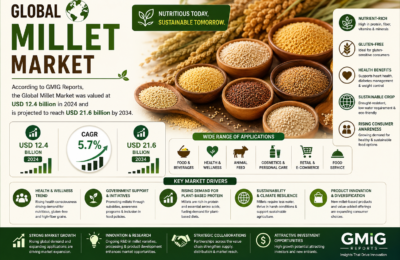
The global millet market was valued at USD 12.4 billion in 2024 and is projected to grow at a compound annual growth rate (CAGR) of approximately 5.7%, reaching USD 21.6 billion by 2034, according to GMI Reports. Millet, encompassing a diverse group of small-seeded cereal grasses including pearl millet, finger millet, foxtail millet, sorghum, and several minor millet varieties, has experienced a remarkable global resurgence driven by growing consumer recognition of its exceptional nutritional profile, climate resilience advantages over water-intensive cereal crops, and alignment with rising gluten-free, whole grain, and sustainable food system consumer preferences.
The United Nations’ declaration of 2023 as the International Year of Millets catalyzed unprecedented global awareness and policy support for millet production and consumption, generating significant government promotional investment, international trade development activity, and mainstream food industry product innovation that has meaningfully accelerated the market’s transition from a predominantly subsistence and traditional diet staple toward a commercially valued premium health grain category within global food systems.
While Asia and Africa collectively dominate both global millet production and consumption volumes, the most significant commercial market opportunity lies at the intersection of growing premium health food demand within developed markets and expanding middle-class health consciousness within emerging economies. Millet’s superior protein content, gluten-free status, low glycemic index, and exceptional drought and heat tolerance creating a favorable sustainability narrative represent the key value propositions driving its rapid adoption across health-conscious consumer segments globally.
Market Overview
The global millet market encompasses the production, processing, and commercial distribution of whole grain millets, millet flour, millet-based food products, millet animal feed, and millet-derived ingredients across food manufacturing, foodservice, and direct consumer retail channels. The market serves a diverse consumer base ranging from traditional rural populations for whom millet represents a staple dietary grain to health-conscious urban consumers in developed and emerging markets seeking nutritionally superior whole grain alternatives.
Pearl millet represents the largest production volume globally, cultivated extensively across sub-Saharan Africa and South Asia as a primary food security crop in semi-arid regions where its exceptional drought tolerance enables production in conditions unsuitable for wheat, rice, or maize cultivation. Finger millet, extensively cultivated in South India and parts of East Africa, commands premium positioning within health food markets given its exceptional calcium content, high fiber, and low glycemic index properties. Foxtail millet, kodo millet, and several other minor millet varieties are experiencing growing premium market demand particularly within Asian health food segments.
The market’s structure is undergoing significant transformation as millets transition from a predominantly commodity and subsistence crop toward an organized commercial market with growing value-added processing, branded product development, and international trade activity. This transition is being supported by government procurement programs in India and other major producing countries, international development organization initiatives promoting millet as a climate-resilient crop for food security, and private sector food company investment in millet-based product innovation across multiple food category applications.
Market Size & Forecast
Market Driving Factors
1. International Year of Millets Legacy and Government Policy Support
The United Nations’ designation of 2023 as the International Year of Millets generated unprecedented global institutional attention, policy commitment, and consumer awareness elevation for millet crops and products. Government initiatives including India’s comprehensive Millets Mission promoting production subsidies, processing infrastructure investment, public procurement, and export promotion have created substantial market development momentum extending beyond the anniversary year into structural policy support sustaining continued market growth.
2. Superior Nutritional Profile and Health Consumer Demand
Millet’s exceptional nutritional attributes, encompassing higher protein content than rice, substantial dietary fiber, significant micronutrient density including iron, calcium, magnesium, and B vitamins, low glycemic index relevant to diabetes management, and natural gluten-free status, position it as a compelling health grain alternative within the growing global whole grain and functional food consumer segment. These health credentials are increasingly well communicated through mainstream media and health content channels, driving first-time consumer trial and repeat purchasing.
3. Climate Resilience and Sustainable Agriculture Positioning
Millet’s exceptional drought tolerance, heat resilience, ability to thrive in poor soil conditions with minimal fertilizer input, and substantially lower water requirement compared to rice and wheat cultivation position it as an increasingly strategically important sustainable and climate-resilient crop within global food security and agricultural sustainability frameworks. This sustainability credential resonates strongly with both institutional food procurement sustainability commitments and consumer purchasing preference for environmentally responsible food choices.
4. Gluten-Free Market Integration and Celiac Consumer Adoption
Growing global gluten-free food market development, driven by celiac disease diagnosis growth and broader gluten sensitivity consumer self-identification, has created significant market opportunity for millet as a naturally gluten-free whole grain capable of substituting wheat in diverse food product applications including bread, pasta, breakfast cereals, and snack food formulations. Millet’s neutral flavor profile and versatile processing characteristics support successful gluten-free product formulation across multiple food categories.
5. Expanding Millet-Based Product Innovation by Food Companies
Major global and regional food companies have substantially expanded millet ingredient integration and dedicated millet-based product development investment following the International Year of Millets’ market awareness catalysis, launching millet-enriched breakfast cereals, snack products, ready-to-eat meals, and functional food formulations targeting health-conscious mainstream consumers beyond specialty health food channel positioning. This mainstream food company engagement dramatically expands millet’s consumer reach and retail channel accessibility.
6. Animal Feed Demand and Biofuel Application Growth
Substantial and growing millet consumption within animal feed applications, particularly within poultry and livestock feed formulations in Asia and Africa, provides a significant and stable demand base complementing the more commercially visible human food market. Growing interest in millet’s potential as a biofuel feedstock in certain regional markets provides additional demand diversification, while millet straw’s value as a livestock fodder contributes to the crop’s overall farm economics supporting continued production investment.
Market Restraining Factors
1. Post-Harvest Processing and Value Chain Infrastructure Gaps
Millet’s relatively hard seed coat and hull require dedicated milling and processing equipment for human food application, and inadequate post-harvest processing infrastructure availability across many major millet-producing regions limits the conversion of raw millet production into commercially viable food-grade processed products. These processing infrastructure gaps create quality inconsistency, food safety risk, and value chain efficiency constraints that moderate the pace at which millet production growth translates into commercial food market development.
2. Consumer Unfamiliarity and Cooking Convenience Perception
Despite growing health food awareness, consumer unfamiliarity with millet cooking methods, taste profiles, and recipe applications remains a meaningful adoption barrier in developed market health food consumer segments. Millet’s longer cooking time relative to quick-cooking grain alternatives and the absence of established cooking tradition knowledge among younger urban consumers in non-traditional millet-consuming markets constrains first-time trial conversion and repeat purchase rates beyond motivated health-enthusiast consumer segments.
3. Yield Variability and Quality Standardization Challenges
Millet production exhibits meaningful yield variability driven by rainfall pattern variability, soil quality differences, and limited improved variety adoption among smallholder farmer populations, creating supply quantity and quality consistency challenges that complicate commercial food industry ingredient procurement planning. The absence of widely adopted quality grading standards across international millet trade complicates specification and pricing consistency for imported millet ingredients within food manufacturing applications.
4. Competition from Established Cereal and Pseudograin Alternatives
Millet competes within the health grain category against well-established and consumer-familiar alternatives including quinoa, amaranth, buckwheat, and ancient grain varieties that have achieved mainstream health food retail positioning ahead of millet’s current commercial development stage. These established competitors benefit from greater consumer recipe familiarity, more extensive retail product range availability, and stronger health food marketing investment history, creating category positioning competition that millet must overcome through price, nutritional differentiation, or sustainability narrative advantages.
Market Segmentation
By Millet Type
Pearl millet retains the dominant market share, reflecting its position as the highest production volume millet globally, extensively cultivated across sub-Saharan Africa and South Asian semi-arid agricultural regions. Finger millet and foxtail millet are gaining proportional market share, supported by their strong premium health food positioning based on exceptional nutritional profiles and growing consumer awareness within urban health food market segments globally.
By Form
Whole grain form retains the dominant market share within traditional consumption and staple food markets. Millet flour and powder are exhibiting the fastest commercial market growth, driven by food manufacturing ingredient demand for gluten-free baking, functional food formulation, and food service application integration that requires consistent processed ingredient form rather than whole grain raw material supply.
By Application
Competitive Landscape
The global millet market features a combination of large agricultural commodity trading companies handling bulk millet trade, domestic food companies in India, Africa, and China processing and marketing millet-based products, and a growing cohort of health food focused brands specifically built around millet’s premium nutritional positioning. The market’s competitive dynamics are evolving rapidly as mainstream food company engagement increases.
Regional Analysis
Asia Pacific dominates global millet production and consumption, with India representing the single largest national market and a globally significant policy driver for millet market development. Sub-Saharan Africa represents the second-largest regional market by production volume, while North America and Europe are exhibiting the fastest commercial value growth driven by premium health food market adoption.
Emerging Market Trends
India’s Millet Export Promotion and Global Brand Building
India’s comprehensive millet export promotion strategy, including government-supported international trade fairs, millet-focused product demonstration at global food exhibitions, and diplomatic outreach promoting Indian millet varieties within major import markets, is progressively building international brand recognition for Indian millet varieties and processed millet products. This export development effort is creating new revenue streams for Indian millet value chain participants and elevating the category’s global commercial profile.
Millet-Based Functional Food and Nutraceutical Innovation
Growing food industry investment in millet-based functional food and nutraceutical product development, leveraging specific millet varieties’ documented bioactive compound content including phenolic acids, flavonoids, and specific micronutrient density, is creating premium product differentiation opportunities beyond basic grain nutrition positioning. Products targeting specific health outcomes including bone health, diabetes management, and cardiovascular wellness are emerging within the premium millet product innovation pipeline.
Craft Brewing and Traditional Fermentation Revival
Growing artisanal and craft brewing industry interest in millet as a naturally gluten-free brewing grain and fermentation substrate, producing millet beer and millet-based traditional fermented beverages, is expanding millet’s commercial application scope beyond food into premium beverage categories with strong consumer interest in authentic, traditionally-rooted alcoholic and non-alcoholic fermented product categories.
Smallholder Farmer Organized Supply Chain Development
Growing food company, NGO, and government investment in organized smallholder millet farmer supply chain development, including farmer producer organization support, quality grading and aggregation infrastructure, and direct procurement relationships, is progressively improving millet supply chain reliability, quality consistency, and farmer income security that collectively support sustainable commercial market development beyond spot market commodity trade dependence.
Millet Inclusion in School Feeding and Public Nutrition Programs
Expanding millet inclusion within government school feeding programs and public nutrition intervention frameworks across India, several African countries, and multilateral development organization-supported food security programs is creating substantial institutional demand and normalizing millet consumption among younger demographic cohorts who will represent future commercial market consumers, supporting long-term market demand sustainability beyond current adult consumer adoption trends.
Key Companies in the Global Millet Market
-
ITC Limited (Aashirvaad)
-
Tata Consumer Products (Soulfull)
-
Nestlé India
-
Slurrp Farm
-
Bob’s Red Mill (Bob Evans Farms)
-
Sorghum United
-
Arrowhead Mills (Hain Celestial)
-
Nature’s Path Foods
-
Regional African and Indian Millet Processors
-
Emerging DTC Millet Brand Companies
Report Target Audience
-
Food and Beverage Manufacturers
-
Agricultural Commodity Trading Companies
-
Health Food Retailers and E-commerce Operators
-
Investment and Private Equity Firms
-
Government Agricultural Policy and Export Promotion Agencies
-
Development Finance and Food Security Organizations
-
Management and Strategy Consultants
-
Academic and Agricultural Research Institutions
Market Segmentation Summary
By Millet Type
-
Pearl Millet (Bajra)
-
Finger Millet (Ragi)
-
Foxtail Millet
-
Sorghum (Jowar)
-
Other Minor Millets
By Form
-
Whole Grain
-
Flour & Powder
-
Flaked & Puffed
-
Ready-to-Eat Products
By Application
-
Food & Beverage
-
Animal Feed
-
Brewing & Fermentation
-
Other Industrial Applications
By Region
-
Asia Pacific
-
Sub-Saharan Africa
-
North America
-
Europe
-
Middle East & Latin America
About GMI Reports
GMI Reports is a premier market intelligence and research organization providing data-driven insights and strategic analysis across global agriculture, food, and nutrition markets. Our research empowers food companies, investors, and policymakers to navigate the evolving millet market landscape with confidence. For the Millet Market report and related research, visit www.gmigreports.com or contact our research team for customized intelligence solutions.
www.gmigreports.com
© 2025 GMI Reports. All Rights Reserved. Unauthorized reproduction or distribution is strictly prohibited.